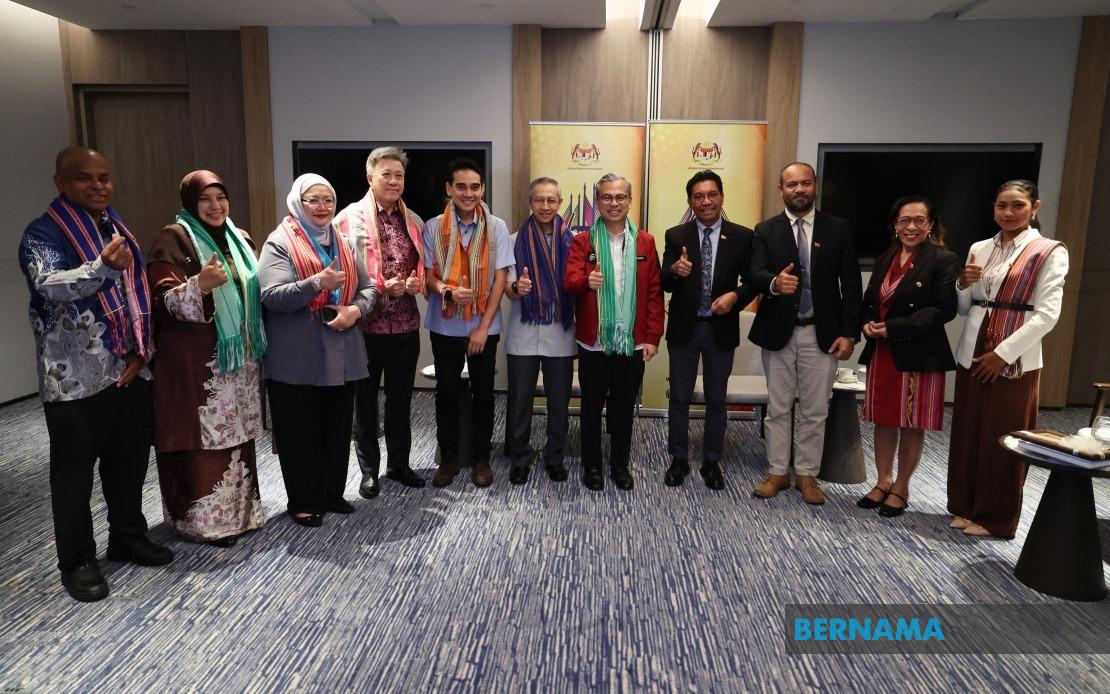
Malaysia's national news agency Bernama and Timor-Leste's official news outlet TATOLI have formalized a partnership aimed at strengthening journalistic capacity and media cooperation across the ASEAN region. The memorandum of understanding, signed during ceremonies in Butterworth on June 20, represents a significant step in integrating Southeast Asia's newest member state into the bloc's information-sharing infrastructure. The agreement encompasses news content exchange, multimedia distribution, and structured training initiatives designed to elevate professional standards at both organizations.
The partnership carries particular significance given Timor-Leste's recent accession to ASEAN in October 2025, marking the organization's expansion to eleven member states. Bernama Chief Executive Officer Datin Paduka Nur-ul Afida Kamaludin emphasized that the arrangement reflects a strategic commitment to ensuring regional narratives remain shaped by local journalistic institutions rather than external media gatekeepers. This collaborative model positions both agencies as custodians of Southeast Asian perspectives in an increasingly fragmented global information landscape, where state-backed news organizations play central roles in defining how nations present themselves to international audiences.
Under the MoU framework, TATOLI's news content will be distributed through Bernama's multilingual platform in Tetum, Portuguese, Bahasa Indonesia, and English, facilitating deeper public understanding of Timor-Leste across the region. Correspondingly, Bernama's output—currently available in six languages including Bahasa Melayu, English, Tamil, Mandarin, Arabic, and Spanish—will reach Timorese audiences through TATOLI's channels. Most notably, Bernama has committed to developing Portuguese-language news services specifically to accommodate speakers of that language globally, reflecting how bilateral agreements can drive organizational evolution beyond their immediate scope.
The training component of this partnership addresses a critical capacity gap within Southeast Asian media institutions. Bernama has committed to hosting Timorese reporters at its facilities before year-end, exposing them to institutional best practices across multiple platforms including digital journalism, broadcast media, photography, and online news production. This knowledge transfer draws on Bernama's more than two decades of journalism training experience and its established Bernama School of Journalism, housed within the Bernama Excellence Centre. The initiative positions Malaysia as a regional hub for media professionalization, extending its soft power influence through institutional mentorship.
The ceremonial nature of the MoU's signing underscored the agreement's political importance within ASEAN frameworks. Communications Minister Datuk Fahmi Fadzil and Timor-Leste's Secretary of State for Social Communication Expedito Loro Dias Ximenes formalized the arrangement, with Prime Minister Datuk Seri Anwar Ibrahim witnessing proceedings during National Journalists' Day celebrations at the PICCA convention centre. This high-level participation reflects how media cooperation has evolved from purely commercial or professional matters into elements of state diplomacy, particularly as Southeast Asian governments navigate information sovereignty concerns in the digital age.
Bernama Chairman Datuk Seri Wong Chun Wai and Penang Chief Minister Chow Kon Yeow's attendance further demonstrated the collaboration's resonance across Malaysian political and institutional hierarchies. The signing ceremony's integration with HAWANA 2026—the annual national journalists' gathering—positioned the partnership within broader conversations about press freedom, journalistic ethics, and professional standards across the region. The event also attracted media representatives from Cambodia and Laos, suggesting that bilateral media partnerships increasingly occur within multilateral forums where multiple nations simultaneously negotiate their information relationships.
TATOLI President Noémio Mateus Soares Falcão articulated the partnership's philosophical underpinnings, emphasizing how collaboration strengthens journalists' professional capabilities while promoting media innovation throughout Southeast Asia. His remarks highlighted the critical importance of maintaining high editorial standards amid the rapid circulation of information across digital platforms, where verification and ethical journalism become increasingly challenging. This framing suggests that Southeast Asian media leaders recognize shared vulnerabilities to misinformation and disinformation, viewing institutional partnerships as mechanisms for collectively defending journalistic integrity.
The agreement reflects evolving patterns within Southeast Asian institutional development, where smaller or newer member states strategically align with established regional players to accelerate capacity building. Timor-Leste's pursuit of collaboration with Bernama predates its official ASEAN membership, indicating that prospective members actively cultivated relationships with existing institutional networks before formal accession. This sequencing suggests sophisticated understanding of how institutional membership creates obligations and opportunities for subsequent relationships, with media partnerships serving as foundational elements for broader integration.
For Malaysian audiences, the partnership demonstrates how Bernama functions as both a national news institution and a regional media leader capable of shaping Southeast Asian discourse. The commitment to Portuguese-language reporting, driven by Timor-Leste collaboration, reflects how bilateral arrangements can expand Malaysian media's global reach, particularly toward Portuguese-speaking communities worldwide. This expansion positions Bernama alongside other regional broadcasters as a source for international audiences seeking non-Western perspectives on global events.
The partnership also carries implications for how Southeast Asian nations collectively approach information governance amid pressures from powerful external media ecosystems. By formalizing news-sharing arrangements and joint training initiatives, ASEAN members strengthen internal information networks that reduce dependence on Western news agencies for regional coverage. This institutional interdependence creates competing sources of authority over how Southeast Asian events are framed, narrated, and eventually remembered—functions traditionally monopolized by international news organizations.
Looking forward, the Bernama-TATOLI model may establish templates for similar partnerships between other ASEAN member states. Laos and Cambodia's participation in HAWANA 2026 suggests receptiveness to comparable arrangements, potentially creating a webwork of bilateral media agreements that gradually integrate the bloc's information infrastructure. Such institutionalization of media cooperation could eventually enable coordinated responses to cross-border information challenges including disinformation campaigns and press freedom concerns affecting multiple member states simultaneously.
The arrangement ultimately represents Southeast Asia's broader maturation as a regional system increasingly capable of managing its own institutional development. Rather than importing foreign media models or accepting external editorial influence, ASEAN members are constructing indigenous frameworks for journalism training, content exchange, and professional standard-setting. Bernama's role in this architecture—as mentor, partner, and institutional model—reflects Malaysia's established position within regional hierarchies while creating opportunities for expanding Malaysian soft power through media cooperation channels.

