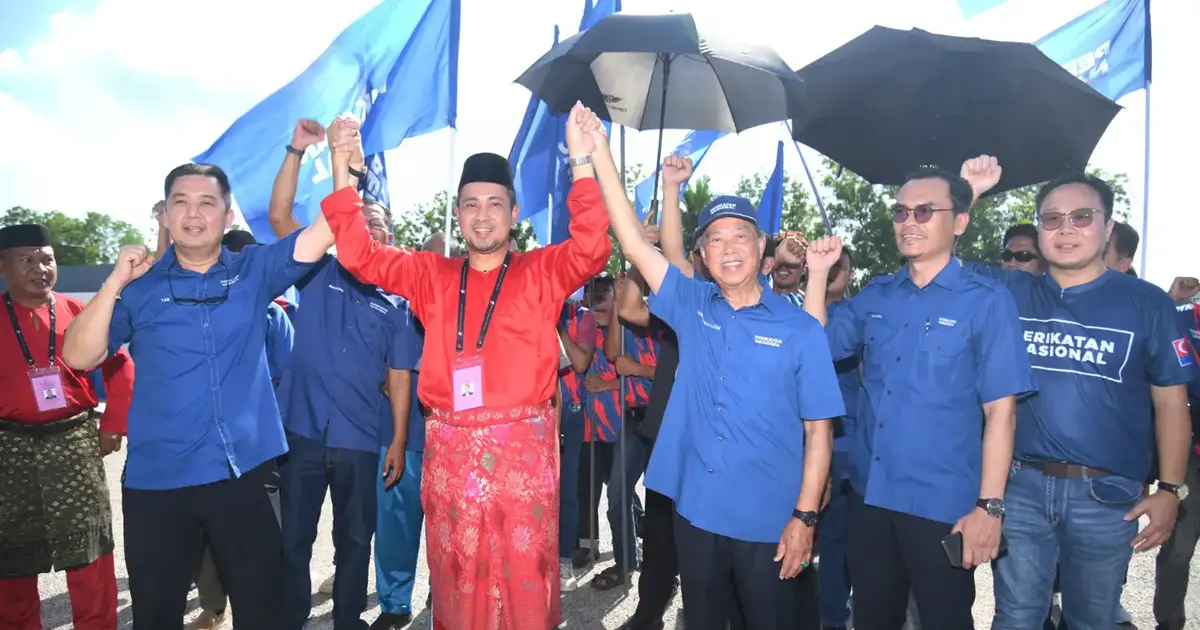
Bersatu's leadership has adopted a conciliatory stance following PAS's apparent reluctance to commit its organisational machinery to support the party, with party president Muhyiddin Yassin framing the disagreement as a natural aspect of coalition dynamics rather than a serious rupture. The remarks underscore ongoing tensions within Perikatan Nasional, the bloc that has anchored Malaysia's political realignment since 2020, while simultaneously signalling that Bersatu intends to absorb the setback without escalating intra-coalition friction.
Muhyiddin's comments reflect a broader reality within PN: despite shared electoral interests and governance arrangements, the coalition's constituent parties maintain fiercely independent operational structures and strategic priorities. PAS, as the bloc's dominant Islamic-oriented party with significant grassroots networks particularly in rural Peninsular Malaysia, possesses organisational capacity that smaller partners like Bersatu naturally covet for their own electoral advancement. The refusal to deploy these resources signals PAS's determination to preserve its autonomy and avoid being drawn into obligations that might compromise its own political calculations.
The Bersatu president's statement that mutual support and cooperation form foundational principles of PN carries implicit acknowledgment that these principles are aspirational rather than binding contractual commitments. By emphasising that his party will not compel others to provide assistance, Muhyiddin effectively concedes that PN operates on a voluntary framework where each party negotiates its own level of contribution. This flexibility has enabled the coalition to survive multiple crises since its formation, but it also reveals the underlying fragility of arrangements built on pragmatic convenience rather than ideological coherence or institutional mechanisms for dispute resolution.
For Malaysian observers, this episode illuminates the mechanics of contemporary coalition politics in Southeast Asia's oldest democracy. Unlike the Pakatan Harapan era, when component parties operated under tighter coordination structures and clearer agreements about resource-sharing, PN has functioned more as a loose alliance of parties with overlapping but distinct constituencies and priorities. Bersatu, which emerged as the largest Malay-Muslim party following its 2020 exit from UMNO, has struggled to consolidate a durable political base independent of its larger partners, particularly PAS and the numerically significant Gabungan Parti Sarawak.
The machinery dispute also reflects deeper competition between Bersatu and PAS for influence within PN's leadership and within Malay-Muslim electoral spaces. Since the 2022 general election, which saw PN contribute significantly to the coalitional government formation, there has been persistent jostling over which party should claim credit for electoral performance and which should receive preferential treatment in candidate selection for future contests. PAS's reluctance to assist Bersatu operationally may thus represent a strategic choice to limit Bersatu's growth rather than merely a logistical decision.
From a Southeast Asian perspective, Bersatu's acceptance of PAS's position without public rancour demonstrates how multiethnic democracies navigate internal coalition disagreements while maintaining external unity. The contrast with more volatile political blocs elsewhere in the region underscores Malaysia's institutional maturity, even as it reveals the limits of consensus-building among parties with divergent organisational capabilities and electoral bases. Muhyiddin's measured rhetoric serves a dual purpose: reassuring PN's broader coalition membership that internal differences will not destabilise the arrangement, while simultaneously signalling to PAS that there are no retaliatory consequences for asserting its autonomy.
Looking forward, this episode suggests that resource allocation within PN will continue to reflect relative bargaining power rather than formal agreements. Parties with robust ground organisations—notably PAS in several states—can afford to be selective about where and how they deploy their networks. Smaller parties must either develop alternative pathways to electoral competitiveness or accept subordinate roles within coalition arrangements. For Bersatu specifically, the machinery snub underscores the urgency of building independent organisational capacity if it seeks to emerge as a genuinely competitive political force beyond its core areas of strength.
The implications for Malaysian governance extend beyond coalition management. If PN fragments or becomes increasingly transactional, the stability of any government formed under its auspices could face pressures from shifting internal alliances. Conversely, if parties like Bersatu can absorb setbacks without escalating tensions, the coalition's durability may prove greater than critics have predicted. Much depends on whether upcoming electoral contests produce results that reinforce current hierarchies or disrupt them sufficiently to trigger repositioning among PN members.
Muhyiddin's public acceptance of PAS's stance also carries implications for how PN positions itself relative to potential alternative coalitional arrangements. By avoiding public criticism of PAS and framing the disagreement as acceptable within PN's operating principles, Bersatu preserves the option of maintaining the current coalition arrangement rather than exploring partnerships outside PN. This pragmatism reflects the political calculation that Bersatu's medium-term interests are better served by remaining within the PN framework, despite occasional frustrations with resource-sharing, than by attempting to construct alternative blocs in Malaysia's fragmented political landscape.

