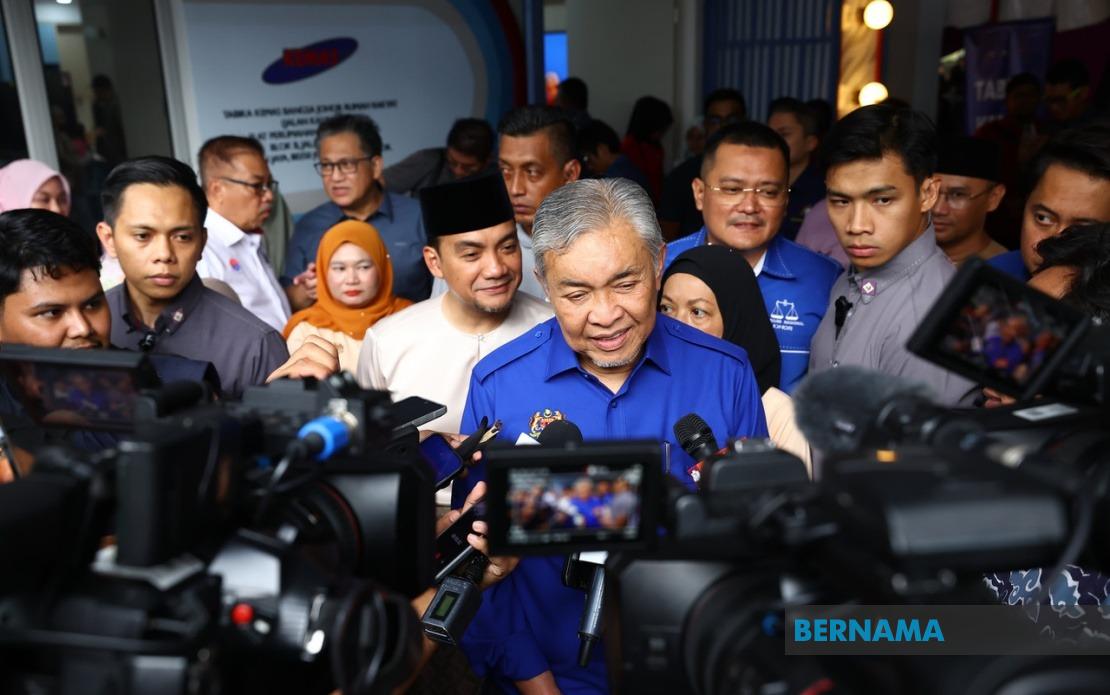
Barisan Nasional's top leadership has publicly acknowledged the substance of Pakatan Harapan's election platform for the Johor state contest, striking a notably measured tone as Malaysia's dominant political coalition braces for the July 11 polling. Speaking in Johor Bahru on July 3, BN Chairman and Deputy Prime Minister Datuk Seri Dr Ahmad Zahid Hamidi said his coalition respects the alternative coalition's manifesto offerings, framing the competition as a healthy expression of democratic engagement. The remark, made during a community engagement session at Larkin Court 1 flats focused on early childhood development programmes, signals an attempt to position BN as confident in its own record rather than dismissive of opposition proposals.
Ahmad Zahid's measured response to PH's 10-point manifesto reveals strategic confidence within BN circles heading into the contest. The Deputy Prime Minister emphasized that as a mature democracy, BN welcomes competing ideas from parties contesting state elections, suggesting the coalition sees little threat from PH's platform. His comment that he has reviewed PH's manifesto and respects their proposals reflects a tone of relative magnanimity unusual in heated electoral contests, possibly reflecting BN's anticipated electoral strength in the state. The presence of Johor Menteri Besar Datuk Onn Hafiz Ghazi and BN's Larkin state seat candidate Mohd Hairi Mad Shah at the engagement underscored the localized nature of campaigning efforts in the week before polling begins.
PH's manifesto launch the same day showcased ten distinct commitments targeting various voter segments. The coalition's platform includes a dedicated Johor Health Scheme aimed at improving healthcare access, down payment assistance for first-time property buyers seeking to navigate Malaysia's increasingly expensive housing market, a RM500 million youth development fund, and proposals to strengthen educational infrastructure and outcomes. These offerings reflect PH's attempt to address persistent concerns among younger voters and middle-income earners struggling with affordability issues. The comprehensiveness of the alternative platform suggests serious policy development work, though BN's response emphasized its own track record rather than engaging substantially with specific PH proposals.
BN's counter-narrative centered on demonstrated delivery in Johor's previous governmental term. Ahmad Zahid stated that BN's manifesto is anchored in the state government's proven performance, noting that the coalition fulfilled more than 90 percent of its previous promises to constituents. This emphasis on execution rather than aspirational rhetoric represents a classic incumbent strategy, positioning experience and proven capability against opposition promises. The figure of 90 percent promise fulfilment, if accurate, represents meaningful political capital in a state where voter skepticism toward unfulfilled pledges runs deep across Malaysia's political landscape.
The breadth of BN's proposed benefits reveals a strategy of comprehensive coverage rather than targeted interventions. Ahmad Zahid detailed how BN's platform spans the entire life cycle, beginning with support for expectant mothers and extending through childhood development, primary and secondary schooling, tertiary education, and specific support mechanisms for single parents of either gender. This cradle-to-grave approach attempts to demonstrate that BN's benefits encompass all demographic segments without ethnic or socioeconomic discrimination. The messaging emphasizes inclusion and universality, responding to persistent perceptions that BN's rule sometimes favors particular communities or groups over others.
The concept of "Bangsa Johor" featured prominently in Ahmad Zahid's framing of BN's electoral promise. The Deputy Prime Minister asserted that anyone residing in the state qualifies as part of this imagined Johor identity and therefore merits identical access to government benefits regardless of background. This language attempts to transcend communal divisions through a state-based identity construct, though observers debate whether such messaging effectively neutralizes concerns about differential treatment in practice. The emphasis on geographic rather than ethnic identity represents an evolving approach within BN's political communication strategy across Malaysia's diverse electoral landscape.
Ahmad Zahid's ministerial position as Rural and Regional Development Minister provides him additional credibility when discussing infrastructure and development programmes. His assurance that he will continue championing Johor's development as long as he leads his portfolio represents a personal commitment layering individual political interest onto his party's broader campaign messaging. This personalization of commitment is typical of how senior Malaysian politicians connect themselves to development narratives, though it also raises questions about continuity should leadership positions shift. The pledge underscores how Malaysian electoral campaigns frequently intertwine individual leaders' fortunes with broader party and government ambitions.
The 16th Johor state election looms as a significant contest within Malaysia's broader political architecture. With 172 candidates competing for 56 state seats, the election encompasses the complexity typical of Malaysian state contests, where federal-state relationships, intra-coalition dynamics, and local grievances all intersect. The election schedule—early voting on July 7 followed by main polling on July 11—compressed campaigning into an intense period where parties must maximize media attention and ground presence simultaneously. For a state as significant as Johor to Malaysia's national politics and economy, the outcome carries implications extending well beyond the state assembly.
Electoral competition in Johor has intensified considerably compared to previous contests. Both BN and PH have invested substantial resources in manifesto development and campaign organization, suggesting neither coalition takes the other for granted. PH's specific focus on healthcare, housing affordability, and education reflects contemporary voter priorities shaped by the post-pandemic experience and economic pressures affecting Malaysian households across income levels. BN's emphasis on demonstrated delivery and comprehensive life-cycle support attempts to remind voters of the incumbent coalition's institutional advantages and implementation capacity.
The contrasting campaign approaches also reveal differing political philosophies about governance and the social contract. PH's targeted interventions addressing specific pain points suggest a diagnosis that previous governance left gaps in key service areas, particularly healthcare and housing support. BN's comprehensive benefits framework implies faith in breadth of provision and universal application, potentially suggesting that previous concerns reflected implementation gaps rather than conceptual inadequacies. These underlying diagnostic disagreements often matter more to informed voters than simple campaign messaging, influencing how different demographic segments assess which coalition better understands their particular circumstances.
For Malaysian and Southeast Asian observers monitoring Johor's election dynamics, the contest illuminates broader questions about political competition in Malaysia's increasingly polarized environment. The tone of mutual respect Ahmad Zahid expressed toward PH's manifesto, while clearly strategic, contrasts with the acrimony sometimes characterizing Malaysian political discourse. The focus on specific policy commitments—healthcare schemes, housing assistance, youth development, education—rather than purely communal or identity-based appeals suggests that Malaysian voters increasingly demand programmatic content alongside symbolic appeals. How Johor voters respond to these competing narratives will likely influence campaign strategies across Malaysia's remaining electoral battlegrounds, making the July 11 polling day consequential for national political trajectories extending well beyond Johor's borders.

