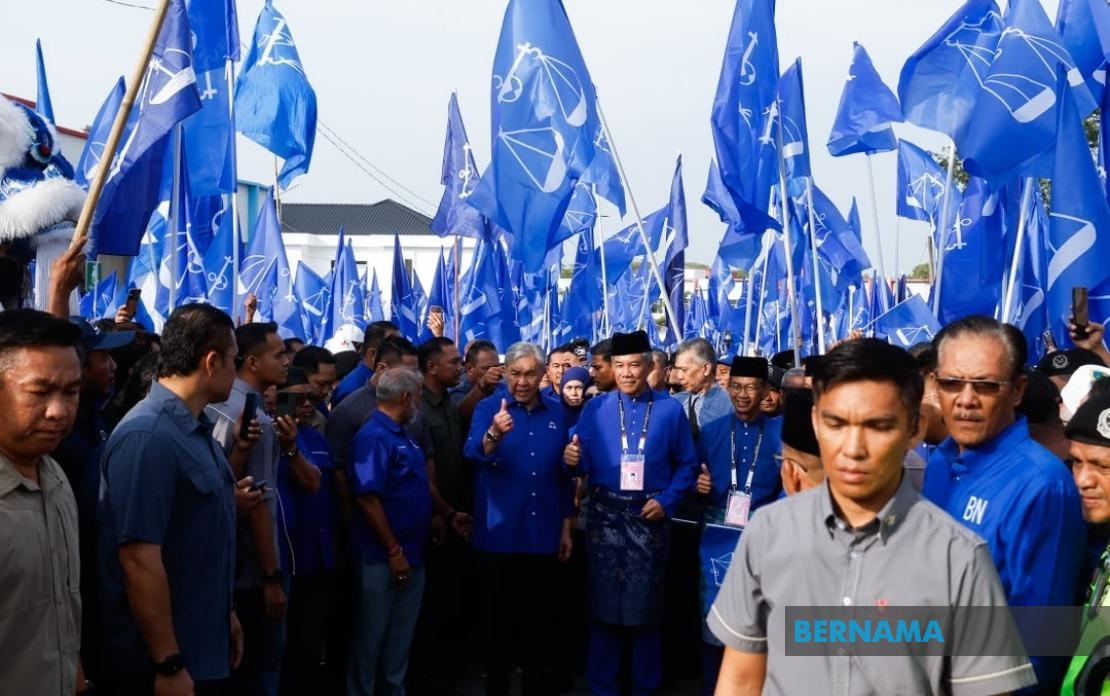
The machinery of Barisan Nasional swung into action across Negeri Sembilan on Thursday as senior party leaders personally escorted candidates to nomination centres, signalling the coalition's determination to defend its grip on the state assembly ahead of polling day on August 1. The high-profile show of unity underscored the strategic importance of the contest in a state where BN has historically dominated electoral outcomes. Nomination centres opened simultaneously at 9 am across eight locations, each operating for exactly one hour, reflecting the tightly managed nature of Malaysia's electoral processes.
At the Dewan Seri Rembau nomination centre in Rembau, BN chairman and UMNO president Datuk Seri Dr Ahmad Zahid Hamidi arrived at 8.40 am alongside his deputy Datuk Seri Mohamad Hasan to file papers for the latter's bid to retain the Rantau state seat. Mohamad Hasan has represented Rantau continuously since 2004, making this constituency a significant stronghold for the coalition. The personal involvement of Ahmad Zahid, who holds dual roles as BN chairman and UMNO president, underscored the high stakes surrounding this election and the need to consolidate support among traditional BN constituencies in the state.
The coordination of senior party figures across multiple nomination centres demonstrated an orchestrated strategy to generate momentum and media visibility during the critical filing period. In Port Dickson, BN secretary-general Datuk Seri Dr Zambry Abd Kadir facilitated the nomination of Datuk Mohd Faizal Ramli for the Linggi state seat, while UMNO vice-president Datuk Seri Johari Ghani accompanied Suhaimizan Bizar in Tampin parliamentary constituency, where the latter is contesting the Gemencheh state seat. These deployments reflected a deliberate allocation of high-ranking party officials to marginal or contested areas where leadership endorsement could prove decisive.
Further evidence of BN's comprehensive engagement came through UMNO secretary-general Datuk Dr Asyraf Wajdi Dusuki's coordination of three candidates in Jempol parliamentary constituency. Datuk Mustapha Nagoor, Datuk Mohd Zaidy Abdul Kadir, and Chong Fui Ming filed nominations for the Palong, Jeram Padang, and Bahau state seats respectively, with Asyraf Wajdi's presence signalling organizational cohesion across multiple legislative divisions. This pattern of senior leaders accompanying candidates at nomination centres has become standard practice in Malaysian state elections, serving dual purposes of bolstering candidate morale and generating photographic evidence of party strength for media consumption.
Beyond BN's mobilization, other political actors also sought to capitalize on nomination day's visibility. PAS president Tan Sri Abdul Hadi Awang accompanied his party's candidate Mohd Fairuz Mohd Isa, who is contesting the Serting state seat, maintaining PAS's presence in the electoral arena despite its diminished role in peninsular politics compared to its historic influence. Meanwhile, Parti Orang Asli Malaysia (ASLI) president Rashid Ka supported Dayana Dal's candidacy for the Jeram Padang state seat, highlighting the participation of smaller political entities in Negeri Sembilan's electoral competition.
The Negeri Sembilan state election represents the sixteenth iteration of assembly polls since independence, and this particular contest occurs within Malaysia's evolving political landscape where coalition dynamics and voter preferences have undergone significant realignment in recent years. The formal dissolution of the Negeri Sembilan State Legislative Assembly on June 5, following receipt of consent from the Yang Dipertuan Besar of Negeri Sembilan, Tuanku Muhriz Tuanku Munawir, triggered the electoral machinery in accordance with constitutional procedures. This timing provided approximately seven weeks for campaigning before the scheduled August 1 polling day.
Early voting arrangements have been scheduled for July 28, reflecting the Election Commission's standard practice of providing advance polling opportunities for designated groups including security force personnel, government servants on duty, and voters travelling abroad during the regular polling period. These procedural details matter significantly because they can influence turnout patterns and the composition of early votes, particularly in constituencies with substantial populations of government workers or military personnel.
The concentration of senior BN figures at nomination centres carries tactical implications for Southeast Asian observers monitoring Malaysia's electoral competitiveness. When national-level party leadership personally oversees candidate filings, it typically signals either confidence in victory or anxiety about particular contests. In Negeri Sembilan's case, BN's historical dominance in state politics suggests the former interpretation is more plausible, though the turnout of Ahmad Zahid Hamidi and other heavyweight figures indicates that the coalition views consolidating its base and managing expectations as critical priorities for the broader national political environment.
For Malaysian voters and regional observers, the Negeri Sembilan state election offers a testing ground for assessing how electoral dynamics have evolved post-2022 in a state where BN has traditionally held commanding majorities. The composition of candidates, campaign messaging, and ultimately voter preferences will reveal whether established patterns of coalition dominance remain resilient or whether alternative political forces have gained traction among state residents. The August 1 polling day will determine not only Negeri Sembilan's state government but also provide early indicators of broader electoral sentiment that could influence planning for subsequent federal or state contests throughout Malaysia.

