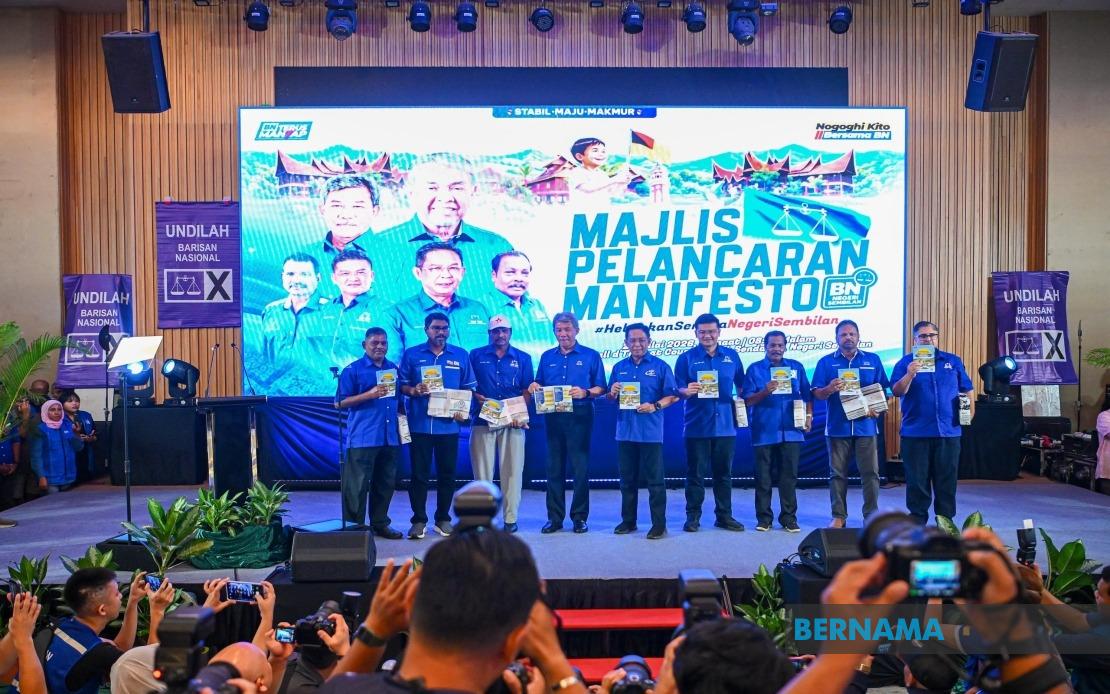
Barisan Nasional formally unveiled its electoral manifesto in Seremban on July 24, setting out an ambitious nine-point agenda for voters ahead of the 16th Negeri Sembilan State Election. The coalition's strategic framework reflects its attempt to address diverse constituencies across the state through a broad platform that touches on economic fundamentals as well as social and cultural priorities that resonate with Malaysian voters.
At the core of the BN platform lies a dual focus on strengthening Negeri Sembilan's economic foundations while simultaneously improving the material conditions of ordinary households. The first pillar targets broad-based economic development and growth initiatives, establishing prosperity as a prerequisite for the coalition's other objectives. The second pillar builds directly on this premise by committing to tangible improvements in living standards, welfare provision, and overall well-being, recognising that economic expansion alone does not guarantee that benefits reach all segments of society. Together, these opening pillars frame BN's pitch to voters as one grounded in practical governance and household pocketbook concerns.
The manifesto allocates significant attention to human capital and opportunity creation, particularly through its third pillar dedicated to educational advancement, skills development among young people, women's empowerment, and entrepreneurship promotion. This emphasis reflects regional and national recognition that long-term competitiveness depends on investing in people rather than infrastructure alone. By linking education explicitly to youth and female participation in the economy, BN signals awareness of demographic shifts and changing workforce expectations across Malaysia.
Rural and agricultural constituencies receive dedicated attention through the fourth pillar, which targets agricultural modernisation, agro-food industry development, rural infrastructure improvement, and Felda estate management. For a state with significant rural populations and established agricultural interests, this commitment carries considerable electoral weight. The fifth pillar's focus on housing and residential development addresses one of Southeast Asia's most persistent voter concerns, as property affordability and homeownership remain central to family security calculations across income levels in Malaysia.
Environmental stewardship and tourism development comprise the sixth pillar, positioning BN as responsive to contemporary concerns about sustainability while recognising that both domestic and international tourism represent growth opportunities for Negeri Sembilan's economy. This reflects broader regional trends whereby even traditionally business-focused coalitions acknowledge climate change and environmental quality as voter priorities.
The seventh pillar addresses religious institutions, customary practices, cultural heritage, and the Orang Asli communities. This commitment to preserving and strengthening cultural and spiritual institutions aligns with constitutional provisions and responds to constituencies for whom cultural continuity holds deep significance. The inclusion of Orang Asli communities acknowledges longstanding marginalisation and signals BN's intention to engage with indigenous populations across Negeri Sembilan.
The eighth pillar encompasses sports, recreational facilities, and national unity initiatives, framing community cohesion as a governmental responsibility. The ninth and final pillar addresses service delivery mechanisms, effectively promising that BN governments will improve the efficiency and responsiveness of state administration across all portfolios.
Key coalition figures attended the manifesto launch, including Datuk Seri Jalaluddin Alias, who chairs the Negeri Sembilan UMNO Liaison Committee and directs BN's election campaign in the state. The presence of MCA deputy president Datuk Dr Mah Hang Soon, MIC vice-president Datuk M. Asojan, and BN candidates reinforced the coalition's multi-ethnic composition and broad party participation. Notably, Perikatan Nasional deputy chairman Datuk Seri Tuan Ibrahim Tuan Man also attended, though PN operates as a separate political force contesting against BN in these elections.
The electoral calendar moves quickly following the manifesto launch. Early voting takes place on July 28, with the main polling day scheduled for August 1. This compressed timeline means that BN's manifesto launch functions as the opening statement in an intensive campaign period, during which voters must absorb and evaluate the competing visions presented by BN, PN, and other contenders for state power.
For Malaysian observers, the Negeri Sembilan election serves as an important midterm indicator of voter sentiment between federal election cycles. The state's results will carry implications not only for Negeri Sembilan's governance trajectory but also for reading shifting political alignments across the peninsula, particularly regarding BN's ability to consolidate voter support after various electoral fluctuations in recent years. The manifesto's emphasis on pragmatic governance and broad social inclusivity represents BN's calculated response to the competitive landscape it faces.

