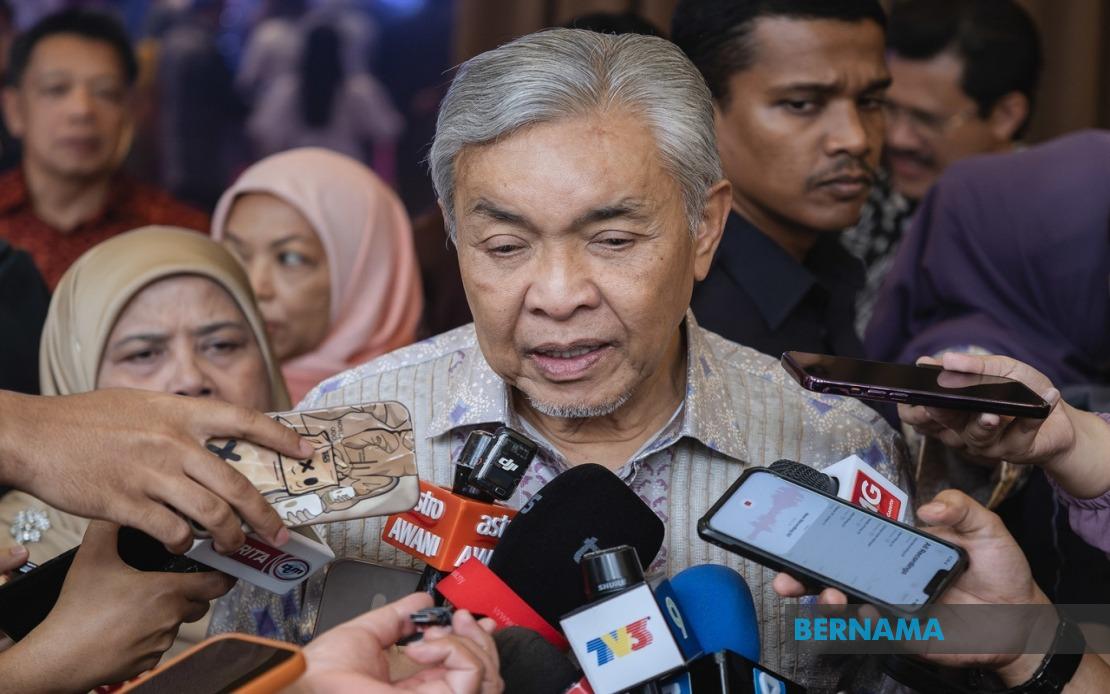
Barisan Nasional will maintain a hands-off approach to matters concerning the Negeri Sembilan Palace and the state's Council of Justice and Laws as campaigning approaches for the upcoming state election, according to Deputy Prime Minister Datuk Seri Dr Ahmad Zahid Hamidi. The UMNO president made the declaration following a strategy session with the party's state-level leadership, signalling a clear boundary between electoral politics and the constitutional sphere occupied by the royal institution. The commitment reflects BN's recognition that interfering in affairs touching on the monarchy could prove politically damaging in a state where traditional power structures command significant respect and where the Sultan retains considerable constitutional influence.
Ahmad Zahid's statement underscores the delicate balancing act that Malaysian political coalitions must maintain when operating in states with active royal institutions. The Council of Justice and Laws, or Dewan Kesultanan dan Undang-Undang (DKU), functions as an advisory body to the Sultan on matters of state governance and constitutional interpretation, giving it considerable symbolic weight beyond its formal remit. By explicitly ruling out BN involvement in such domains, the coalition's leadership is attempting to position itself as respectful of constitutional boundaries and traditional institutions—a positioning that carries electoral weight in Negeri Sembilan, where Malay-Muslim voters represent a significant constituency that values adherence to established protocols surrounding monarchy and Islamic governance.
The emphasis on non-interference also carries implicit commentary about how BN intends to conduct itself differently in this state election compared to previous contests. At the fifteenth round of state elections, Barisan Nasional had worked in cooperation with component parties from the Pakatan Harapan coalition, creating an unusual cross-coalition arrangement. This forthcoming election will see a markedly different tactical approach, with Ahmad Zahid indicating that BN will contest independently rather than seeking formal alliances with opposition-aligned parties. The coalition's internal cohesion therefore becomes paramount, as BN cannot rely on external partnership arrangements to bolster its parliamentary numbers or provide additional legitimacy through cross-party collaboration.
The focus on intra-party unity reflects practical concerns about maintaining discipline within BN's own rank-and-file as members and grassroots leaders prepare for what party strategists evidently anticipate will be a competitive contest. Elections in Negeri Sembilan have historically been unpredictable affairs, with swing voting patterns and fluid voter preferences creating conditions where organizational efficiency and unified messaging can prove decisive. Ahmad Zahid's reiteration that BN must demonstrate cohesion across all organizational levels—from central leadership down through state, district, and branch structures—suggests that internal divisions or conflicting priorities among component parties could undermine the coalition's electoral performance. The statement therefore functions partly as a reminder to potential dissidents within BN's own ranks that now is not the moment for public displays of disagreement or factional infighting.
Negeri Sembilan's political landscape presents particular challenges and opportunities that differ markedly from federal-level contest dynamics. The state encompasses 36 state assembly seats distributed across seven constituencies, each with distinct demographic and socioeconomic characteristics. Rural constituencies in the interior tend toward traditional BN support, while urban-fringe areas around Seremban have demonstrated growing receptiveness to opposition messaging. The state's middle-income profile and relatively high educational attainment levels mean that voter sophistication is generally elevated, making broad-brush campaign appeals less effective than targeted messaging addressing specific local grievances. For Barisan Nasional, managing this heterogeneous electorate while maintaining coalition discipline represents a formidable organizational challenge.
The timing of Ahmad Zahid's statements, made in late June with polling scheduled for August 1, reflects a campaign phase where BN's leadership is attempting to establish the narrative foundation for its electoral push. By articulating a commitment to respecting constitutional boundaries and focusing on internal party unity, the coalition seeks to deflect potential criticisms about overreach or interference with state institutions while simultaneously appealing to voters who value political stability and respect for established order. In Malaysia's political context, such positioning carries real electoral weight, particularly among voters inclined toward conservative governance preferences and those concerned about potential institutional instability or partisan abuse of governmental power.
The Malaysian electoral environment has shifted considerably in recent years, with patterns of voting behaviour becoming less predictable and traditional support bases becoming more volatile. Negeri Sembilan's electorate reflects these broader trends, with younger voters showing less automatic deference to traditional party alignments and urban constituencies demonstrating greater willingness to experiment with alternative political options. For an established coalition like Barisan Nasional, which built its dominance across decades of continuous electoral success, adapting to these changed circumstances requires both sophisticated campaign strategy and careful attention to maintaining party coherence. Ahmad Zahid's emphasis on unity therefore addresses not merely the mechanics of winning the election but also the deeper challenge of keeping BN's component parties and factional interests aligned behind a common platform.
The pledge of non-interference in royal institution matters also carries implications for how BN might conduct itself should controversies emerge during the campaign period. Political disputes in Malaysian states sometimes acquire constitutional dimensions when politicians publicly dispute royal prerogatives or question Sultan-related decisions. By pre-emptively declaring its intention to remain outside such spheres, BN is attempting to constrain its own members' scope for politically opportunistic commentary that might otherwise generate controversy. This represents a calculated choice to prioritize electoral stability and institutional comity over the short-term tactical advantage that might derive from stoking discontent about royal decisions or constitutional procedures, suggesting that BN's strategists believe the electoral benefits of such restraint outweigh potential gains from more aggressive positioning.
As the August 1 election date approaches, Negeri Sembilan's political temperature will inevitably rise, with competing parties deploying increasingly sophisticated messaging and grassroots mobilization efforts. Against this background, BN's declared commitment to maintaining distance from palace affairs and legal institutions represents a strategic positioning choice that reflects both respect for constitutional boundaries and pragmatic recognition that such restraint serves the coalition's broader electoral interests. The statement also signals to state-level leaders and party members that Ahmad Zahid's national leadership is engaged and attentive to Negeri Sembilan's particular political characteristics and challenges, offering both guidance and accountability expectations for the campaign period ahead.

