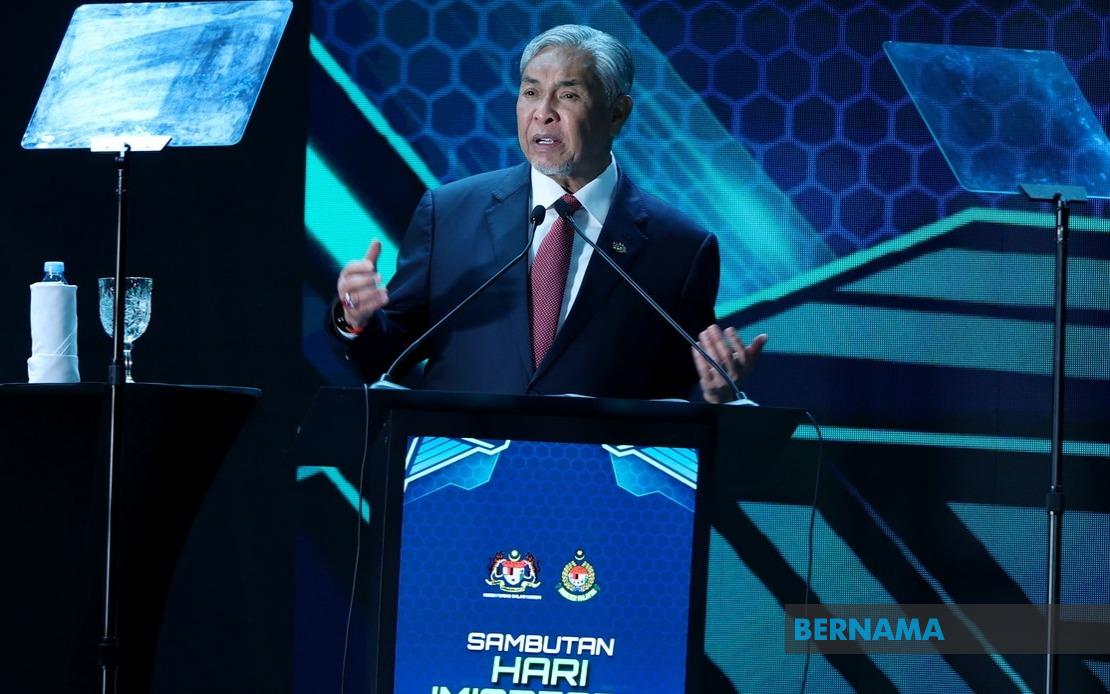
Barisan Nasional will continue as part of the Unity Government following a formal resolution adopted at UMNO's recent General Assembly, according to the coalition's chairman Datuk Seri Dr Ahmad Zahid Hamidi. Speaking at the 2026 Immigration Day celebration in Cyberjaya, the UMNO president and Deputy Prime Minister sought to quell any speculation about the coalition's future by emphasising that the party's commitment has already been settled through proper institutional channels.
The clarification comes at a time when coalition politics in Malaysia remain fluid, with various parties navigating competing interests and electoral considerations. Ahmad Zahid's remarks underscore UMNO's view that major political decisions should derive legitimacy from the party's supreme governing body. By invoking the General Assembly's authority, he signalled that the decision carries the weight of internal party consensus rather than being merely a leadership preference.
In addressing concerns about the stability of the governing arrangement, Ahmad Zahid urged all stakeholders to respect the resolution that emerged from UMNO's highest decision-making forum. His statement reflected a careful attempt to manage expectations and prevent continued debate about whether Barisan Nasional might reconsider its participation in the coalition. The emphasis on respecting assembly decisions serves to frame the matter as settled, a position designed to prevent further speculation from unsettling investor and public confidence in the government's durability.
The UMNO leader's comments gain additional significance given ongoing tensions within Malaysia's coalition politics. State elections continue to test the unity arrangement, particularly when it comes to campaign conduct and the behaviour of government officials. Ahmad Zahid's reaffirmation appears timed to reinforce institutional stability ahead of what promises to be a challenging electoral period for the coalition partners.
Separately, Ahmad Zahid acknowledged the Prime Minister's prerogative in making Cabinet appointments and removals, a statement that underscores the delicate power-sharing dynamics within the Unity Government. Datuk Seri Anwar Ibrahim, as Prime Minister, maintains exclusive authority over ministerial positions, a principle Ahmad Zahid endorsed without reservation. This deference to the Prime Minister's constitutional powers represents an important signal that Barisan Nasional respects the executive hierarchy within the coalition structure.
Prime Minister Anwar had recently issued a directive warning government officials against using their positions to attack Unity Government partners during state-level campaigns. The warning carried implicit consequences, with reports suggesting that officials who violated this instruction could face removal from their posts. This guidance reflects the practical challenges of managing a multi-party coalition where competing electoral interests and campaign dynamics can threaten the broader unity arrangement.
The tension between campaign ambitions and coalition discipline represents a recurring challenge in Malaysia's contemporary political landscape. State elections create natural incentives for individual parties to differentiate themselves and attack opponents, but when those opponents are coalition partners, the potential for damage to the overall government extends beyond electoral results. Anwar's intervention aimed to establish clear boundaries that allow parties to campaign vigorously while preserving the integrity of their governing partnership.
Ahmad Zahid's acknowledgment that such disciplinary decisions fall to the Prime Minister suggests a recognition that maintaining coalition discipline requires clear hierarchical authority. By accepting Anwar's prerogative to enforce conduct standards and remove officials, the UMNO leader demonstrated that Barisan Nasional operates within an understood framework where the Prime Minister serves as final arbiter of ministerial conduct. This framework, while potentially contentious, provides the structural clarity necessary for coalition governance.
The timing of these statements reflects broader concerns about the Unity Government's stability as Malaysia approaches a critical electoral phase. With state elections providing testing grounds for the coalition's durability, and with the 2026 federal election on the horizon, political actors face constant pressure to demonstrate both loyalty to their coalition partners and commitment to winning their own electoral contests. Ahmad Zahid's clarifications attempt to address these competing imperatives by establishing clear parameters for acceptable conduct.
For Malaysian readers and regional observers, these developments carry implications for the predictability and stability of Malaysia's political environment. International investors and regional partners typically favour political arrangements that appear durable and institutionally grounded. By anchoring Barisan Nasional's commitment to the assembly resolution and accepting hierarchical discipline from the Prime Minister, Ahmad Zahid conveyed a message of institutional coherence that extends beyond rhetorical reassurance.
The convergence of these statements—affirming coalition commitment while respecting Prime Ministerial authority—suggests a particular understanding of how the Unity Government will function through its challenging electoral period. Rather than operating as a purely voluntary association of independent parties, the arrangement appears to be evolving mechanisms for binding the partners together through acknowledged hierarchies and institutional constraints. Whether these mechanisms prove sufficient to maintain coalition discipline through the electoral cycle ahead remains a question that will shape Malaysian politics for months to come.

