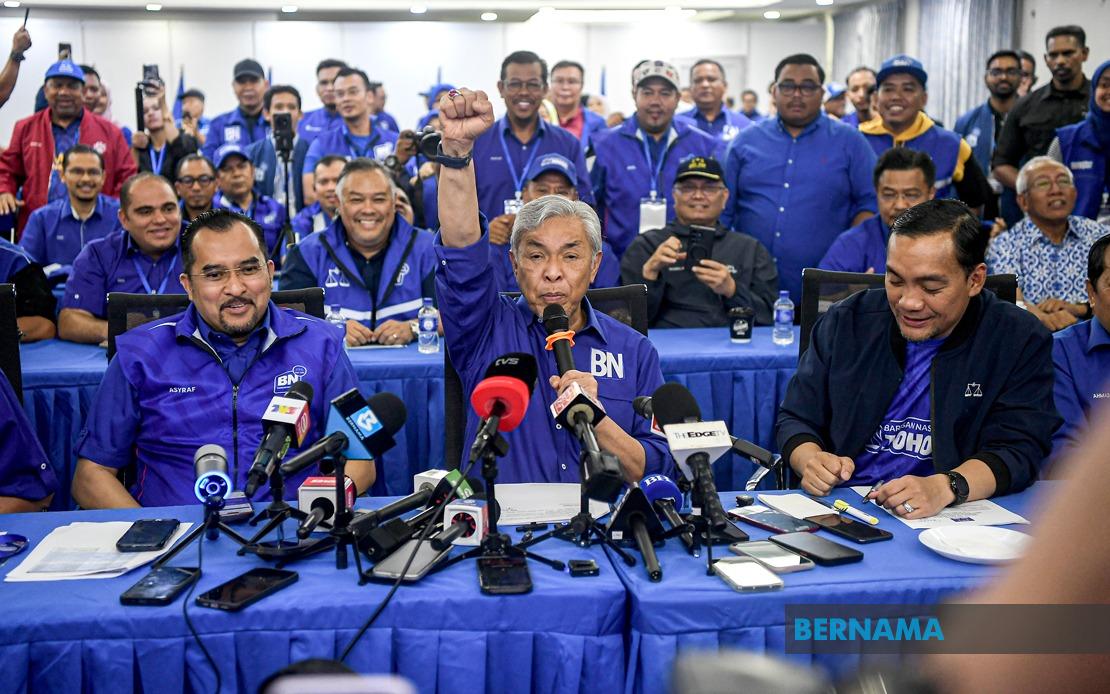
Senior figures within Barisan Nasional descended on the coalition's primary command centre in Johor Bahru on the evening of July 11, establishing themselves at the UMNO Liaison Committee headquarters to track the unfolding developments and official outcomes of the Johor State Election. The gathering represented a show of organisational strength as the ruling coalition awaited crucial results that would shape the political landscape of Malaysia's southern powerhouse state.
The contingent of BN leadership was marked by the presence of key figures spanning the coalition's hierarchy. UMNO president and BN chairman Datuk Seri Dr Ahmad Zahid Hamidi anchored the gathering, his position underscoring the central role of the Malay-Muslim dominant party within the broader coalition framework. Alongside him stood Menteri Besar Datuk Onn Hafiz Ghazi, whose presence highlighted the stakes involved for the sitting state government, and BN secretary-general Datuk Seri Zambry Abd Kadir, responsible for coordinating party machinery and logistics throughout the electoral campaign.
The establishment of a centralised operations room reflected standard electoral procedure in Malaysia, where major coalitions create dedicated command centres to consolidate information flows, coordinate responses to emerging trends, and ensure rapid communication with grassroots party workers across voting constituencies. Such facilities serve as nerve centres where senior strategists can assess performance in real time, identify areas of strength or weakness, and adjust messaging or campaign focus as preliminary results emerge.
Meanwhile, the opposition bloc Pakatan Harapan maintained parallel monitoring operations from their own headquarters at Pulai Springs Resort, demonstrating the competitive nature of electoral contests in Malaysia's federal system. The physical separation of command centres reflects the adversarial structure of democratic elections, with each major political force maintaining independent assessment capabilities and communication networks insulated from rival organisations.
Within the PH operations room, Parti Amanah Negara's vice-president Datuk Seri Dr Dzulkefly Ahmad occupied a prominent position overseeing incoming election data. Dzulkefly's dual role as both party official and incumbent Health Minister underscored the stakes for opposition figures whose ministerial portfolios might be influenced by electoral performance, though he is part of a federal government rather than the Johor state administration.
The composed demeanour Dzulkefly exhibited while monitoring incoming tallies suggested a disciplined approach to electoral observation among PH leadership, even as results began flowing in throughout the evening. Party machinery surrounding him coordinated information collection and analysis, performing the same analytical function their BN counterparts undertook in separate facilities across the state capital.
The 16th Johor State Election represented a significant electoral contest within Malaysia's political calendar. State elections in Johor carry outsized importance within national political discourse given the state's economic significance, large voter population, and historical role as a BN stronghold. Performance in Johor often provides early indicators of broader electoral trends, influencing perceptions of coalition viability heading into future federal elections.
For Malaysian observers tracking regional political dynamics, the gathering of opposing command centres demonstrated the systematic nature of modern electoral administration. Rather than chaotic or ad-hoc responses to results, established political organisations deployed tested frameworks for information management, ensuring that senior leaders maintained situational awareness as official tallies accumulated throughout the counting process.
The concentration of top-tier BN figures at a single location during vote tabulation reflected the coalition's confidence in its organisational reach across Johor's constituencies. Whether such assembly also indicated uncertainty regarding certain outcome margins remained unclear from observers' perspectives, though the visible presence of UMNO's national leadership suggested the party regarded the election as sufficiently important to warrant executive-level attention and personal oversight.
The electoral management practices evident in both operations rooms represented standard Malaysian democratic procedure, with established protocols governing how parties receive official results from electoral commission announcements and verification systems. Both coalitions maintained parallel information networks to ensure independent confirmation of outcomes before making public statements or strategic declarations responding to electoral performance.

