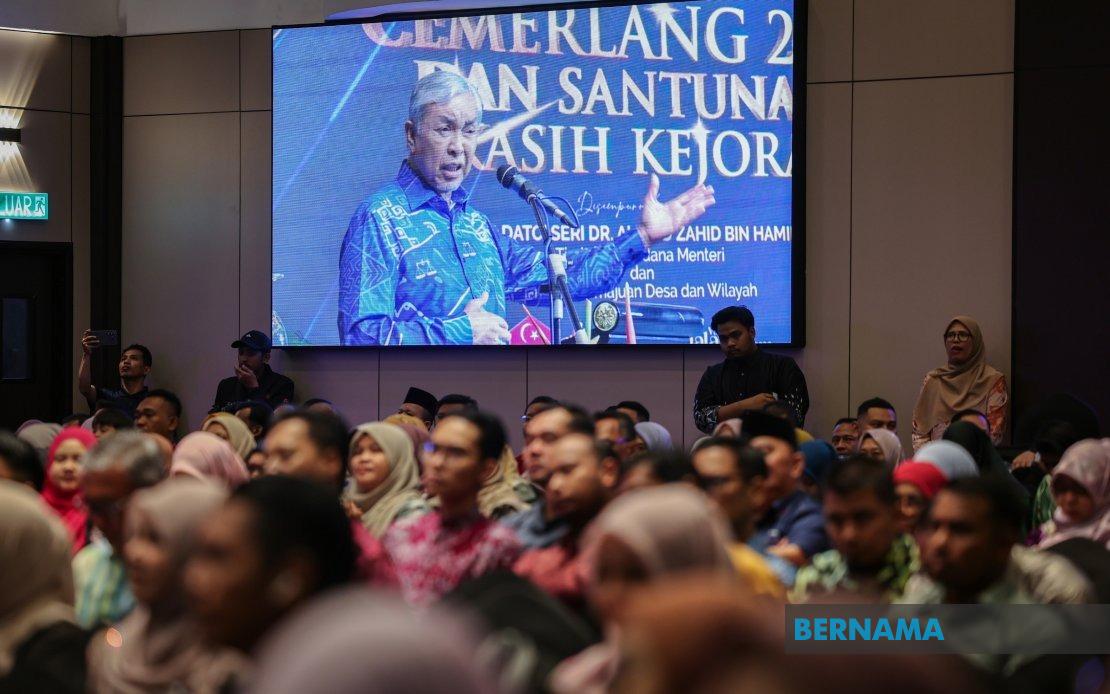
Barisan Nasional's campaign machinery in Johor is functioning at full capacity and delivering results on the ground, according to the coalition's chairman, who has pushed back against suggestions that the effort has lost momentum ahead of the state election scheduled for July 11. Datuk Seri Dr Ahmad Zahid Hamidi made these remarks during a public engagement in Kota Tinggi, where he emphasised that external criticism of BN's campaign intensity reflects political posturing rather than observable reality. The characterisation as "lacklustre" appears rooted in perceptions held by rival coalitions, which Zahid indicated were entitled to their own assessments but were not necessarily grounded in facts.
Zahid framed the situation as a natural consequence of competitive electoral politics, where opposing camps would naturally seek to question the viability of their opponents' campaigns. He acknowledged that organisations outside BN's component parties maintained their own prerogatives in either supporting or opposing the coalition, but stressed that such judgments should not be mistaken for evidence of actual campaign weakness. The Deputy Prime Minister's remarks suggest a strategy of remaining focused on BN's own electoral machinery rather than engaging extensively with opposition narratives about campaign energy levels. This approach reflects a confidence that ground-level activity would ultimately vindicate BN's position once voting concluded.
The Menteri Besar's administration has become a centrepiece of BN's pitch to Johor voters, with Zahid highlighting the state government's financial performance under Datuk Onn Hafiz Ghazi's leadership. State revenue reached RM2.26 billion in the previous year, a figure Zahid cited as the highest recorded among peninsular Malaysian states. This metric forms part of BN's broader argument that demonstrated administrative competence should translate into an expanded mandate. The coalition is contesting all 56 state seats, indicating confidence in its organisational reach and candidate quality across the state. Zahid framed the election as an opportunity for voters to strengthen BN's hand in pursuing a multi-year development agenda outlined in the party's election manifesto.
A potential source of voter confusion—the cooperation between BN and Pakatan Harapan at the federal level—has been flagged by some observers as problematic for the coalition in a state where BN maintains local control. Zahid addressed this directly, noting that Johor occupies a distinctive constitutional position because the state government was formed prior to the establishment of the current federal Unity Government arrangement. This temporal sequencing, he suggested, eliminates any contradiction or inconsistency in BN's state administration operating alongside a broader federal coalition that includes PH. The Deputy Prime Minister emphasised that federal-level cooperation proceeds professionally and constructively, which should pose no impediment to Johor voters backing BN candidates at the state level.
This framing reflects an implicit acknowledgment that the BN-PH partnership does present messaging challenges in certain electoral contexts. By anchoring his explanation in Johor's constitutional history and institutional separation from federal politics, Zahid attempted to compartmentalise the two electoral environments. Whether this argument resonates with swing voters in the state remains uncertain, particularly among older BN supporters who may harbour reservations about the party's alliance with PH elsewhere in the federation. The coalition appears to be betting that demonstrated state-level performance will outweigh ideological concerns about federal-level cooperation.
Zahid's response to calls from Perikatan Nasional for the outright rejection of Pakatan Harapan demonstrates BN's determination to maintain a professional posture distinct from the more combative stances adopted by other political actors. When Perikatan president Tan Sri Abdul Hadi Awang urged voters to exclude PH candidates even in contests where BN and PH faced off against Perikatan, Zahid characterised this as a matter of tactical preference. Rather than adopting similarly aggressive language, the BN chairman suggested the coalition would concentrate on advocating for its own candidates and welcoming additional support from any quarter without attacking rival coalitions' approaches. This calculated restraint may reflect BN's assessment that inflammatory rhetoric could alienate moderate voters whose support proves decisive in closely contested seats.
The seven-party field contesting the 56 Johor seats signals a fragmented opposition landscape that could theoretically benefit BN in a three-way or four-way split. Pakatan Harapan is fielding a full slate of 56 candidates, presenting BN's principal challenge, whilst Perikatan Nasional's 33 candidates indicate a secondary but meaningful presence. Smaller parties including Bersama, MUDA, and the socialist and indigenous-focused parties add additional variables to seat calculations, though their individual impact on most contests is likely marginal. The presence of six independent candidates further fragments the opposition vote in certain constituencies.
Early voting has been scheduled for July 7, giving BN campaign organisers a measure of early performance data before the main polling day. This staggered voting arrangement has become standard in Malaysian elections and provides valuable intelligence for campaign managers assessing momentum and turnout patterns. The coalition's ability to mobilise early voters effectively could provide psychological benefit heading into the principal voting day, potentially influencing media narratives about campaign trajectory and perceived viability. Zahid's insistence that BN machinery is operating at full intensity may receive validation or contradiction depending on early voting performance.
The Johor state election carries implications extending beyond the state itself, as political observers view state elections as barometers of federal political sentiment and indicators of shifting voter preferences. A decisive BN victory would strengthen the coalition's standing within the federal Unity Government and provide momentum heading into future electoral cycles. Conversely, a reduced majority or unexpected losses could prompt internal questioning about the viability of state-level cooperation with Pakatan Harapan and raise concerns about BN's longer-term electoral sustainability. For federal coalition dynamics and the stability of Malaysia's current power-sharing arrangement, the Johor outcome carries disproportionate significance relative to the state's electoral size.
Zahid's defensive posture regarding campaign intensity, whilst rhetorically dismissing external criticism, inadvertently acknowledges that perceptions of momentum matter in electoral politics. The repeated emphasis that BN's machinery operates effectively represents not merely factual assertion but also an attempt to influence voter psychology by projecting confidence and suggesting that backing the coalition aligns with supporting the likely victor. This narrative strategy becomes particularly important if actual polling data suggests tighter-than-expected contests in certain constituencies. By insisting that ground-level reality contradicts claims of lacklustre campaigning, BN seeks to establish dominance of the pre-election discourse and set expectations at a level that would allow the coalition to claim victory even if the margin falls below previous performance levels.
The Malaysian electoral landscape continues to demonstrate the fluidity and unpredictability characteristic of post-2018 politics, where traditional assumptions about voter behaviour and coalition strength no longer hold reliably. The Johor election provides an opportunity for BN to reassert its foundational strength in what remains one of Malaysia's most electorally significant states. Yet uncertainty persists regarding how federal-level coalition dynamics, internal opposition fragmentation, and the demonstrated competence of the Onn Hafiz administration will combine to influence voter behaviour. Zahid's assertions about campaign vigour will ultimately be tested against ballot-box results on July 11, when voter intentions become quantifiable facts rather than matters of perception and political narrative.

