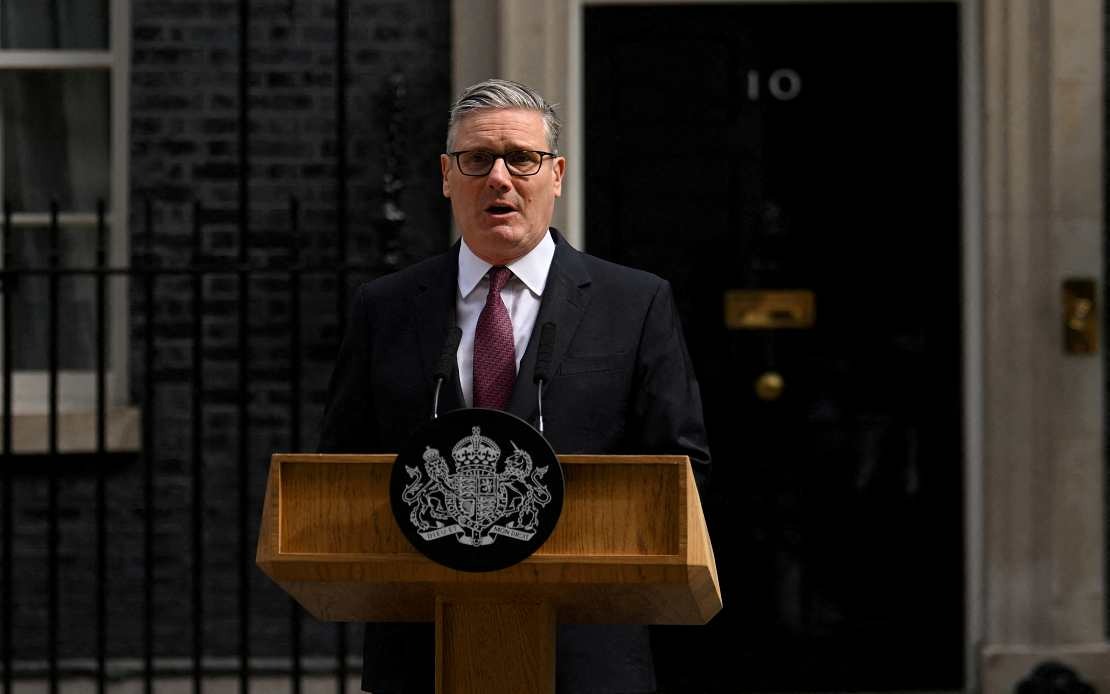
British Prime Minister Keir Starmer has added his voice to international calls for an urgent restoration of the ceasefire between the United States and Iran, as tensions simmer over control of the strategically critical Strait of Hormuz. Speaking at a joint press conference in Paris on Monday alongside the leaders of France, Germany, and Ukraine, Starmer issued a stark rebuke of Iranian actions while pledging Britain's readiness to support diplomatic resolution of the deepening standoff.
The confrontation between Washington and Tehran has intensified sharply following a weekend exchange of military strikes, with President Donald Trump announcing that the United States intends to reinstate its blockade on Iranian commerce and levy charges on vessels transiting the Strait of Hormuz for safe passage guarantees. This dramatic escalation marks a significant reversal of the relative calm that had prevailed since June, when both sides appeared to accept a memorandum of understanding intended to conclude the broader US-Israeli conflict that erupted in late February.
Starmer's intervention reflects growing concern among Western allies that the unravelling of this fragile agreement could precipitate a full-scale crisis affecting one of the world's most vital shipping corridors. The Strait of Hormuz remains the primary conduit through which roughly one-third of globally traded seaborne oil passes, making its security essential to international energy markets and economic stability far beyond the Middle East region. Any prolonged disruption would reverberate through supply chains worldwide, with particular consequences for energy-dependent economies across Asia and Southeast Asia.
The British Prime Minister was unambiguous in condemning Tehran's targeting of commercial vessels and strikes against Gulf partner nations, characterizing such actions as intolerable provocations that must cease immediately. However, his carefully calibrated statement acknowledged that security concerns and disputes over maritime access represent legitimate negotiating points rather than issues to be resolved through military escalation. This balanced posture attempted to maintain Britain's diplomatic credibility with both regional allies and Iran itself.
Crucially, Starmer signalled that London stands prepared to deploy military and naval assets to facilitate the resumption of normal shipping operations through the contested waterway. This commitment extends beyond symbolic gesture; Britain maintains significant naval presence in the Persian Gulf and possesses the capability to protect merchant convoys and coordinate international maritime security efforts. The willingness to commit assets underscores how seriously Western powers view the threat posed by continued Iranian actions.
The broader context illuminates why this confrontation has triggered such urgent diplomatic mobilization. Iran had effectively sealed the Strait of Hormuz during the height of the February conflict, leveraging control over this geographic chokepoint as a weapon against perceived enemies. The expectation that a full reopening would follow the June agreement reflected hopes that regional tensions would substantially diminish and international commerce could resume unimpeded. The recent reversal of this trajectory suggests that underlying disputes remain far more intractable than the initial ceasefire agreement implied.
For Southeast Asian nations, the implications extend well beyond theoretical concerns about energy supplies. Many countries in the region depend on shipping corridors through the Gulf for trade with Europe, Africa, and the Middle East itself. Malaysia, Singapore, and other regional economies maintain substantial trading relationships with both Iranian and American partners, creating complex diplomatic cross-pressures. Any prolonged disruption to Strait of Hormuz passage would directly increase transport costs and extend delivery timelines, ultimately raising consumer prices and dampening regional economic growth.
Starmer's insistence on negotiation as the pathway forward, paired with his refusal to accept military blockades as legitimate instruments of statecraft, articulates a position increasingly difficult to maintain as both sides dig deeper into confrontational postures. The British-led coalition effort, bringing together leaders from France, Germany, and Ukraine, represents an attempt to mobilize diplomatic pressure against further escalation. However, the limited leverage available to these external actors raises questions about whether exhortations to reason can overcome the fundamental strategic calculations driving both American and Iranian decision-making.
The question of maritime freedom of navigation remains central to Starmer's framing of the dispute. His emphasis on unrestricted passage through the Strait of Hormuz reflects a core principle of international maritime law, enshrined in the United Nations Convention on the Law of the Sea. Neither Iran nor the United States can legitimately impose transit fees or selective passage restrictions without violating these established norms. Yet the Trump administration's suggestion of charging vessels for safe passage represents a potential new precedent that could fundamentally alter how global maritime commerce operates.
The timing of this escalation carries additional significance given ongoing global tensions and competing great-power interests in the Middle East. Russia's continued positioning within Middle Eastern affairs, China's growing economic ties to the region, and the fragility of intra-Gulf cooperation all compound the challenges facing Western mediators. Britain's invocation of coalition solidarity and shared commitment to international order serves partly to reassure regional allies that Western powers remain engaged and capable of providing security guarantees independent of current American policy directions.
For Malaysian policymakers observing these developments, the situation presents both immediate practical concerns and longer-term strategic considerations. The direct impact on shipping costs and supply chain reliability demands attention, but equally important is the broader question of how regional states should position themselves amid great-power competition over Middle Eastern affairs. Countries that can maintain balanced relationships with multiple major powers, while advocating for adherence to international law and peaceful resolution of disputes, may ultimately prove best positioned to protect their interests.
Starmer's call for ceasefire resumption ultimately rests on an appeal to rationality and mutual interest in avoiding economic catastrophe through military escalation. Whether such appeals prove persuasive will depend largely on whether the United States and Iran can identify shared ground beyond their profound strategic disagreements. The British position, while diplomatically sound and oriented toward stability, offers limited leverage to move the fundamentally opposed parties toward compromise on their core demands.

