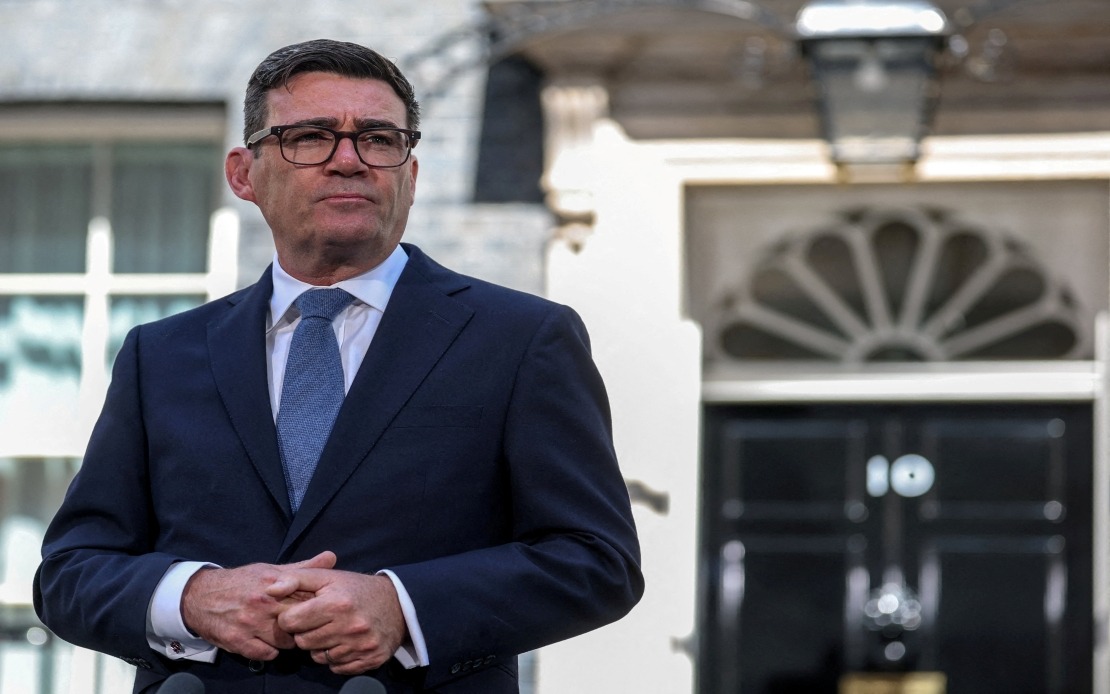
British Prime Minister Andy Burnham has launched a bold experiment in political decentralisation by establishing a secondary government headquarters in Manchester. The new facility, housed within Heron House in the heart of Manchester's commercial district, represents a tangible commitment to rebalancing power away from the traditional seat of Westminster. Described officially as "No10 North," the office will function as a dedicated centre for coordinating regional economic growth and implementing the government's devolution agenda across the United Kingdom.
The establishment of No10 North signals a fundamental shift in how the British government intends to approach economic governance. Rather than concentrating all major policy decisions at 10 Downing Street in London, Burnham has committed to splitting his working week between the capital and Manchester, setting a precedent that senior ministers and other cabinet members will similarly rotate through the northern office. This regular presence from the highest levels of government is designed to demonstrate that regional concerns and local economic development are no longer peripheral to Westminster's priorities but rather central to national strategy.
The office has been branded as the government's "situation room for growth," a designation that underscores its operational significance. Its primary mandate encompasses overseeing local economic development initiatives and coordinating the devolution of powers from Whitehall to regional and local authorities. For regions across northern England and beyond, this suggests a willingness to engage in genuine partnership with locally elected leaders rather than imposing top-down policies from the capital. Burnham's characterisation of this phase as one where "the days of Whitehall resisting devolution are over, for good" points to a recognition that the previous system of governance had become an obstacle to responsive, regionally tailored policymaking.
The immediate operational test of this commitment comes through the revived National Economic Council, which Burnham will chair at No10 North on Friday. This body, originally convened in 2008 in response to the global financial crisis, has been reconstituted as a platform for dialogue between senior government ministers and regional mayors. The inclusion of mayors from across the country in this decision-making apparatus elevates local leaders from consultative roles to participants in substantive economic planning. The council's flexibility in membership—expanding to include business leaders, trade unions, and other organisations depending on the topics under discussion—suggests an effort to build broader consensus around growth strategies rather than relying solely on government and elected officials.
From a Malaysian and Southeast Asian perspective, this development warrants attention as an example of how mature democracies are grappling with regional inequality and the concentration of economic opportunity in capital cities. The pattern Burnham is attempting to address—where London dominates the national economy while peripheral regions struggle—mirrors challenges faced across the region. Nations like Malaysia, where Kuala Lumpur and the Klang Valley account for a disproportionate share of economic activity, and Indonesia, where Jakarta's dominance shapes national policy, might observe how Westminster's decentralisation experiment unfolds. Should No10 North succeed in catalysing meaningful regional development, the model could offer instructive lessons for Asian governments considering similar architectural shifts in governance structures.
The symbolism of locating the office in Manchester carries particular weight. The city, once the industrial heartland of Britain during the nineteenth-century textile boom, has experienced decades of post-industrial decline and economic reorientation. Choosing Manchester as the seat of this devolved decision-making authority signals an attempt to redirect investment and opportunity toward regions that feel abandoned by Westminster's focus on financial services and London-based industries. This alignment of symbolic and substantive action—pairing rhetorical commitments to devolution with concrete changes in where government business is conducted—represents a recognition that institutional structures themselves communicate political priorities.
The expansion of the National Economic Council to incorporate diverse stakeholders beyond government reflects a broader acknowledgment that economic growth cannot be achieved through ministerial decree alone. By creating forums where regional mayors sit alongside business leaders and union representatives, the government is attempting to forge consensus about the specific obstacles preventing regional development. This participatory approach contrasts with more centralised models where economic policy emerges from technocratic processes within ministries and then flows outward to regions. Whether such consensus-building can overcome entrenched regional inequalities and structural disadvantages remains uncertain, but the framework at least provides mechanisms for those challenges to be articulated and collectively addressed.
The practical implications of Burnham's strategy extend beyond symbolism to questions of resource allocation and policy priority. Ministers working from Manchester will be positioned to understand regional perspectives more directly and to advocate for policies responsive to local concerns. Over time, this exposure to non-Westminster perspectives could alter the policy positions emerging from government, though sceptics might argue that real power remains concentrated in London. The critical test will involve whether regional mayors secure tangible increases in fiscal autonomy, control over policy design, and decision-making authority, or whether the Manchester office becomes largely ornamental despite its high-profile opening.
The timing of this initiative reflects broader European trends toward political decentralisation, though the British approach remains relatively cautious compared to federal or quasi-federal systems elsewhere on the continent. Spain, Germany, and Belgium have all experimented with various degrees of regional autonomy and shared governance structures, each with mixed results. Britain's movement in this direction, while still limited in scope, acknowledges that centralised governance has become politically untenable in an era where regional identities and interests increasingly demand recognition and accommodation. The devolution settlement now being formalised through No10 North represents an attempt to preserve the United Kingdom as a coherent political entity while accommodating demands for local agency and self-determination.

