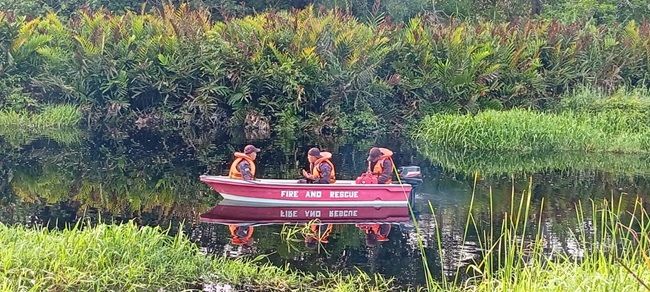
Rescue operations in Brunei are now in their third day of intensive searching following a suspected crocodile attack that claimed a fisherman in the Sungai Bera waterway near Kampong Baru. Despite coordinated efforts across multiple government agencies and sustained search activity, investigators have yet to locate any trace of the missing victim, raising concerns about his likely fate.
The initial distress call reached Brunei's Fire and Rescue Department on Wednesday, 24 June, when the man was reported missing after entering the river for fishing. Family members who contacted emergency services indicated that a crocodile had attacked the victim while he was engaged in fishing activities along the waterway. Two fire engines were dispatched to the scene with nine personnel, led by Acting Station Officer Mohd Zulkifli Md Tahir, who began preliminary investigations with the family and witnesses present.
The scale and coordination of the response underscores the seriousness with which Brunei authorities treat such incidents. The Fire and Rescue Department has deployed multiple operational assets including dedicated patrol vessels that have been conducting continuous searches along the river corridor. Beyond boat-based patrols, rescue teams have conducted systematic sweeps of the riverbanks on foot, examining accessible areas where a victim might have washed ashore or become stranded.
Drone surveillance has emerged as a critical component of the search strategy, with the Fire and Rescue Department's unmanned aerial systems providing aerial reconnaissance capabilities that allow search teams to cover larger areas and identify potential locations that would be difficult to access by ground. This technological approach represents a modern enhancement to traditional search methods and enables rescuers to maintain vigilance over the river and surrounding landscape continuously.
The operation is being coordinated under the leadership of Senior Superintendent Amirul Hadi Junaidi, who commands the Operations Branch and oversees the overall search strategy. This command structure ensures unified direction across the various agencies involved in the rescue effort. The Royal Brunei Police Force has mobilised personnel from multiple operational units, including officers stationed at Seria Police Station and specialist marine police personnel from POLMAR, the force's dedicated maritime division. The Wildlife Division has also been integrated into the response team, bringing expertise in crocodile behaviour and habitat patterns that can inform search tactics and help predict where the victim or animal might be located.
The involvement of the Wildlife Division reflects a recognition that understanding crocodile behaviour is essential to predicting likely movements and locations. These reptiles follow patterns based on territory, feeding habits, and environmental conditions, and specialists can advise rescue teams on where the animal might retreat with prey. This ecological expertise complements the emergency response capabilities of the fire and police services.
Sungai Bera and its tributary waterways are known habitats for crocodiles in Brunei, and incidents involving these predators, while not common, represent a recognised environmental risk in the region. Fishing remains a popular activity among local residents and visitors, often conducted with limited protective measures given the relative infrequency of attacks. This incident highlights the inherent dangers of river-based activities in areas where large reptilian predators inhabit the ecosystem.
For Malaysian observers, the incident carries echoes of similar incidents in bordering regions where crocodile habitats overlap with human activity. Sarawak and Sabah have experienced occasional crocodile attacks despite conservation measures, and rescue operations in these areas typically involve comparable multi-agency coordination and resource deployment. The Brunei operation demonstrates regional best practices in emergency response and inter-agency cooperation.
The extended three-day search with no positive developments suggests an increasingly grim prognosis for the missing victim. Experience from other crocodile attack incidents indicates that survival prospects diminish rapidly once substantial time has elapsed, particularly in river environments where currents, water conditions, and animal behaviour complicate rescue scenarios. The search's continuation despite these sobering realities reflects official commitment to providing closure for the family and establishing a complete account of the incident.
The incident underscores broader questions about water safety in Southeast Asian communities where fishing remains economically and culturally significant despite proximity to wildlife hazards. While crocodile attacks remain statistically rare events, their high fatality rate and dramatic nature mean that prevention through awareness and protective practices may be more effective than emergency response after an incident occurs.
As the search continues into its fourth day, rescue teams face the challenge of maintaining operational momentum while managing limited prospects for a positive outcome. The involvement of specialist equipment and trained personnel across multiple agencies demonstrates the thoroughness of the response, even as weather conditions, river dynamics, and elapsed time work against recovery prospects.

