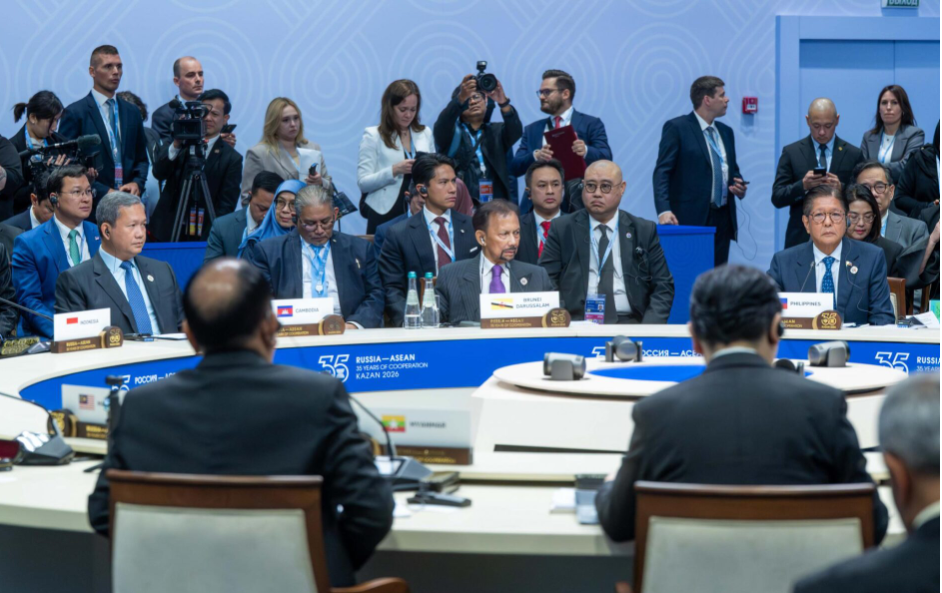
Sultan Hassanal Bolkiah has underscored the critical importance of sustained engagement between Asean and Russia, addressing regional leaders gathered at the Kazan Expo International Exhibition Centre in Russia on June 18 for a commemorative summit marking three and a half decades of diplomatic relations. The Bruneian monarch used the platform to articulate a vision of intensified cooperation grounded in shared responsibility for navigating an increasingly complex global landscape.
In his remarks, the Sultan acknowledged the exceptional reception accorded to Asean delegations by Russian President Vladimir Putin and Tatarstan officials, while also expressing sympathy to Thai Prime Minister Anutin Charnvirakul following the death of Princess Bajrakitiyabha. The diplomatic gesture reflected broader regional sensitivities and demonstrated the interconnected nature of Asean affairs even during bilateral engagement. The Sultan's attendance was accompanied by Brunei's Foreign Minister Prince 'Abdul Mateen, signalling Bandar Seri Begawan's commitment to this longstanding partnership.
The 35-year relationship between Asean and Russia has proven resilient despite dramatic shifts in the international order, according to the Sultan's assessment. Rather than framing this longevity as merely historical, he presented it as evidence that the partnership possesses structural foundations capable of withstanding geopolitical turbulence. This characterisation becomes particularly significant given current tensions dividing the international community, suggesting that Asean nations view their engagement with Moscow as essential to maintaining their cherished principle of non-alignment and equidistant diplomacy in an era of great power competition.
Cooperation between the two blocs has reportedly expanded across all three pillars of the Asean Community framework—political and security, economic, and socio-cultural dimensions. This comprehensive engagement pattern reflects the ambition to create interconnected relationships that extend beyond traditional state-to-state dealings into people-to-people exchanges and institutional linkages. The Sultan emphasised that such multifaceted cooperation has already yielded tangible benefits, though he stopped short of providing specific examples, leaving room for interpretation about the nature and scale of these gains.
As Asean pursues its ambitious Vision 2045 development roadmap, the Sultan identified Russia as an indispensable partner for navigating an array of transnational challenges. Political tensions—a somewhat oblique reference to conflicts within and around the region—demand collaborative diplomatic responses. Economic fragmentation threatens the prosperity that regional integration was designed to secure. Climate change poses existential risks to low-lying island nations and coastal areas throughout Southeast Asia. Meanwhile, rapid technological advancement creates both opportunities and vulnerabilities that require coordinated policy responses. By situating Russia within this framework of global challenges, the Sultan implicitly argued that strategic isolation would be counterproductive to Asean's interests.
Specific sectors where the Sultan identified cooperation as particularly vital include energy and food security—two domains where geopolitical competition has intensified markedly in recent years. Russia's position as a global energy supplier and agricultural producer makes it strategically relevant to regional supply chain resilience, a concern that has grown acute following various international crises. Climate action and disaster management reflect the existential challenges facing Southeast Asia's vulnerable geography, while non-traditional security threats encompassing transnational crime, cybersecurity, and pandemics demand responses that transcend borders and nationalisms.
Education and human capital development featured prominently in the Sultan's vision, reflecting recognition that institutional capacity and skilled personnel form the bedrock of enduring partnerships. Exchange programmes and training initiatives were presented not merely as cultural gestures but as essential mechanisms for building the networks and mutual understanding necessary to navigate complex negotiations and coordinate responses to shared threats. This emphasis on the younger generation suggests confidence in the partnership's future even as current geopolitical temperatures remain elevated.
The Kazan Declaration 2026, endorsed at the summit, establishes the architecture for deepened engagement in the coming years. Alongside this overarching declaration, leaders adopted a Comprehensive Plan of Action for 2026–2030 that presumably operationalises the strategic partnership framework. Separate joint statements on energy and cultural cooperation signal recognition that different domains require tailored approaches while remaining embedded within broader strategic partnership architecture. These formalised commitments represent diplomatic currency that will shape bilateral and multilateral interactions throughout the decade.
The summit's working lunch session examining integration processes in Eurasia underscored the geopolitical salience of this engagement. Contributions from the Asean secretariat, the Shanghai Cooperation Organisation, and the Eurasian Economic Commission situated the Asean-Russia relationship within the broader architecture of continental integration efforts. This contextualisation suggests that Asean leaders view their engagement with Russia not in isolation but as part of a larger strategic positioning within Eurasian affairs. The inclusion of business forum outcomes alongside formal diplomatic declarations reflected recognition that economic engagement provides both substance and incentive for sustained political cooperation, particularly as sanctions regimes complicate conventional commercial relationships.

