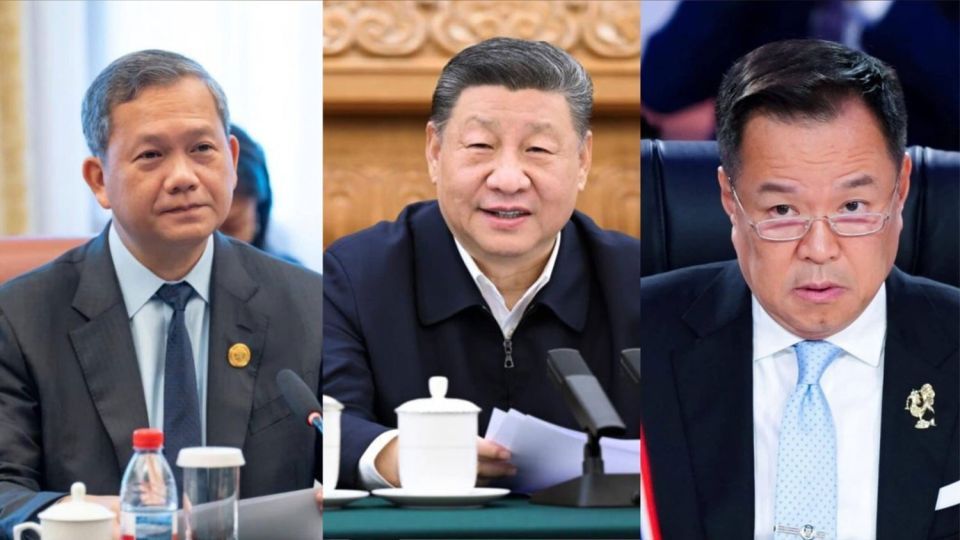
Prime Minister Hun Manet of Cambodia and his Thai counterpart Anutin Chanvirakul will converge on Shanghai on July 17 for the opening session of the World AI Conference 2026, accepting an invitation extended personally by Chinese President Xi Jinping. The attendance of both leaders at this high-profile tech summit in China raises renewed questions about whether Beijing will capitalize on the visit to broker progress on the thorny border disputes that have plagued the two Southeast Asian neighbours. The invitation itself reflects China's continued efforts to position itself as a central player in regional diplomacy, while the timing remains strategically significant given that meaningful dialogue between Manet and Anutin has stalled since December of last year.
Cambodia's delegation to Shanghai will be substantial and carefully curated. Accompanying Manet on his July 15-17 trip will be Foreign Minister Prak Sokhonn, Defence Minister Tea Seiha, and Sun Chanthol, who holds the position of first vice-chairman of the Council for the Development of Cambodia. Thailand has also mobilized diplomatic resources, with reports indicating that Foreign Minister Sihasak Phuangketkeow will travel alongside Anutin. These ministerial-level attendances underscore the importance both governments attach to the engagement and suggest that substantive discussions beyond the conference agenda may well occur behind closed doors.
Both leaders are scheduled for bilateral meetings with Xi and Chinese Premier Li Qiang, representing the calibre of diplomatic attention China is dedicating to the engagement. From Cambodia's perspective, the visit carries multilayered significance. In official statements, the Phnom Penh foreign ministry characterized the trip as underscoring the deep commitment between Cambodia and China to fortify their historically close relationship and foster cooperative ventures that serve mutual interests. The language employed emphasized continuity and expansion—describing the visit as a catalyst for advancing the Comprehensive Strategic Partnership of Cooperation, enhancing the Diamond Cooperation Framework, and constructing what officials termed an all-weather Cambodia-China Community with a Shared Future suited to the contemporary era.
Thailand's diplomatic messaging similarly emphasizes bilateral strengthening, with Bangkok's foreign ministry positioning the Shanghai engagement as an opportunity to deepen the Thailand-China Comprehensive Strategic Cooperative Partnership for the benefit of both peoples. Yet beneath the rhetorical veneer of cooperation and friendship lies an unresolved geopolitical problem that Beijing may well attempt to address. The border dispute between Cambodia and Thailand has festered for decades, rooted in competing territorial claims and complicated by historical grievances dating back to conflicts that scarred both nations. Recent military actions and the stalled negotiations represent a deterioration that threatens regional stability and complicates ASEAN cohesion.
The backdrop to this Shanghai meeting includes a telling encounter that occurred merely weeks earlier. Both Manet and Anutin attended the third iteration of the ASEAN Future Forum held in Hanoi in early June, where they managed a handshake captured by photographers but conspicuously failed to engage in substantive discussions addressing their ongoing territorial disagreement. This hollow diplomatic gesture highlighted the depth of the impasse and the public nature of their estrangement. Regional observers have begun theorizing that China, leveraging its status as a paramount trading partner to both nations and its track record in regional mediation, may deploy economic and diplomatic pressure to nudge Cambodia and Thailand toward renewed negotiations.
However, structural obstacles to resolution may prove more intractable than optimistic analysts assume. According to Kin Phea, director of the International Relations Institute at Cambodia's Royal Academy, the central impediment to progress involves those within Thailand who genuinely exercise power and control policy implementation. Phea argues that Thailand's military establishment has fundamentally failed to honour commitments negotiated between civilian government representatives and Cambodian counterparts, allowing the armed forces to act with impunity in ways that infringe upon Cambodian territorial sovereignty. This civilian-military disconnect in Bangkok has effectively paralyzed diplomatic progress, as agreements signed by one arm of government face non-compliance from another.
Phea contends that military encroachment on Cambodian territory continues unabated, reflecting either an unwillingness or inability on Bangkok's part to enforce civilian directives within its own defense establishment. He advocates forcefully for China to assume a more interventionist posture, positioning Beijing as an active arbitrator rather than a passive observer. His vision involves China using its diplomatic leverage to insist both nations return to formal negotiations, establish frameworks grounded in international law, and resolve their conflict through peaceful consultation rather than military posturing. The December 2025 Fuxian Consensus, brokered by China itself, established principles for such resolution, yet compliance remains minimal.
The practical manifestations of the dispute are severe and humanitarian in nature. Significant portions of Cambodian territory remain under Thai military control, with approximately 20,000 Cambodian civilians effectively displaced from their homes, unable to return to their communities and properties. This humanitarian dimension transforms the border question from an abstract diplomatic matter into a concrete crisis affecting tens of thousands of ordinary people. The Joint Boundary Commission, theoretically tasked with managing boundary disputes through a bilateral mechanism, has become moribund, unable to function productively given the political obstacles on both sides.
Phea's prescription is clear: Thailand must be compelled to honour the Fuxian Consensus reached earlier this year, withdraw military forces from illegally occupied areas, return to substantive negotiations, and recommit to the Joint Boundary Commission framework without further delay. Whether China possesses either the will or sufficient leverage to impose such discipline on Bangkok remains an open question. The Shanghai conference will provide an immediate litmus test of Beijing's intentions. If Xi and Li Qiang engage both Manet and Anutin on the border question during their scheduled bilateral meetings, it would signal that China intends to press the issue. Conversely, if the border dispute remains conspicuously absent from the diplomatic agenda, it would suggest Beijing has chosen to prioritize its broader strategic relationships with both nations over regional conflict resolution.
For Malaysia and other ASEAN members, the Cambodia-Thailand situation carries implications beyond the bilateral relationship. Unresolved border conflicts within ASEAN undermine the bloc's collective credibility, distract from shared regional challenges, and create space for external powers to exploit divisions. Thailand's military actions, if unchecked, establish a troubling precedent for how territorial disputes might be managed elsewhere in Southeast Asia. The question of whether China will actively intervene to promote settlement, merely facilitate contacts, or remain studiously neutral will shape not only the trajectory of Cambodian-Thai relations but also broader patterns of Chinese influence and mediation in Southeast Asian geopolitics during the coming years.

