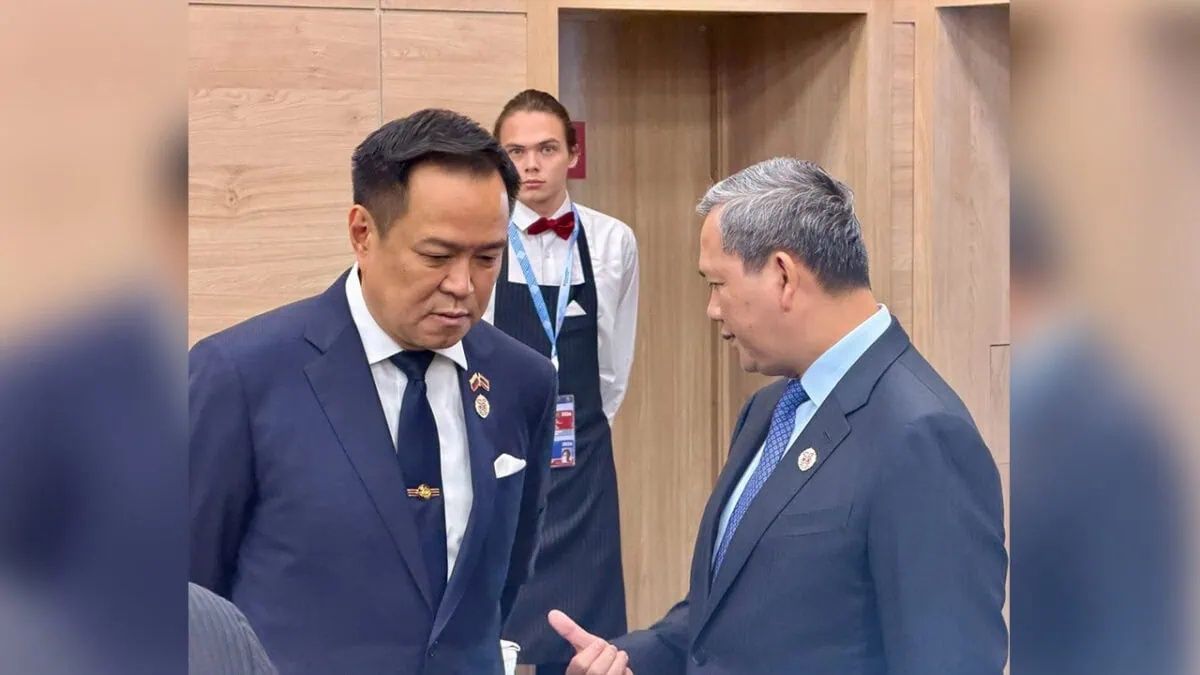
The relationship between Cambodia and Thailand took on fresh diplomatic momentum last week when Prime Minister Hun Manet appealed directly to his Thai counterpart Anutin Charnvirakul to move forward on critical border demarcation work. The two leaders met briefly on the margins of an Asean-Russia engagement held in Kazan, Russia, where Manet used the opportunity to press for concrete action on a longstanding issue that continues to shape regional stability in mainland Southeast Asia.
At the core of Manet's appeal lies a specific procedural gap: Thailand has yet to appoint a chief negotiator to the Joint Boundary Commission, the bilateral mechanism tasked with surveying and demarcating the countries' terrestrial borders. According to a statement posted on Friday, Manet emphasised that Cambodia remains bound by a Joint Statement signed on December 27, 2025, which explicitly calls for both nations to activate their JBC leadership and commence joint survey work. The Cambodian premier framed this not as a complaint but as an urgent need to honour existing legal commitments between the two nations.
The border dispute between these two Southeast Asian neighbours carries significant weight across multiple dimensions. Cambodia and Thailand share a complex frontier spanning hundreds of kilometres, with historical claims and counterclaims stretching back decades. The demarcation process itself requires meticulous technical work, involving cartographic expertise, field surveys, and careful documentation of boundary markers. Without active leadership on both sides, such work simply stalls, leaving ambiguity that can breed tension and occasional flare-ups along the frontier communities.
Parallel to the terrestrial border questions runs a separate maritime dimension that has drawn international legal machinery into play. Cambodia and Thailand are currently engaged in compulsory conciliation proceedings under the United Nations Convention on the Law of the Sea (UNCLOS), which governs disputes over maritime boundaries and offshore resource rights. This dual-track approach reflects a sophisticated understanding of the issues: land boundaries require bilateral negotiation and technical expertise, while maritime boundaries increasingly fall under international legal frameworks designed to manage such disagreements systematically.
Manet's framing reveals Cambodia's strategic positioning on the wider dispute. Rather than escalating rhetoric or suggesting unilateral action, he anchored his appeal to existing agreements and international law. By invoking the December 2025 Joint Statement and referencing UNCLOS, Cambodia positions itself as a rule-following state committed to orderly processes. This rhetorical stance matters significantly in Southeast Asian diplomacy, where legitimacy often derives from demonstrating adherence to agreed frameworks and international norms.
Thai Prime Minister Anutin's characterisation of their encounter offered a slightly different emphasis, though one ultimately consistent with Cambodian messaging. Anutin described the conversation as brief and informal, characterising it somewhat colourfully as leaders simply "pulling each other aside by the elbow" during the Kazan meetings. His account stressed that both nations reaffirm their desire to avoid conflict and prefer managing disputes through established mechanisms. Notably, when reporters asked whether border checkpoint reopening had been discussed, Anutin demurred with humour, suggesting such a move would provoke public backlash within Thailand.
This aside reveals an often-overlooked dimension of border politics: domestic political sensitivities. Citizens in border regions on both sides hold strong views about security, sovereignty, and the pace of normalisation. Governments must navigate these sentiments carefully, particularly when discussing measures like reopening checkpoints that symbolise reconciliation and trust. Anutin's reluctance to even discuss such matters publicly underscores how loaded these conversations remain, despite official commitment to peaceful resolution.
Thailand's own emphasis on a multi-mechanism approach mirrors Cambodia's strategy. Anutin referenced Thailand's commitment to UNCLOS, the JBC framework, and the General Border Committee (GBC), suggesting Bangkok views border management as requiring parallel rather than singular solutions. The GBC, less prominent in recent discussions, has historically served as a broader forum for addressing cross-border issues including trade, security, and community concerns. The invocation of this mechanism alongside UNCLOS and the JBC suggests both nations recognise that boundary questions cannot be solved by technical demarcation alone but require attention to the human and economic dimensions of the border.
For Malaysian observers and broader Southeast Asian watchers, the Cambodia-Thailand border dynamics carry regional implications. The region remains dotted with unresolved maritime boundary questions and terrestrial demarcation ambiguities involving multiple states. How Cambodia and Thailand navigate their disputes—whether through escalation or dialogue, whether through international mechanisms or bilateral patience—establishes precedent and models for other regional powers grappling with similar challenges. Malaysia itself maintains maritime boundary considerations with neighbouring states, making the evolution of Cambodia-Thailand negotiations relevant to regional peace architecture.
The public restraint evident in both leaders' statements also signals something important: despite periodic tensions, Cambodia and Thailand appear genuinely committed to preventing border disputes from metastasising into confrontation. The decision to continue talking, to reference shared commitments, and to invoke international law rather than military posturing represents a baseline diplomatic stability that has often been fragile in this region's history. Manet's explicit call for Thailand to appoint JBC leadership, while pressing, avoids accusatory language and instead frames the request as urgent implementation of agreed steps.
Looking forward, the real test will come in whether Thailand translates these expressions of commitment into concrete action, particularly the appointment of a JBC chief and resumption of survey work. Bureaucratic delays, budget constraints, or political complications within Thailand could slow progress. Conversely, Cambodia's emphasis on existing mechanisms and international law suggests it will not rush into aggressive unilateral actions but rather apply steady diplomatic pressure through established channels. The Kazan conversation may thus represent a turning point where both sides reaffirm their desire for orderly resolution, setting conditions for the practical work that must follow.

