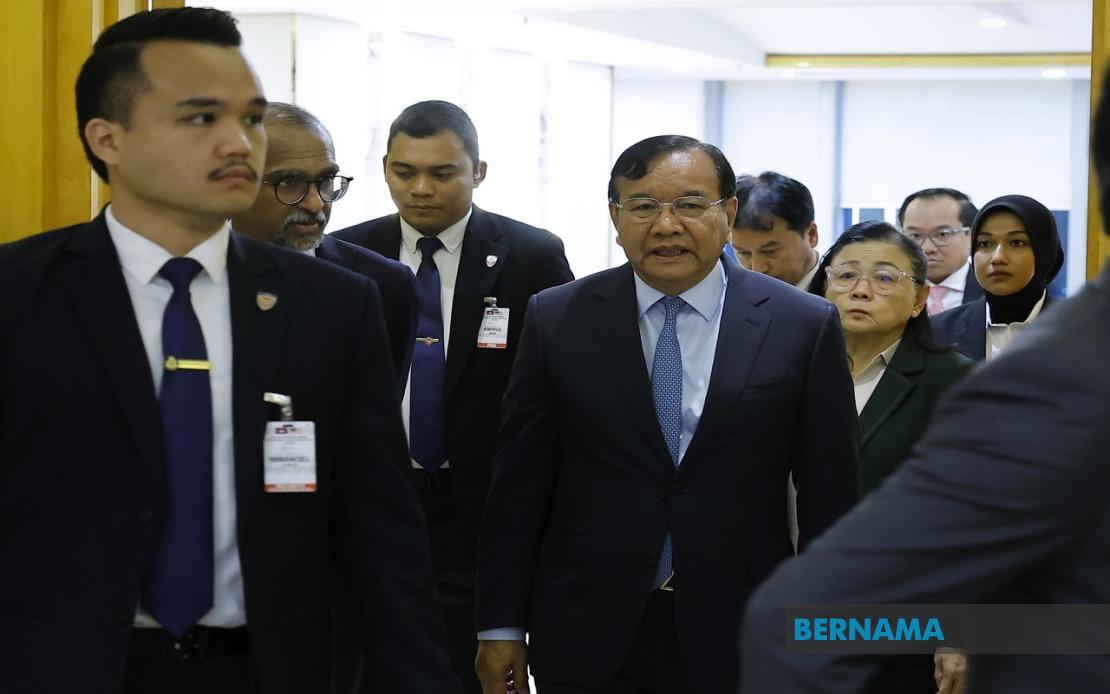
Cambodian Deputy Prime Minister and Minister of Foreign Affairs and International Cooperation Prak Sokhonn departed Malaysia on Monday afternoon, concluding a two-day official engagement that underscored the strengthening relationship between Kuala Lumpur and Phnom Penh. His departure from Kuala Lumpur International Airport Terminal 1 at 4:45 pm marked the end of a visit that produced tangible outcomes for bilateral cooperation, with Malaysian Government protocol chief Datuk Rozainor Ramli attending his farewell.
The timing of Sokhonn's visit carries particular significance, as it occurs within the framework of preparations for the 70th anniversary of Malaysia-Cambodia diplomatic relations scheduled for 2027. This milestone provides both nations an opportunity to reflect on nearly seven decades of formal ties and chart a forward trajectory for enhanced engagement. The focus on this historical marker signals mutual intent to transform a relationship rooted in Cold War-era diplomacy into one suited for contemporary regional challenges and opportunities.
During his stay, Sokhonn held substantive discussions with Malaysian leadership, notably visiting Prime Minister Datuk Seri Anwar Ibrahim at the Prime Minister's Office. Both leaders reaffirmed their commitment to longstanding bilateral bonds and committed to intensifying cooperation in sectors critical to Southeast Asian development. The conversation encompassed the digital economy and artificial intelligence—emerging technologies shaping regional competitiveness—alongside traditional areas such as the halal industry, where Malaysia holds established expertise, and cross-border concerns including food security and workforce development.
The centrepiece of Sokhonn's visit was co-chairing the 3rd Malaysia-Cambodia Joint Commission for Bilateral Cooperation alongside Malaysian Foreign Minister Datuk Seri Mohamad Hasan. This meeting constitutes a watershed moment in bilateral relations, representing the formal resumption of this institutional mechanism after a 20-year dormancy. The revival of the Joint Commission signals both nations' determination to move beyond ad hoc diplomatic engagements and establish structured channels for regular dialogue and coordination on strategic matters.
Economic indicators paint a picture of deepening commercial integration between the two neighbours. Bilateral trade surged substantially in 2025, climbing 27.4 per cent year-on-year to reach RM5 billion, equivalent to approximately USD1.17 billion. Malaysian exporters shipped RM4.13 billion worth of goods to Cambodia during this period, while reciprocal imports totalled RM880 million. These figures demonstrate that Malaysia remains a significant supplier of manufactured goods, capital equipment, and consumer products to Cambodia's growing economy.
Beyond trade flows, Malaysia's investment footprint in Cambodia has expanded considerably over successive years. As of 2024, Malaysian enterprises had accumulated USD3.20 billion in cumulative direct investment across 162 registered projects operating throughout the kingdom. This investment stock positions Malaysia as Cambodia's third-largest foreign investor, trailing only China and Vietnam. Such commercial presence translates into job creation, technology transfer, and integration of Cambodian supply chains into broader Southeast Asian production networks.
The economic relationship reflects broader regional trends within ASEAN. Cambodia, as a lower-middle-income country with abundant labour and natural resources, naturally attracts investment from more developed member states like Malaysia seeking to diversify production bases and access growing consumer markets. For Malaysia, Cambodia represents both a market for its manufactured goods and services and an investment destination offering competitive advantages in labour costs and resource availability. This complementarity has driven steadily expanding economic ties despite the geographical proximity and historical complexities that sometimes characterise Southeast Asian bilateral relations.
The revival of the Joint Commission after two decades of inactivity warrants examination of what stalled the mechanism and what prompted its resurrection. The gap likely reflects a period when direct bilateral engagement operated through less formal channels or suffered from competing regional priorities and domestic political transitions in both countries. The renewed commitment to structured cooperation suggests both governments have prioritised Malaysia-Cambodia relations within their current foreign policy frameworks and view the institutional mechanism as essential for managing an increasingly complex bilateral agenda.
For Malaysia specifically, strengthened ties with Cambodia align with its broader Indo-Pacific strategy and efforts to deepen ASEAN cohesion. Cambodia's strategic location, straddling maritime trade routes and serving as a land bridge between Southeast Asia's core and peripheral regions, carries geopolitical significance. Enhanced Malaysian investment and commercial presence in Cambodia contributes to regional economic integration while providing Malaysian businesses with diversified opportunities beyond traditional markets in Vietnam, Thailand, and Indonesia.
The focus on emerging sectors including digital economy and artificial intelligence reflects both nations' recognition that 21st-century competitiveness depends on technological adoption rather than traditional comparative advantages alone. By prioritising these areas within their bilateral framework, Malaysia and Cambodia acknowledge that maintaining relevant partnerships requires shared engagement with disruptive technologies and evolving global value chains. Malaysian expertise in fintech, e-commerce infrastructure, and digital governance can assist Cambodia's technological development while creating opportunities for Malaysian service providers and technology companies.
The halal industry component of their bilateral cooperation carries additional weight given Malaysia's global leadership in halal certification, product development, and Islamic finance. Cambodia's Muslim communities and potential for halal product manufacturing and trade present opportunities for Malaysian firms to extend their halal ecosystem leadership throughout the region. This sector also facilitates people-to-people connectivity and demonstrates how Malaysia's distinctive religious and cultural identity can generate commercial and diplomatic value.
Food security discussions between Sokhonn and Malaysian leaders reflect shared vulnerabilities within Southeast Asia's agricultural landscape. Both nations depend partly on food imports and face challenges from climate variability, land constraints, and population growth. Cooperation in agricultural technology, supply chain resilience, and policy coordination can mitigate these risks. Malaysia's advanced agricultural research capabilities and Cambodia's substantial arable land suggest complementary interests in productivity enhancement and market integration.
As Sokhonn departed Malaysian soil, the visit concluded with positive momentum for bilateral relations that extends well beyond ceremonial exchanges. The revival of the Joint Commission, substantive discussions on strategic cooperation, and impressive trade and investment statistics collectively demonstrate that Malaysia-Cambodia relations have entered a more intensive phase. For regional observers, this development underscores ASEAN members' capacity to strengthen partnerships despite competing global alignments, and suggests that the 70th anniversary of diplomatic relations in 2027 may serve as catalyst for even deeper institutional integration and cooperation across multiple domains.

