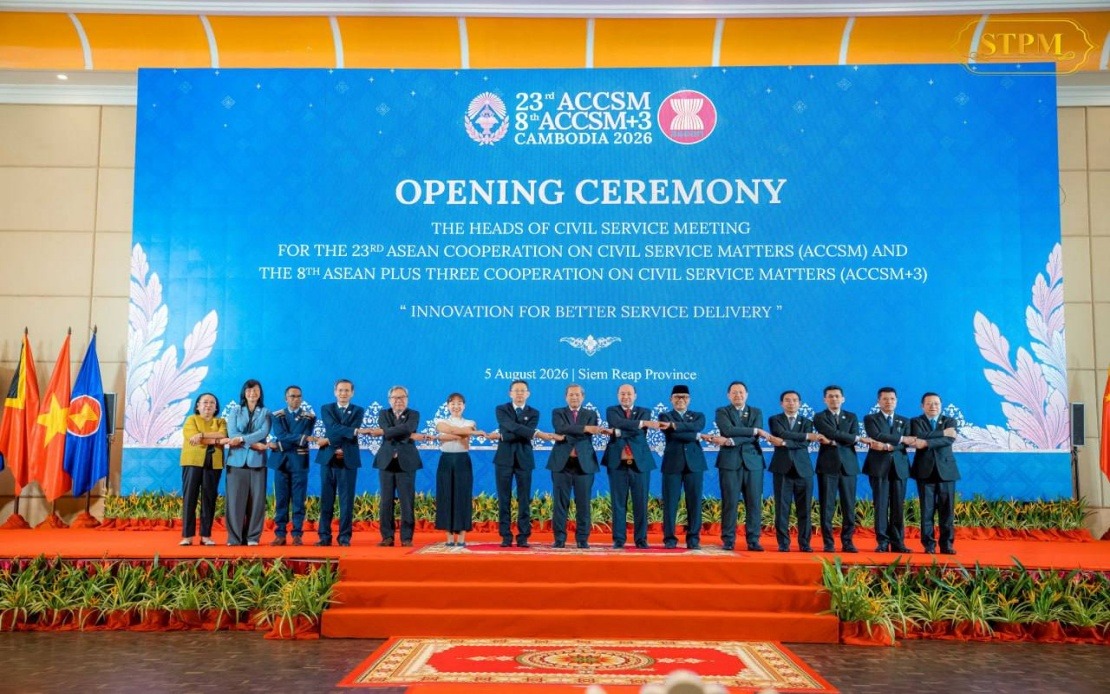
Cambodian Prime Minister Hun Manet has called on ASEAN to embrace artificial intelligence and digital innovation as tools for delivering more responsive public services, improving living standards, and closing development disparities within the region. Speaking at a high-level civil service cooperation forum in Siem Reap this week, Hun Manet emphasized that technological advancement must remain grounded in practical solutions addressing the genuine concerns of ordinary citizens, rather than pursuing innovation for its own sake.
The remarks came during the 23rd ASEAN Cooperation on Civil Service Matters and the 8th ACCSM+3 gathering, which ran from August 3 to 5 under the banner of "Innovation for Better Service Delivery." The forum brought together civil service leaders and policymakers from across the 10-member bloc and three dialogue partners—China, Japan and South Korea—to discuss how governments can modernise their administrative apparatus through thoughtful technology integration.
Hun Manet's intervention reflects a broader recognition across ASEAN that digital transformation has become essential to competitiveness and governance effectiveness. Governments throughout the region are actively exploring how AI and related tools can streamline bureaucratic processes, reduce operational costs, and enhance the speed and quality of services delivered to citizens. However, the Cambodian leader cautioned against a one-size-fits-all approach, noting that sustainable implementation demands robust institutional foundations and skilled workforces capable of managing complex technological systems.
Central to Hun Manet's message was the acknowledgment that ASEAN's member states operate at markedly different stages of economic and administrative development. This heterogeneity, he argued, necessitates a calibrated strategy where each nation adopts new technologies, particularly artificial intelligence, at a measured pace aligned with its specific capacities and constraints. Rather than racing to match more advanced economies, less-developed members should be supported in building the human capital and institutional frameworks essential for meaningful digital integration.
The prime minister also underscored that innovation must serve collective regional interests, not merely individual state advancement. ASEAN confronts shared challenges—including climate-induced disasters, uneven economic development, and persistent poverty—that transcend national boundaries and demand coordinated responses. In this context, technological innovation becomes a vehicle for strengthening mutual resilience, enabling member states to support one another through knowledge exchange, policy harmonisation, and joint capacity-building initiatives.
Hun Manet stressed that the ACCSM platform remains instrumental in facilitating this collaborative agenda. By maintaining focus on mutual learning and shared problem-solving, the forum can empower governments to move beyond internal efficiency gains and establish mechanisms for genuine regional cooperation. This framing positions civil service innovation not as a competitive race but as a collaborative enterprise designed to strengthen ASEAN's collective capacity to address transnational challenges.
For Malaysia and other Southeast Asian economies, Hun Manet's emphasis on inclusive and sustainable digital transformation carries particular weight. The region's governments have invested substantially in smart city initiatives, e-governance platforms, and AI-driven administrative systems. Yet these efforts often reveal fault lines between digitally advanced urban centres and less-connected rural areas, as well as between countries with strong technological infrastructure and those still building foundational capabilities.
The framework Hun Manet articulated suggests that successful ASEAN-wide digital governance requires not just technology transfer but also institution-building and human development. This implies that wealthier member states may need to contribute technical expertise and financial support to help less-developed neighbours establish the prerequisites for meaningful AI adoption. Such an approach could enhance regional stability by reducing disparities that sometimes fuel political tensions and economic grievances.
Moreover, Hun Manet's call for innovation rooted in institutional capacity signals recognition that technology alone cannot solve governance challenges. Effective digital public services depend on transparent procurement processes, ethical AI frameworks, cybersecurity protections, and trained personnel capable of managing these systems responsibly. Building these elements requires time, investment, and sustained political commitment—factors that cannot be rushed regardless of how advanced the underlying technology may be.
The Cambodian leader's emphasis on addressing citizens' real needs rather than pursuing technological sophistication for prestige also reflects a pragmatic understanding of public sector reform. Many digital government initiatives across Asia have foundered because they prioritized technical features over usability and genuine responsiveness to citizen demands. A people-centred approach, by contrast, begins by identifying the services citizens actually require and then determining how technology can improve access, speed, and quality.
Looking forward, Hun Manet's remarks suggest ASEAN is moving toward a more thoughtful, equity-conscious approach to digital transformation. Rather than viewing AI adoption as an inevitable race where lagging countries must simply catch up to leaders, the bloc appears increasingly committed to managing this transition in ways that preserve social cohesion and ensure benefits reach across all member states and populations. This orientation could serve as a model for other developing regions grappling with rapid technological change and uneven capacity.

