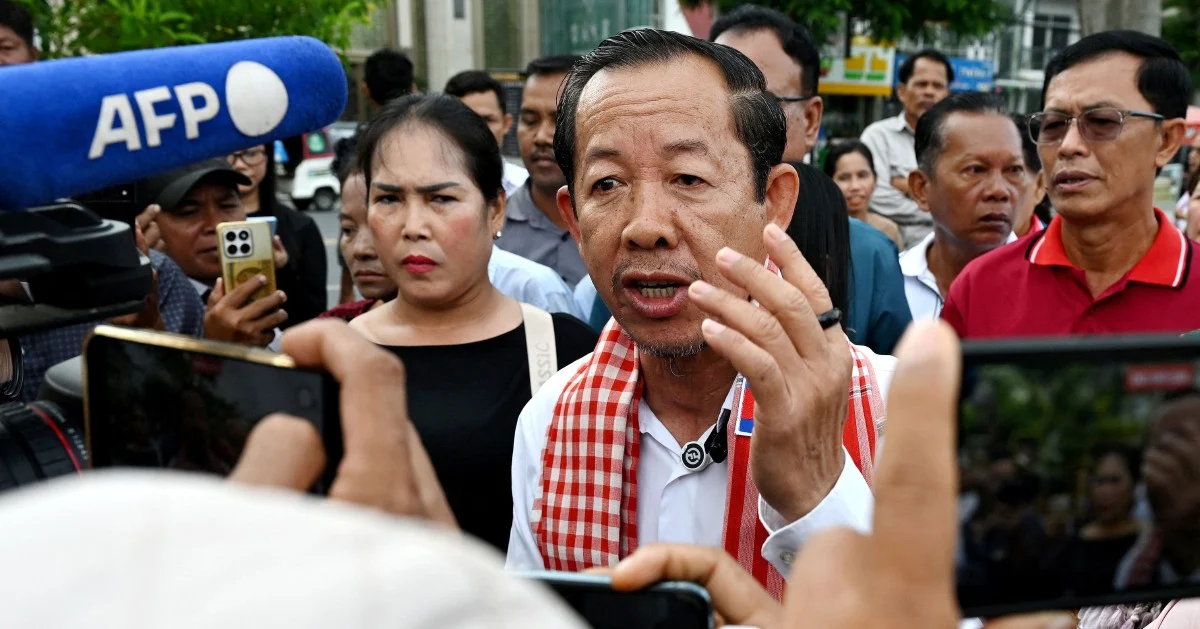
Cambodia's Supreme Court has taken a measured but ultimately restrictive approach to the case of opposition politician Rong Chhun, opting to suspend his imprisonment while leaving intact a prohibition on his participation in electoral contests. The decision, announced Friday through his legal representatives, represents a partial concession that stops short of clearing the way for his political rehabilitation or return to active candidacy.
The suspended prison sentence signals a degree of leniency from the nation's highest judicial authority, suggesting at least some recognition that the original conviction may have warranted reconsideration. However, the preservation of the electoral ban demonstrates the court's determination to enforce restrictions on opposition activity regardless. This two-pronged outcome exemplifies the delicate balance that Cambodia's judicial system appears to strike when addressing high-profile cases involving dissent and political challenge.
Rong Chhun's case has drawn international attention as observers monitor Cambodia's political trajectory and the space available for legitimate opposition voices. His continued exclusion from electoral participation carries significant implications for the competitiveness of future elections and the broader question of whether multiple political viewpoints can genuinely compete for power. The ban effectively removes him from any potential slate of candidates, limiting voter choice and narrowing the spectrum of political representation that citizens can support through the ballot.
The legal proceedings against Rong Chhun reflect deeper patterns in Cambodian politics, where opposition figures frequently face criminal charges that critics argue are politically motivated. The suspension of his sentence, while welcome to his supporters, does not erase the underlying conviction or restore his fundamental right to seek elected office. This distinction matters considerably for understanding the actual impact on his political future and on Cambodia's democratic institutions.
For Malaysia and other Southeast Asian democracies, the Cambodian court's decision offers a cautionary example of how judicial systems can be weaponised to neutralise political opposition even when authorities appear to offer partial relief. The separation between criminal punishment and electoral eligibility remains administratively distinct yet strategically interconnected in limiting a politician's ability to challenge incumbent power structures. Whether such bans survive international scrutiny or regional democratic standards remains an open question.
The ruling comes amid broader concerns about the health of Cambodia's political system, where the ruling Cambodian People's Party has dominated governance for decades. Opposition parties have repeatedly reported obstacles to their operations, including legal challenges against leadership and allegations of unfair campaign conditions. Rong Chhun's case, whether viewed sympathetically or with scepticism depending on one's perspective, fits within this wider context of contested political space and disputed judicial independence.
Suspending rather than cancelling the prison sentence may offer tactical advantages to Cambodia's authorities, allowing them to demonstrate judicial flexibility while maintaining core restrictions on political competition. The suspended sentence also creates potential leverage, as it can be reinstated if conditions are violated, effectively keeping pressure on the opposition politician. This approach preserves options for the government whilst appearing outwardly moderate to international observers and local constituents who value rule-of-law appearances.
For Rong Chhun himself, the decision presents a complex outcome. Freedom from incarceration allows him to continue living and working in Cambodia, but exclusion from elections eliminates his primary avenue for directly influencing national policy or competing for power. He remains a political figure but one stripped of electoral agency, a status that constrains his relevance to party operations and public influence. His supporters can cite the suspended sentence as a partial victory, yet the sustained ban undermines any narrative of full rehabilitation or vindication.
The timing and details of Cambodia's court decision warrant careful examination by regional governments and international democracy advocates. Elections scheduled for future years will proceed without Rong Chhun as a candidate, shaping the configuration of parliamentary representation and potentially affecting the balance of political forces. Whether additional opposition leaders face similar bans, or whether this case represents a singular instance, will indicate broader trends in Cambodia's willingness to permit genuine political contestation.
Southeast Asian governments observing this situation may draw different lessons depending on their own political circumstances and commitments to democratic principles. Nations committed to competitive elections and protection of political rights will likely view the electoral ban as problematic, whilst others may interpret it as a pragmatic way to manage political stability. The Cambodian court's approach—partial clemency paired with continued restriction—occupies an intermediate space that satisfies neither those seeking genuine political freedom nor those preferring complete suppression of opposition activity.
Cambodia's handling of Rong Chhun's case ultimately reflects choices about what kinds of political competition a state will tolerate and how justice systems relate to electoral access. The suspended sentence may offer relief to the individual, but the preserved ban ensures that formal democratic participation remains constrained. This outcome, neither full victory nor complete defeat for the opposition, exemplifies the complicated reality of political contestation in contemporary Southeast Asia, where formal legal systems continue to shape and sometimes limit the possibilities for democratic expression.

