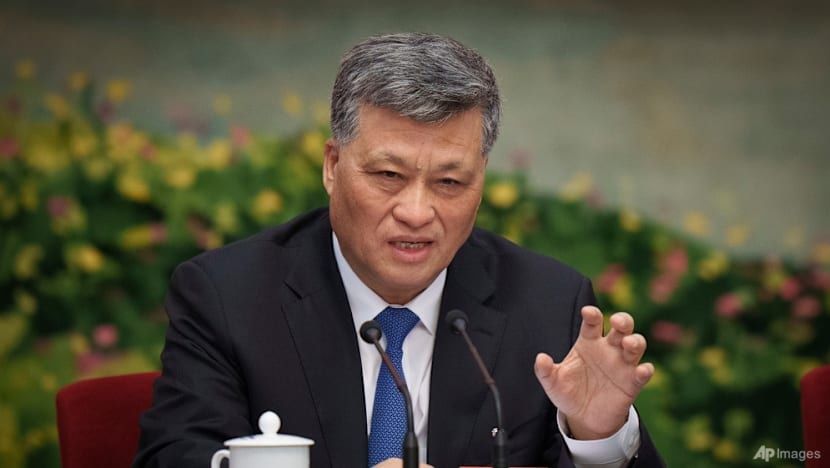
China's Communist Party has moved to expel Ma Xingrui, a 66-year-old former Politburo member who oversaw the northwestern region of Xinjiang, following a lengthy corruption investigation that unearthed serious allegations of graft and abuse of power. The disciplinary action, approved by the Politburo and announced through state media on Tuesday, represents a significant fall from grace for an official who occupied one of the party's most influential decision-making circles under President Xi Jinping's leadership. The party's Central Commission for Discipline Inspection, which functions as the Communist Party's internal anti-corruption agency, completed its investigation into Ma after launching proceedings in April, culminating in this definitive punishment.
The litany of charges against Ma paints a picture of systematic misconduct spanning personal enrichment and the weaponisation of state authority. According to Xinhua, investigators found that Ma had facilitated the purchase of residential properties by family members at substantially discounted prices, far below prevailing market rates—a common corrupt practice in China where such transactions often represent hidden transfers of wealth. Beyond property dealings, the investigation documented what state media described as "power-for-sex and money-for-sex transactions," suggesting Ma had leveraged his official position to engage in sexual misconduct. His immediate family also benefited directly from his position, with relatives allegedly exploiting Ma's influence to secure substantial financial advantages and business opportunities that would otherwise have been inaccessible to them.
Ma's conduct extended into the realm of official decision-making, where he allegedly abused his authority to provide advantages to individuals and companies seeking to advance their interests. The investigation found evidence that he had facilitated benefits for business partners in operational matters, project contracts, and employment promotions—manifestations of corruption that underscore how Chinese officials can distort market mechanisms and bureaucratic processes for personal gain. Additionally, Ma illegally accumulated large sums of money and valuable assets through his position, accepting bribes and other forms of improper compensation. State media characterised the totality of these violations as "particularly serious," language typically reserved for high-level corruption cases that demonstrate egregious breaches of party discipline and public trust.
Ma's tenure in Xinjiang spanned the critical period from 2021 to 2025, a time when the region remained under intensive state oversight following decades of sporadic violence. The Xinjiang region experienced a succession of attacks targeting civilian populations throughout the 2010s, which Beijing attributed to armed separatist movements and Islamist extremist groups operating among the Uyghur Muslim population. In response, Chinese authorities implemented what officials characterised as comprehensive counter-terrorism measures, though the scope and intensity of these operations have drawn international scrutiny and condemnation from human rights advocates.
The crackdown in Xinjiang has become one of the most contentious aspects of China's internal security policy. Over the past decade, the government has deployed extensive surveillance infrastructure, mass detention facilities, and security operations that have disproportionately affected Uyghurs and other ethnic minorities in the region. The measures include restrictions on religious practice, extensive monitoring of daily life, and mandatory vocational training programs that critics argue constitute forms of political coercion. For Malaysian and Southeast Asian observers, the Xinjiang situation remains significant given the region's proximity and the presence of Muslim populations across the broader region who have expressed concerns about the treatment of their co-religionists.
The international dimension of Xinjiang policy received renewed attention following a 2022 report by Michelle Bachelet, who served as the United Nations High Commissioner for Human Rights. Bachelet's assessment suggested that Chinese government actions in Xinjiang could potentially constitute crimes against humanity, a determination that lent credibility to long-standing allegations from human rights organisations. This characterisation from a high-ranking UN official elevated the matter beyond NGO criticism to the level of potential international legal concern, though China rejected the assessment and has consistently defended its policies as legitimate security measures responding to genuine threats.
Ma Xingrui's removal from the Politburo also carries broader implications for power dynamics within China's leadership structure. The Politburo represents the apex of decision-making authority in the Communist Party system, and membership in this body signifies inclusion in the elite circle that shapes national policy. Expulsion from both the party and this prestigious body represents not merely a loss of position but a fundamental delegitimisation—marking Ma as having violated the standards and values that the Communist Party claims to uphold. For regional observers watching Chinese politics, such high-profile purges of senior officials offer insights into the party's internal enforcement mechanisms and the consequences of straying from the discipline that the leadership expects.
The timing and nature of Ma's expulsion also reflect the Communist Party's emphasis on anti-corruption campaigns as a governance tool. Since assuming paramount power, Xi Jinping has deployed anti-corruption investigations as both a genuine reform effort and a mechanism for consolidating control by removing potential rivals or officials outside his faction. The investigation into Ma, initiated months before the formal expulsion, demonstrates the methodical approach Chinese authorities take in such cases, conducting thorough fact-finding before announcing punishments that carry significant career and personal consequences.
For Malaysia and other Southeast Asian nations, the Xinjiang issue and cases like Ma's expulsion underscore the complexities of engaging with China on matters of governance and human rights. While bilateral relationships with Beijing remain economically and strategically important for the region, questions about accountability and standards of conduct within Chinese institutions continue to surface. The treatment of officials like Ma, regardless of the legitimacy of specific charges, occurs within a system that critics argue lacks transparency and independent judicial oversight comparable to democratic standards. At the same time, the existence of internal disciplinary mechanisms suggests that the Communist Party does maintain some apparatus for addressing misconduct, even among its highest-ranking members, though the effectiveness and fairness of such mechanisms remain contested.
The broader context of Xinjiang governance under Ma's leadership will likely remain a subject of international debate and scrutiny. While his removal on corruption charges addresses one aspect of accountability, questions persist about the policies and practices implemented under his oversight. The expulsion serves as a reminder that even senior officials operating within authoritarian systems can face consequences for personal misconduct, yet it does not necessarily translate to accountability for controversial policies pursued in the name of state security. As China continues to grapple with its international image and reputation, particularly among Muslim-majority nations in Southeast Asia and beyond, the resolution of cases like Ma's will continue to intersect with broader questions about governance standards and respect for human rights.

