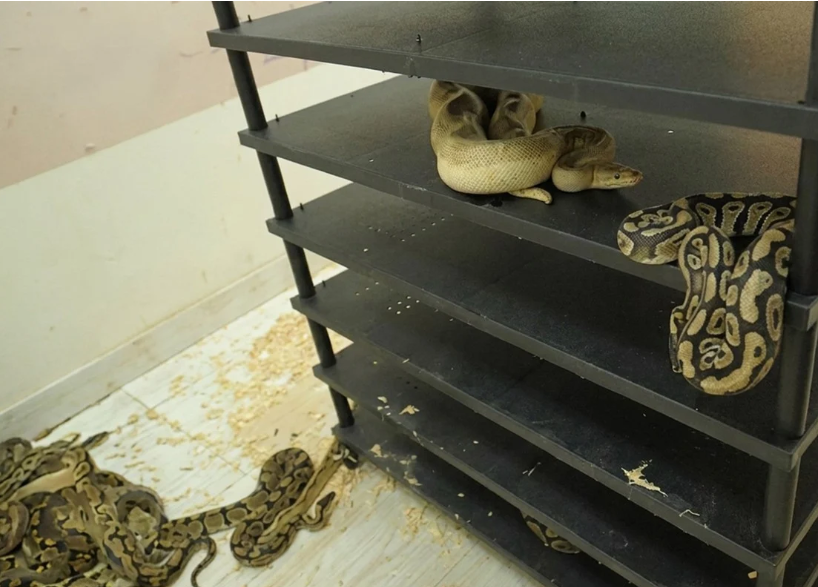
A resident of Taizhou in Zhejiang province has been sentenced to prison for operating one of China's largest illegal python breeding operations, a sophisticated criminal enterprise that was ultimately exposed through routine analysis of electricity consumption patterns. The discovery of 309 pythons crammed into a residential flat represents a significant enforcement action against trafficking in endangered wildlife, with state media highlighting the case as a landmark example of how authorities can detect environmental crimes through unconventional investigative methods.
The operation came to light in March 2024 when an elderly local resident discovered a large python near a mountain base in the area. The thick, tawny-coloured snake, measuring as wide as an adult's arm, was unfamiliar to the elderly man, who promptly reported the discovery to police. Officers recognised the anomaly immediately: pythons are not native to the Taizhou region, and these reptiles are ordinarily dormant in the wild during March months. The escaped snake provided the crucial first thread that would eventually unravel an elaborate breeding network spanning multiple locations.
Investigators theorised that the reptile had escaped from a breeder rather than arrived through natural means. Python species require meticulously maintained environmental conditions to thrive in captivity—specifically, temperatures between 20 and 30 degrees Celsius and consistently high humidity levels. This realisation proved transformative for the investigation. Police consulted with professional snake handlers who confirmed that maintaining such conditions year-round would demand substantial electricity consumption far exceeding that of a typical single-occupant household. Armed with this insight, officers systematically reviewed electricity usage records across the neighbourhood, identifying anomalies that might indicate illicit breeding facilities.
The investigation zeroed in on a man surnamed Guo, who lived alone and was unemployed. His residence displayed electricity patterns wildly inconsistent with normal residential usage. Further surveillance revealed a second individual, Di, who regularly visited Guo's flat. Police observed Di frequently collecting parcels from courier stations—packages subsequently traced to online purchases of small white mice. Cross-referencing with online sellers confirmed that bulk mice purchases typically serve as feeder animals for reptile enthusiasts. Digital footprints proved equally damning: Guo had shared photographs of snakes on social media accounts, occasionally posting cryptic references to selling pythons. Transaction records uncovered evidence that Di had sold two pythons to another buyer for 1,000 yuan, suggesting a coordinated commercial operation rather than casual hobby.
When police executed a search warrant on Guo's flat, officers encountered a sight that shook them: the residence had been transformed into a reptile factory. Two of the three bedrooms, the living room, and available storage spaces were completely filled with stacked plastic boxes, each housing one or more pythons. Guo had compressed all his personal furniture and sleeping quarters into a single remaining bedroom, effectively sacrificing his entire living space to the breeding operation. In total, officers seized 309 pythons from this single location and transferred them to a local zoo for care and rehabilitation.
Guo later confessed to authorities that he had harboured a deep fascination with snakes since childhood and expressed no fear whatsoever of the animals. He disclosed that his breeding journey began in 2014 when he purchased four pythons, marking the inception of what would become a decade-long pursuit of snake reproduction expertise. By his own account, Guo had invested years in researching optimal breeding conditions and had achieved considerable success in producing pythons displaying diverse colour variations. In an interview segment quoted by authorities, Guo remarked: "I am capable of cultivating snakes of various colours. I feel like a creature creator." This statement reveals the mindset of someone who viewed himself as an artist or scientist rather than a criminal trafficker.
The investigation expanded beyond Guo's residence when police identified his supply chain. A third individual, Deng, operated as a supplier and breeder in his own right. Police discovered that Deng had sold four pythons to Guo back in 2014, initiating the chain of events. When authorities searched Deng's residence, they recovered an additional 47 pythons, substantially expanding the scope of the criminal conspiracy. Police records indicated that Guo and Di had successfully sold approximately 80 pythons throughout their operation, generating significant illicit revenue and distributing protected wildlife throughout wider criminal networks.
China's legal framework provides substantial protections for pythons, which are designated as Grade Two protected animals under national wildlife regulations. This classification strictly prohibits buying, selling, breeding, and transporting pythons without explicit governmental authorisation. The Criminal Law stipulates maximum sentences of five years imprisonment for violations involving Grade Two protected species. A local court in Taizhou sentenced Guo, Di, and Deng to prison terms, though official statements did not disclose the specific duration of sentences imposed on each defendant.
The aggregate scope of the operation proved remarkable: across all three defendants' residences and identified transactions, authorities catalogued a total of 436 pythons, with an estimated market value exceeding 30 million yuan, equivalent to approximately US$4.4 million. This valuation underscores the lucrative nature of illegal wildlife trafficking in China and Southeast Asia, where demand for exotic pets and traditional medicine applications continues to drive poaching and smuggling networks. The case demonstrates that even substantial criminal enterprises can operate undetected in urban residential areas, requiring creative investigative approaches that extend beyond traditional surveillance methods.
For Malaysian and Southeast Asian readers, this case carries significant implications regarding regional wildlife trafficking networks. Chinese demand for exotic reptiles fuels poaching across Southeast Asian nations, where python species are exploited both for the illegal pet trade and for traditional medicine markets. The investigative technique employed here—using consumption data to identify hidden operations—offers a model that Malaysian authorities and regional enforcement agencies could potentially adapt to combat local wildlife crimes. The case also illustrates how individual consumer demand, often perceived as harmless hobby collecting, can generate massive commercial operations that devastate wild populations and undermine conservation efforts across the region.

