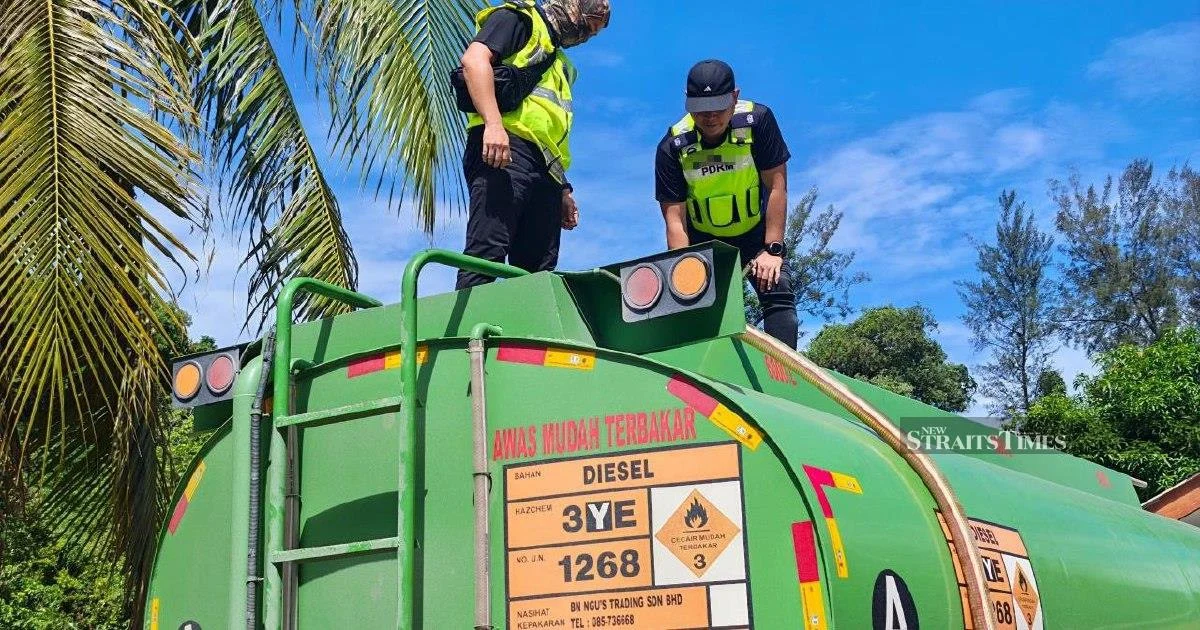
Authorities in Miri have dismantled what investigators describe as a sophisticated operation siphoning subsidised diesel into an undisclosed residential compound, resulting in the recovery of 15,000 litres of fuel and the arrest of four men implicated in the scheme. The raid on a concealed depot in Tanjung Lobang represents another significant breakthrough in the ongoing crackdown against fuel subsidy abuse, a persistent challenge across Malaysian regions where price-controlled petroleum products are systematically diverted for illegal resale.
The discovery of the makeshift storage facility nestled within a private bungalow underscores the adaptability of fuel smuggling operations, which have evolved to avoid detection by authorities. By operating from residential premises rather than traditional industrial sites, syndicate members attempted to lower their visibility and exploit gaps in regulatory oversight. Intelligence gathered during the investigation revealed a coordinated network capable of moving substantial quantities of controlled diesel, suggesting the operation had achieved a degree of operational maturity before being dismantled.
Fuel subsidy diversion constitutes a major drain on national resources, particularly acute in Sabah and Sarawak where the geographic challenges of enforcement create opportunities for illicit activity. Each litre recovered represents a direct loss prevented from the government's fuel equalisation fund, the mechanism through which Malaysia sustains artificially depressed prices at the pump. The 15,000 litres seized in this single operation, valued at approximately RM22,500 at subsidised rates, demonstrates the financial scale that such enterprises achieve through accumulated illicit sales.
The four detained individuals are being processed under provisions addressing fuel subsidy abuse, though specific charges and their alleged roles within the operational hierarchy have not yet been disclosed. Investigators will likely pursue lines of inquiry extending beyond the four arrestees, particularly regarding downstream distribution networks and upstream sourcing mechanisms. The identification of supplier links proves crucial to dismantling the entire chain, as single-operation busts prove ineffective against syndicates unless supplemented by prosecutions targeting procurement and distribution tiers.
This operation in Miri reflects broader enforcement trends in East Malaysia, where state authorities have intensified surveillance of suspicious fuel movements and suspicious commercial activities at fuel distribution points. The Royal Malaysian Police and Petronas have collaborated on intelligence sharing to identify irregularities in fuel accounting and unusual withdrawal patterns. The use of residential properties as concealment points has prompted law enforcement to broaden investigation parameters beyond commercial warehousing and industrial zones.
The timing of the bust arrives amid renewed attention to fuel subsidy leakage, a persistent issue that policymakers have struggled to contain despite years of targeted enforcement operations. Every state in Malaysia experiences some degree of subsidy abuse, though East Malaysian operations tend toward greater sophistication due to reduced enforcement presence and greater geographic barriers. The financial impact accumulates substantially across monthly cycles, with government estimates suggesting that diversion schemes cost the treasury hundreds of millions ringgit annually.
The concealment methodology employed—housing a fuel depot within a residential compound—reflects the adaptability of criminal operations responding to conventional enforcement strategies. Law enforcement agencies have consequently adjusted their investigative approaches to include residential surveillance and neighbourhood intelligence gathering. The Tanjung Lobang operation demonstrates that effective detection increasingly depends on community tips and systematic cross-referencing of suspicious activities rather than solely targeting known distribution points.
Beyond immediate law enforcement implications, this seizure highlights structural vulnerabilities within the fuel subsidy distribution system that enable large-scale diversion. Unlike price decontrol mechanisms employed in other nations, Malaysia's approach of maintaining government-subsidised pumps creates inherent arbitrage opportunities. The price differential between controlled domestic rates and international market prices incentivises systematic diversion, whether through smuggling across borders or local black-market sales.
Investigators pursuing this case face practical challenges in attributing responsibility within the broader supply chain. Establishing precisely how subsidised diesel entered the Tanjung Lobang facility requires tracing movements through multiple intermediaries, a process complicated by deliberately obscured transaction records and the involvement of apparently unrelated commercial entities as conduits. Successful prosecution depends on developing documentary and forensic evidence proving deliberate diversion rather than innocent administrative error.
The recovery of the 15,000 litres represents a prevention of subsidised fuel loss, but the incident simultaneously suggests that such operations require sophistication in procurement, storage, and distribution. The existence of a fully operational residential depot equipped to store and distribute quantities of this magnitude implies that upstream suppliers, downstream buyers, and logistics support were functioning sufficiently to warrant investment in physical infrastructure. Authorities will likely investigate whether this represents a standalone operation or one node within a larger network.
Moving forward, enforcement agencies across Malaysian states will absorb lessons from this operation into their investigative methodologies. The discovery of industrial-scale fuel storage in a residential setting challenges previous assumptions about where such operations concentrate. Enhanced intelligence protocols targeting unusual utility connections, suspicious vehicular movements, and anomalous fuel withdrawal records from distribution points may prevent similar operations from achieving operational maturity before detection.