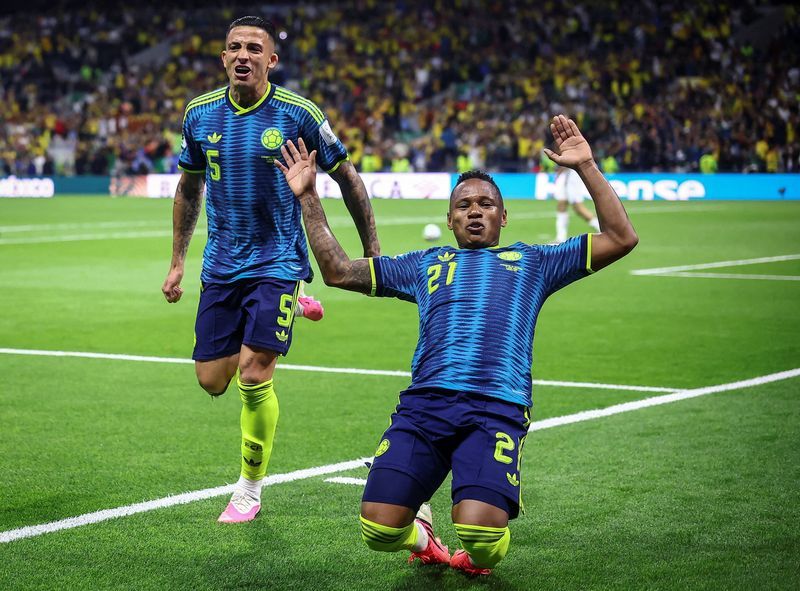
Colombia will attempt to maintain their winning momentum in Group K when they confront DR Congo on Tuesday, though Nestor Lorenzo's squad enters the encounter acutely aware that their opponents have already demonstrated an ability to frustrate established World Cup contenders. The South American nation's opening 3-1 victory over Uzbekistan, while yielding three points, revealed defensive frailties that could prove costly against a DR Congo side riding high from their unexpected 1-1 stalemate with Portugal in the tournament's opening round of matches.
The scale of Colombia's triumph over Uzbekistan masks a second-half performance in which the Central Asians exploited gaps in the defensive shape, exposing tactical vulnerabilities that Lorenzo will have addressed extensively in training. Despite the emphatic scoreline, questions linger about Colombia's capacity to maintain defensive discipline when pressed by a technically proficient opponent, a consideration that takes on heightened significance given DR Congo's proven ability to trouble elite sides. A victory on Tuesday would mathematically secure Colombia's passage to the next stage and could realistically be sufficient to claim the group's top position should Portugal stumble against Uzbekistan in a parallel fixture.
The expectation is that Colombia's attacking play will again pivot around Luis Diaz, the Bayern Munich forward who has shown precisely the kind of cutting edge the team requires in the tournament's knockout phases. Diaz's combination of pace, technical ability, and clinical finishing proved decisive against Uzbekistan, where he contributed a goal and an assist while earning recognition as the standout performer. However, Lorenzo will seek greater creative involvement from captain James Rodriguez, whose influence in the opening match remained surprisingly muted as Colombia often circumvented his customary playmaking role by relying on Diaz's directness to unlock defensive formations.
DR Congo's emergence as genuine contenders arrived as a shock to many observers, but the Africans' performance against Portugal represented a tactical masterclass in controlled defensive football married with intelligent counter-attacking transitions. The nation's quarter-century absence from World Cup competition—their last appearance came in 1974 when they competed as Zaire—makes their current showing all the more remarkable. Yoane Wissa's opening-match goal holds particular significance, marking DR Congo's first World Cup score in fifty years and serving as a tangible symbol of a team operating without fear against opposition expected to dominate possession and territory.
Coach Sebastien Desabre has constructed a compact, disciplined unit that succeeds through minimizing space and capitalizing on moments when opponents relinquish possession in dangerous areas. This direct, transition-based approach presents a fundamentally different examination than the technical, possession-heavy football Uzbekistan attempted against Colombia. The Congolese will almost certainly employ similar defensive compactness against Lorenzo's side, seeking to compress space through the middle whilst remaining alert to opportunities for swift break-neck counter-attacking movements that can catch conventional defenses unbalanced.
Lorenzo articulated his awareness of this tactical challenge in the aftermath of the Uzbekistan match, acknowledging that DR Congo's contrasting style would require significant adjustments to Colombia's approach. The Argentine tactician emphasized that the Africans' propensity to move the ball quickly through longer passes and exploit spaces behind high defensive lines represents a distinct problem, one that demands concentration and positional discipline from his players. Simultaneously, Lorenzo identified an inefficiency in Colombia's attacking play that contributed to the unconvincing nature of their opening performance—an observation that extends beyond mere goal-scoring profligacy to encompass a broader sluggishness in transition and final-third decision-making.
The coach's assessment revealed how Colombia's dominant possession at times became counterproductive, with the team shifting the ball horizontally without generating genuine attacking penetration, allowing opponents to consolidate their defensive shape. This lack of clinical execution in finishing moves, combined with the tendency to revert possession through sideways passes, cost Colombia an opportunity to deliver a more authoritative opening-match performance. Against a DR Congo team that will surrender possession willingly whilst setting traps for turnovers, such inefficiency becomes magnified, requiring Colombia to demonstrate improved movement off the ball and sharper decision-making in the final third.
Columbia will derive considerable encouragement from the atmosphere generated by their substantial traveling support, particularly given that thousands of Colombian supporters transformed Mexico City's Estadio Azteca into a de facto home ground during the opening fixture. The team's tournament base in Guadalajara ensures proximity to match venues, and another large contingent of yellow-shirted fans is anticipated to create an intimidating environment for visiting African opponents. This advantage in crowd support can prove decisive in closely contested matches, particularly when facing teams lacking similar financial resources for traveling supporter delegations.
Yet the outcome will ultimately depend on whether Colombia can synthesize their technical superiority, attacking talent, and home advantage into a coherent team performance that combines defensive rigor with clinical efficiency. DR Congo's capacity to trouble Portugal demonstrates that tournaments frequently produce surprising results when lesser-regarded nations combine tactical discipline with unwavering self-belief. Lorenzo's side must deliver a complete performance that avoids defensive lapses whilst maintaining the pace and creativity that defines their best football, recognizing that underestimating opponents who have already upset expectations represents a cardinal error in knockout-stage football.

