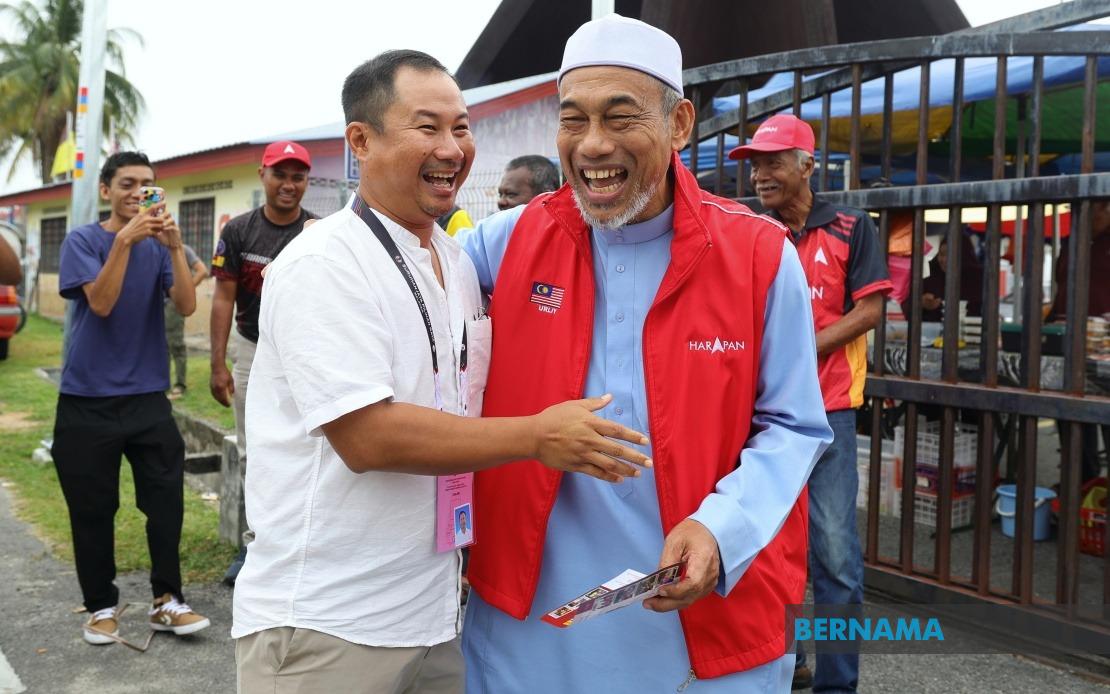
The Negeri Sembilan State Election campaign has taken on a distinctly personal dimension as two family members from rival political camps battle for the Klawang state seat, a contest that has unfolded with surprising civility. During weekend market campaigning in Kuala Klawang, incumbent Datuk Bakri Sawir representing Pakatan Harapan and opposition challenger Danni Rais of Perikatan Nasional found themselves working the same voter crowds simultaneously, creating an unusual dynamic that has drawn considerable public attention across the constituency.
The accidental encounters between the two cousins at the Kuala Klawang market highlighted a refreshing aspect of Malaysian electoral politics: political rivalry does not necessarily preclude personal courtesy or family bonds. As both candidates moved through the market engaging with traders and visitors on their respective campaign rounds, the public seized the moment to document the unusual spectacle, with voters approaching both men for handshakes, conversations, and photographs. Despite representing opposing political coalitions locked in a competitive three-cornered race, the cousins maintained a pleasant demeanor throughout their separate campaign activities, even exchanging light-hearted banter as they encountered one another in the marketplace.
Datuk Bakri Sawir, seeking to retain his seat after his previous electoral victory, has adopted a notably philosophical stance toward his contest with his cousin. In remarks to observers, Bakri emphasized that he views the election not as a personal rivalry but as an opportunity for both candidates to demonstrate their commitment to public service. Rather than framing the situation as an extraordinary family conflict, he has positioned the election as a platform where voters can evaluate the offerings and capabilities of competing candidates on their respective merits.
The incumbent has made campaign discipline and procedural compliance central to his messaging, underscoring the importance of conducting electoral activities within established legal frameworks. When the Jelebu District Council recently issued a directive regarding improperly installed flags on a stadium fence, Bakri's campaign swiftly complied by removing the offending banners without delay or protest. This incident has become emblematic of his broader philosophy that political actors must lead by example in respecting regulatory requirements, as failure to do so undermines their credibility when calling upon citizens to observe the law.
Bakri has extended his call for propriety beyond his own campaign, explicitly urging all political parties and their grassroots machinery to maintain orderly and respectful conduct throughout the election period. He has framed such discipline not merely as a legal obligation but as essential to preserving communal harmony during a season when electoral competition might otherwise generate tension within communities. This messaging reflects broader concerns within Malaysian politics about maintaining social cohesion during intensely competitive electoral cycles.
The Klawang constituency presents a moderately sized electoral battleground with 13,355 registered voters, a scale that makes personal interaction and ground-level campaigning particularly consequential. The three-way contest features Datuk Bakri Sawir defending his Pakatan Harapan seat against Danni Rais's Perikatan Nasional challenge and independent candidate Muhammad Adib Musa representing Bersatu. This triangular configuration means that vote splitting could prove decisive, potentially rewarding whichever candidate most effectively mobilizes their base.
The scheduling of the election has been set by the Election Commission with early voting designated for July 28 and general polling day fixed for August 1. This compressed timeframe concentrates campaigning activity and intensifies the competition for voter attention across the brief window available to all candidates. Within such a truncated campaign period, the ability to build momentum and maintain disciplined, visible presence in the constituency becomes critically important.
The harmonious encounter between the two cousins stands in contrast to some acrimonious election campaigns witnessed elsewhere in Malaysia, where personal animosity and inflammatory rhetoric have occasionally characterized contests between rival candidates. The Klawang situation demonstrates that political competition and familial relationships need not be mutually exclusive, and that shared heritage can sometimes temper the intensity of electoral battle. This dynamic has resonated with voters who appreciate the demonstration of civility and mutual respect, even when candidates fundamentally disagree on policy and governance approaches.
For Malaysian observers monitoring electoral trends, the Klawang race illustrates how state elections in smaller constituencies often operate according to different rules than national campaigns, with personal connections and local reputation frequently outweighing broader partisan narratives. The ability of Bakri and Danni to maintain cordiality while competing vigorously suggests that Malaysian politics retains space for substantive electoral competition without descending into personal acrimony. This balance reflects the maturity of local political culture in Negeri Sembilan, where voters apparently appreciate candidates who can disagree without demonizing their opponents.
The outcome of the August 1 polling will determine whether Datuk Bakri Sawir successfully retains his seat or whether Danni Rais's challenge succeeds in displacing the incumbent. Regardless of the result, the campaign has already established a precedent for respectful electoral conduct that other constituencies and candidates might profitably emulate. The example set by these two cousins suggests that Malaysian democracy can accommodate robust political competition while maintaining the personal civility and institutional discipline that strengthen democratic processes and community trust in electoral systems.

