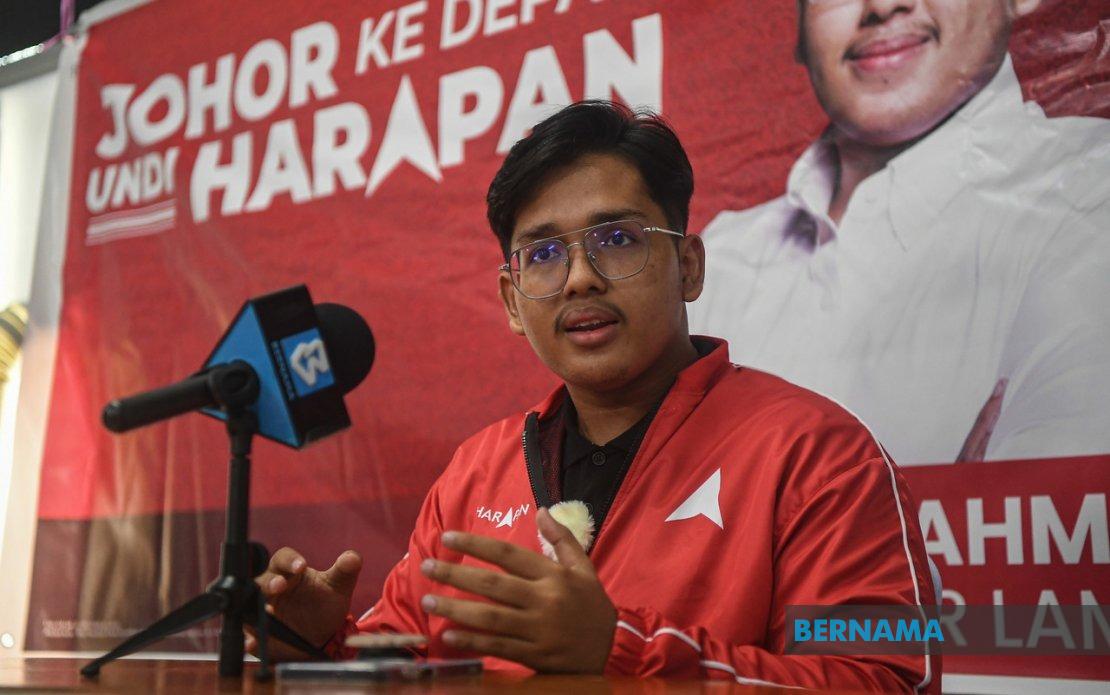
The race for the Johor Lama state seat is intensifying as Pakatan Harapan's Danish Hossman Abd Rahman positions economic revitalisation at the heart of his electoral strategy. Running under the campaign banner "Wajah Baharu, Johor Lama" (A New Face, Johor Lama), the 23-year-old candidate is seeking to address a persistent challenge facing rural constituencies across Malaysia: the chronic outflow of young talent to cities and overseas markets in search of viable livelihoods.
Danish's platform centres on closing the development gap between Johor Lama and more prosperous urban areas such as Johor Bahru and Tebrau. His core argument rests on a straightforward observation: without targeted investment and job creation initiatives, rural communities—particularly those in Felda settlements—will continue losing their working-age populations to migration. Rather than viewing this as an inevitable demographic trend, he frames it as a policy failure that a better-coordinated government approach could reverse. His vision involves attracting high-impact private and public sector investment directly to the constituency, thereby reducing the economic incentive for residents to relocate.
Central to this strategy is a call for stronger alignment between state and federal government initiatives. Danish argues that development projects and policy implementation cannot succeed in isolation; they require seamless coordination across different levels of government. This reflects broader frustrations within rural constituencies about how national development plans frequently bypass smaller towns and agricultural areas in favour of established economic hubs. By emphasising this coordination angle, Danish is implicitly critiquing the current state of governance while offering a technocratic rather than ideological solution.
The Felda dimension of his campaign is particularly significant given its electoral weight. Felda settlements have traditionally been Barisan Nasional strongholds, but shifting economic realities and generational changes have made them increasingly volatile constituencies. Young Felda residents today are more likely to question whether settlement schemes provide genuine long-term prosperity or merely trap them in declining agricultural communities. Danish's proposal to redirect development investment toward these areas attempts to address this anxiety head-on, suggesting that staying in Johor Lama could be economically rational rather than a sacrifice.
Beyond macroeconomic policy, Danish has identified a specific administrative pain point that affects daily life for constituents. The absence of an Immigration Department branch office in Kota Tinggi forces residents seeking passport services or immigration-related assistance to undertake lengthy journeys to Johor Bahru, Kulai, or Mersing. While seemingly a minor bureaucratic issue, such service gaps exemplify how rural areas often receive inferior government support despite being equally deserving. This grievance-based approach—identifying concrete, immediately addressable complaints—provides constituents with tangible proof that a candidate understands their lived experience.
At just 23 years old, Danish is the youngest candidate contesting the 16th Johor state election, a distinction that cuts both ways. Youth can signal fresh thinking and energy, potentially appealing to voters fatigued by establishment politics. However, it also invites questions about experience and whether someone so young can effectively navigate the institutional machinery of state government. Danish appears aware of this dynamic and is attempting to compensate through intensive grassroots engagement and savvy social media deployment.
His campaign methodology reflects contemporary electoral realities in Malaysia. Rather than relying solely on traditional door-to-door canvassing or public forums, Danish is blending face-to-face voter contact with active social media outreach. With more than 32,000 registered voters in Johor Lama, digital platforms allow him to reach significantly more people than traditional methods alone. The reported positive response on social media suggests he has resonated with at least a segment of the electorate, particularly younger voters who increasingly consume political information through online channels rather than mainstream media.
The electoral battlefield itself is crowded. Danish faces incumbent Norlizah Noh of Barisan Nasional and Aisah Esa representing Perikatan Nasional in a three-cornered contest. This fragmentation potentially benefits a new face unburdened by the baggage of previous administrations, though it also means victory requires a plurality rather than majority support. The three-way split suggests that Johor Lama voters are genuinely contested territory, with no faction confident of holding the seat.
For Malaysian observers tracking rural electoral dynamics, the Johor Lama race illuminates broader trends affecting peninsula politics. Rural constituencies are no longer accepting automatic loyalty based on historical voting patterns or administrative appointments. Instead, candidates must articulate specific, credible responses to economic concerns. Danish's emphasis on employment creation, investment attraction, and service improvement reflects an understanding that rural voters today are less interested in ideology than in concrete improvements to their material circumstances and access to government services.
The polling for the 16th Johor state election will take place on July 11, with early voting scheduled for July 7. These dates provide Danish and his rivals limited time to consolidate voter support and convert campaign rhetoric into electoral momentum. For Pakatan Harapan, capturing Johor Lama would represent a symbolic breakthrough in traditionally Barisan Nasional territory. For Danish personally, success would validate his assertion that age and fresh perspectives can compete effectively against entrenched political machinery.

