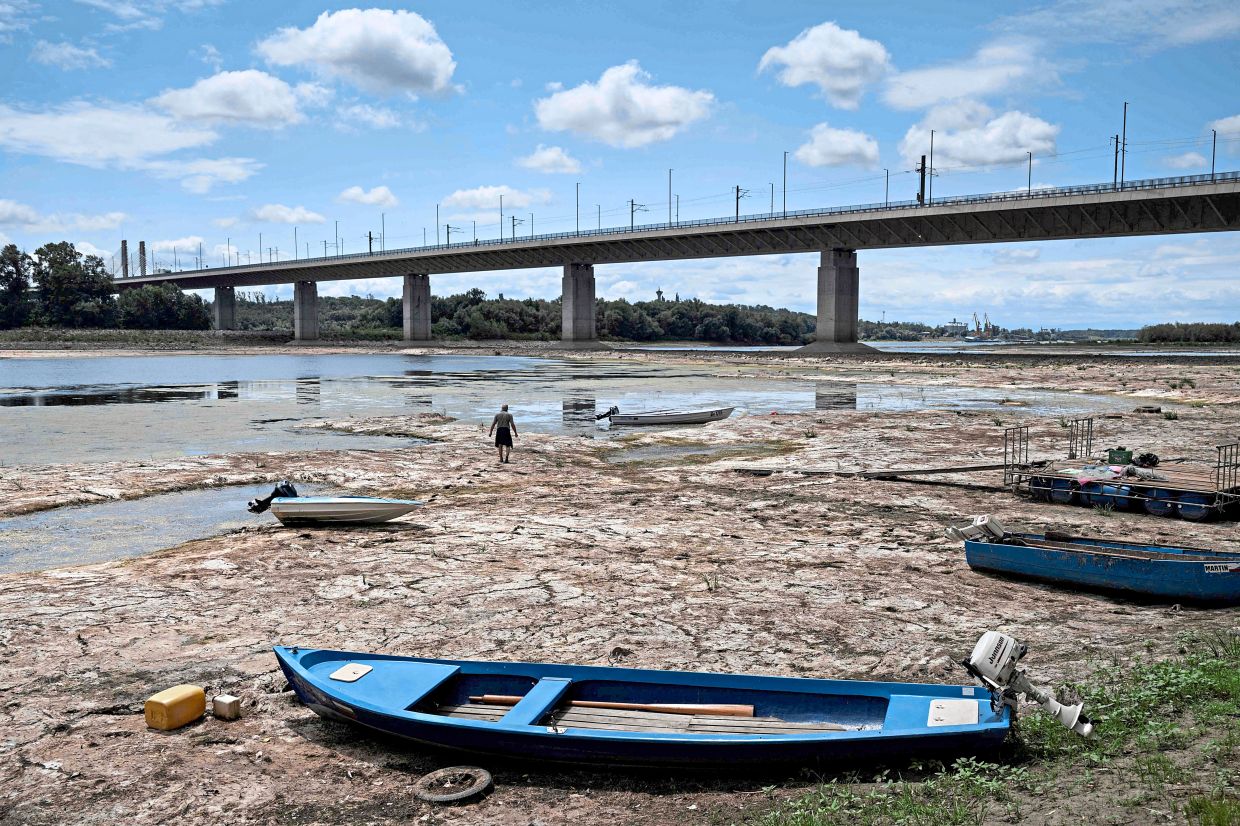
Central Europe is facing an environmental crisis as the Danube River, one of the continent's most vital waterways, has receded to historically unprecedented lows, constraining the movement of commerce, stranding tourists, and forcing difficult decisions about power generation across multiple nations. The drought gripping the region—spanning 10 countries from southwestern Germany to the Black Sea—has exposed the river's hidden geography: submerged rocks, sandbars, and warship wreckage that have remained hidden for decades now lie bare under the summer sun. In Budapest, Hungary's national water authority recorded a water level of just 23 centimetres on July 29, shattering the previous record of 33 centimetres established in 2018, with forecasts suggesting further decline as temperatures climb above 38 degrees Celsius and no meaningful rainfall approaches.
The immediate impact on regional tourism has been severe and visible. Cruise operators who normally transport thousands of passengers through Budapest for guided excursions have been forced to relocate mooring points far upstream, fundamentally disrupting the logistics of holiday operations that depend on easy access to the capital's attractions. Cargo transport, which traditionally relies on the Danube as a cost-effective alternative to road haulage, has been essentially halted, with Hungary's Ministry of Transport and Investment confirming that commercial shipping operations have largely ceased. The constraints have proven dangerous as well; Bulgarian authorities mounted a rescue operation on July 28 to evacuate 186 tourists stranded aboard the Viking Ullur near Vidin after the vessel ran aground on a shallow ridge. The ship's 52 crew members faced an indefinite wait to refloat the vessel, leaving passengers without adequate supplies of food and water after the planned resupply stop at Vidin became unreachable.
The humanitarian dimension extends beyond tourism disruptions. In Serbia, hundreds of small recreational boats and dozens of cargo vessels have been left stranded along the dried riverbanks near Novi Sad, abandoning the summer season entirely. Local operators relying on river commerce and passenger services describe their livelihoods as effectively suspended. Radovan Segrt, who operates river excursions for tourists, noted that the Danube's shoreline has retreated between 15 and 20 metres from its normal position, making navigation impossible for his business. These visible impacts underscore how integrated the river remains to the economic fabric of Central Europe, despite modernisation and alternative transport networks.
Behind the disruption lies a meteorological pattern that extends well beyond a single dry spell. Hungary's Meteorological Service confirms that precipitation across nearly the entire country over the past 90 days has fallen 80 to 130 millimetres below historical averages. Successive heat waves throughout the year have accelerated evaporation from reservoirs and watercourses, compounding the effects of lower-than-normal rainfall. For residents and policymakers accustomed to the Danube's dependable flow, the prolonged nature of this drought raises uncomfortable questions about climate stability and future water availability.
The crisis has moved beyond tourism and transport into the critical domain of energy security. Romania's Cernavoda nuclear power plant, which depends on Danube water for reactor cooling, has shut down one reactor unit due to safety concerns, with a second closure imminent. The Danube's flow has plummeted to approximately 1,630 cubic metres per second—roughly one-third of typical July levels. Hungary faces similar pressures at its Paks nuclear facility, which furnishes nearly half the country's entire electricity supply. On July 29, operators began powering down one reactor due to insufficient cooling water, following two earlier reductions in output across other reactors over the preceding 48 hours. The cascade of power plant restrictions across the region illustrates how climate stress threatens not merely tourism or commerce, but the foundational infrastructure upon which modern economies depend.
The exposed riverbed presents additional hazards alongside economic disruption. Budapest authorities closed the Margaret Bridge after discovering a World War II-era bomb lying on the previously submerged riverbed, now exposed by receding waters. This unexpected archaeological consequence—the unearthing of dangerous wartime ordnance—adds a safety dimension to the drought crisis and raises questions about other hazards potentially lurking on the Danube's floor.
Yet the disaster has created unexpected opportunities for those seeking historical artefacts. Zsolt Horvath, a treasure hunter, has capitalised on the exposed riverbanks by recovering metal objects using powerful magnets. He has retrieved items ranging from old radio amplifiers to bullet casings from the world wars, describing the extreme conditions as paradoxical: a blessing for historical recovery but a curse for everyone else dependent on the river's normal function. His observation encapsulates the complex reality of climate-driven environmental shifts—they create winners and losers, and the broader consequences for energy, transport, and tourism far outweigh isolated archaeological gains.
For Malaysia and Southeast Asian observers, the Danube crisis offers a sobering case study in climate vulnerability. While tropical Southeast Asia faces different hydrological patterns than continental Europe, the fundamental lesson remains identical: major rivers upon which millions depend for transport, power generation, and tourism can be severely disrupted by shifts in precipitation and temperature. The Mekong River system, which underpins economies across Cambodia, Thailand, Vietnam, and Laos, faces comparable long-term pressures from drought, damming, and climate change. Thailand's hydroelectric dams and Vietnam's Mekong Delta agriculture demonstrate how intimately regional development has become entwined with river management.
The Danube situation also highlights how quickly environmental crises can cascade through interconnected systems. The decision to reduce nuclear power output in Hungary and Romania was not made lightly; it reflects the reality that energy security, industrial competitiveness, and climate mitigation are now locked together. Southeast Asian nations, many of which depend on hydroelectric generation or face similar water stress, would benefit from observing how Central European countries are managing this transition—whether through accelerating renewable energy deployment, investing in water storage, or implementing demand-side management.
Photographer Gabor Kertesz's observations from the Margaret Bridge capture the psychological dimension of this crisis. The visible transformation of a familiar landscape—the sudden exposure of rock and sand where water normally flows—serves as visceral proof of climate change's reality. For Central Europeans accustomed to the Danube's constancy across centuries, the shock is profound. Similar moments of recognition are likely to multiply across the globe as climate impacts intensify, making the abstract concept of global warming a tangible, disruptive force visible in everyday life.
As Central Europe enters the remainder of summer with no significant rainfall forecast and temperatures expected to remain elevated, the outlook remains concerning. The recovery timeline depends entirely on meteorological conditions over which policymakers have no control. Meanwhile, the economic costs accumulate daily—foregone tourism revenue, halted cargo operations, constrained power generation, and the costs of managing stranded vessels and evacuated passengers. The Danube's extraordinary low point thus serves as a regional barometer not merely of weather patterns, but of broader climate system changes that are reshaping the relationship between Europe's greatest rivers and the societies that have organised themselves around their flow.

