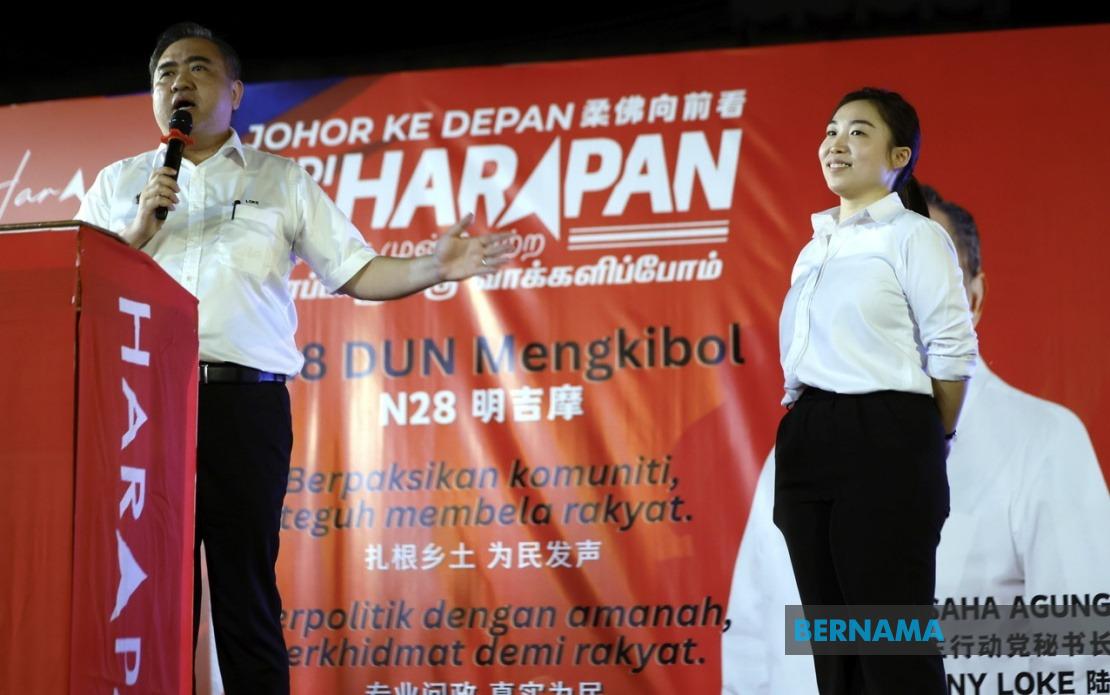
The Democratic Action Party unveiled its first candidate for the forthcoming Johor state election on June 18, announcing 33-year-old lawyer Chu Poh Yee as its choice to contest the Mengkibol assembly seat. The decision marks a significant generational and gender shift for the party in one of its key strongholds, as Chu replaces incumbent assemblyman Chew Chong Sin, who has represented the constituency across two consecutive terms.
Party secretary-general Anthony Loke framed the nomination as part of a deliberate succession strategy that rewards Chew's tenure with elevation to parliamentary-level politics. Loke explained that Chew is being groomed as a candidate for the Labis parliamentary seat in the next General Election, following an announcement by the current Labis Member of Parliament Pang Hok Liong that he does not intend to contest another term. This arrangement allows the DAP to retain institutional continuity while creating opportunities for fresh faces at the state assembly level, a balancing act that regional political parties frequently attempt during electoral transitions.
The party leadership's endorsement of Chu was described as unanimous, signalling broad internal consensus around her candidacy. Loke highlighted her professional credentials and community engagement, particularly her track record of providing legal assistance to constituents through aid-related cases handled alongside local representatives. This background suggests the party views her as someone with practical understanding of grassroots concerns rather than a purely partisan pick, which could prove strategically valuable in a diverse constituency like Mengkibol.
Beyond her legal background, Loke emphasized Chu's linguistic abilities and educational qualifications as assets that would resonate with voters in an increasingly cosmopolitan Johor electorate. Her fluency in multiple languages reflects the demographic composition of many Johor constituencies, where Malay, Mandarin, Tamil, and English speakers coexist. The articulation of these specific credentials suggests DAP's campaign messaging will position her as a capable administrator rather than relying solely on gender representation as a campaign tool.
The nomination also underscores DAP's stated commitment to increasing female political representation within its ranks. By highlighting this aspect of Chu's selection, Loke signalled that the party sees gender diversity not merely as a social policy matter but as integral to its electoral competitiveness and party-building strategy. This positioning aligns with broader trends across Southeast Asian democracies, where women candidates are increasingly mobilized as part of modernization narratives that appeal to younger and urban-centred voter bases.
Chu's reported proximity to the Mengkibol constituency addresses one traditional weakness of new candidates: perceived outsider status. The party's claim that she maintains close ties to the area suggests either family connections or substantial previous involvement in local affairs, factors that could mitigate voter concerns about whether she understands local issues and relationships. In Malaysian electoral politics, such embedded community presence often proves decisive, particularly in state assembly contests where personal relationships carry considerable weight.
The Mengkibol seat represents one of DAP's established strongholds in Johor, making it a relatively secure nomination within the party's electoral calculus. By selecting a new candidate rather than attempting to field a celebrity or external heavyweight, the party demonstrates confidence in the seat's electoral fundamentals while using the succession as an opportunity for internal renewal. This approach minimizes disruption to existing party machinery and grassroots networks that have delivered electoral success in previous cycles.
Loke confirmed that DAP's candidate selection process for the Johor state election has reached finalization across all 17 constituencies the party intends to contest. The portfolio comprises ten seats currently held by DAP—including Mengkibol—four constituencies previously lost by the party that it seeks to reclaim, and three additional new targets. This geographic distribution reflects DAP's ambitions to both consolidate existing strongholds and expand into adjacent areas, a common strategy as opposition parties attempt to broaden their electoral footprint.
The rollout of candidate announcements follows a deliberate tempo designed to maintain media momentum and public engagement throughout the campaign period. Loke indicated that four additional candidates for the Tiram, Johor Jaya, Senai, and Bukit Permai seats would be announced the following Saturday, with the remaining candidates to be revealed in conjunction with other Pakatan Harapan coalition partners the following Monday under the Prime Minister's stewardship. This coordinated approach reflects the broader opposition coalition's desire to present unified messaging while allowing individual parties to showcase their respective contributions.
The significance of DAP's candidate selection extends beyond Johor state politics to broader questions about opposition coalition management and campaign positioning in Malaysia. As the largest Chinese-majority party in the Pakatan Harapan alliance, DAP's candidate choices carry implications for how the coalition balances demographic representation, generational renewal, and geographic competitiveness. The emphasis on a young female professional candidate for a traditional DAP stronghold suggests the party is attempting to project an image of forward-looking inclusivity while maintaining electoral efficiency.
For Malaysian voters following opposition party dynamics, the Mengkibol nomination exemplifies how established political parties navigate succession planning and demographic change. Rather than treating the seat as personal property to be retained by an individual assemblyman, DAP's decision to rotate representation while promoting the outgoing incumbent to higher office demonstrates a degree of institutionalization that could appeal to voters fatigued by personality-driven politics. Whether Chu Poh Yee can replicate or exceed her predecessor's electoral performance will become a key metric for assessing DAP's effectiveness in managing generational transitions in an increasingly competitive Johor political landscape.

