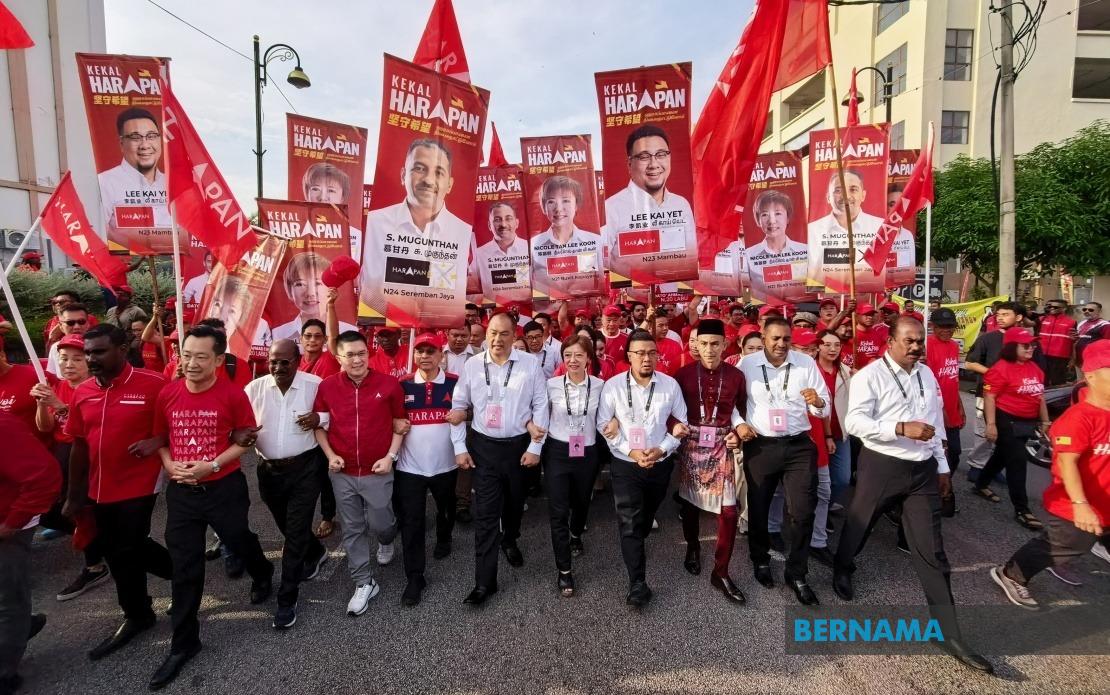
The Negeri Sembilan state election is shaping up to deliver several closely-contested races, with nominations now formally closed following proceedings at the Seremban City Council Hall. Negeri Sembilan DAP treasurer Siaw Meow Keong will defend his Rahang seat, which he has held since 2023, in a four-cornered clash that underscores the fragmented political landscape in the southern Selangor state. Fielded by Pakatan Harapan to retain the constituency, Siaw will encounter competition from three rivals representing different political blocs across Malaysia's fractious opposition and government coalition structures.
The candidate lineup reveals the diversity of political representation in Rahang. Yap Siok Moy, who chairs the Rasah MCA Wanita division, will carry Barisan Nasional's colours into the contest, presenting the traditional coalition's challenge to the incumbent. S. Thinagaran of Parti Sosialis Malaysia and Tang Jay San representing Bersatu round out the field, creating a competitive environment that mirrors broader realignments within Malaysian politics. The nomination filing order, recorded by returning officer Mohamad Najib Mustafa as candidates submitted their papers between 9.06 am and 9.13 am, reflects the orderly administration of the electoral process despite the multiple contenders seeking to advance their respective political movements' interests in this crucial constituency.
Elsewhere in Negeri Sembilan, the electoral contests present varying degrees of competition intensity. The Bukit Kepayang seat will witness a more straightforward two-candidate affair, with defending DAP Wanita chief Nicole Tan Lee Koon confronting Perikatan Nasional's Lee Boon Shian. This direct confrontation contrasts sharply with the fragmented contests characterising other constituencies, suggesting that some races will hinge on clear ideological or coalition-based choices rather than dispersed voter preferences across multiple candidates. The contrast between the four-way and two-way contests demonstrates how voter fragmentation varies geographically within the state, with implications for campaign strategies and expected turnout patterns.
Three additional constituencies will feature three-cornered contests that promise competitive dynamics. In Labu, Datuk Ahmad Faez Abdul Razak will represent Pakatan Harapan against Bersatu's Mohamad Hanifah Abu Baker and BN's Siti Nur Umaira Hasim, creating a scenario where no single coalition dominates the field. Mambau presents another three-way competition with PH's Lee Kai Yet opposing Bersatu's N. Sarawanan and Perikatan Nasional's Eric Michael, fragmenting votes across government and opposition representatives. The Seremban Jaya constituency will see S. Mugunthan carrying PH's banner against BN's Datuk T. R. Thinalan and Bersatu's R. Mahendran, continuing the pattern of three-candidate races that characterise much of the electoral contest.
These multiple three-cornered contests reflect the complex political realignment affecting Negeri Sembilan and broader Malaysia. The presence of Bersatu candidates across multiple constituencies signals the party's determination to establish itself as a meaningful force in state-level politics, challenging the traditional two-coalition framework that dominated previous electoral cycles. Perikatan Nasional's involvement in several races indicates continuing attempts by this newer coalition to carve out electoral space independent of both Barisan Nasional and Pakatan Harapan, fragmenting what was once a more bipolar electoral environment.
The electoral timeline established by the Election Commission provides crucial markers for the campaign period. Early voting has been scheduled for July 28, allowing voters with particular circumstances to cast ballots ahead of the main polling day, which the commission has designated as August 1. This two-stage voting arrangement, increasingly standard in Malaysian elections, accommodates voters unable to participate on the primary election day while maintaining the administrative requirements of a comprehensive electoral exercise. The interval between nomination closure and early voting provides candidates approximately one week to intensify their ground operations and public engagement.
For Pakatan Harapan, these contests represent an important opportunity to consolidate or expand its position in Negeri Sembilan, a state where it has made significant inroads in recent electoral cycles. The party's decision to field Siaw in Rahang and Tan in Bukit Kepayang indicates confidence in these candidates' ability to retain their seats against a divided opposition. However, the proliferation of three-cornered and four-cornered contests introduces greater uncertainty into predictions of electoral outcomes, as vote splitting among non-PH candidates could either benefit or disadvantage the incumbent coalition depending on local campaign dynamics and voter sentiment.
Barisan Nasional's positioning in these contests reflects its ongoing effort to remain electorally competitive in a state where its traditional dominance has eroded. The fielding of Yap in Rahang and representation across other constituencies demonstrates BN's intent to contest seriously, yet the presence of multiple rival candidates in several races complicates BN's path to victory. The coalition will need to achieve higher vote concentrations in contested areas to overcome the vote-splitting dynamics that favour incumbent or consolidated opposition forces.
Bersatu's participation across multiple constituencies represents a significant variable in these contests. As the party continues its complicated political trajectory following its departure from earlier coalitions, its candidacies in Labu, Mambau, Seremban Jaya and Rahang signal attempts to establish an independent electoral identity. The impact of Bersatu's candidacies depends heavily on whether it attracts voters dissatisfied with both traditional coalitions or simply fragments the opposition vote in ways that advantage incumbent Pakatan Harapan candidates.
Peikatan Nasional's involvement in Bukit Kepayang and multiple three-cornered races reflects this newer coalition's ambitions to translate its federal government role into state-level electoral success. Lee Boon Shian's straight fight with Tan in Bukit Kepayang offers PN its clearest opportunity for a straightforward victory narrative, whereas the three-way contests provide less predictable pathways to electoral success dependent on complex vote distributions.
PSM's nomination of Thinagaran in Rahang represents the smaller socialist party's continued efforts to maintain electoral presence in Malaysian contests, though the party's realistic prospects of victory in a four-way race appear modest. Nevertheless, such nominations serve important functions in advancing the party's political profile and testing its organisational capabilities in competitive electoral environments.
The Negeri Sembilan state election will provide valuable insights into evolving voter preferences across Malaysian states and the continuing impact of coalition fragmentation on electoral outcomes. The mixture of competitive contests at varying intensity levels, combined with the August 1 polling date, will determine whether Pakatan Harapan can consolidate recent gains, whether Barisan Nasional can restore competitive strength, and how effectively newer political forces like Bersatu and Perikatan Nasional translate their activities into electoral victories.

