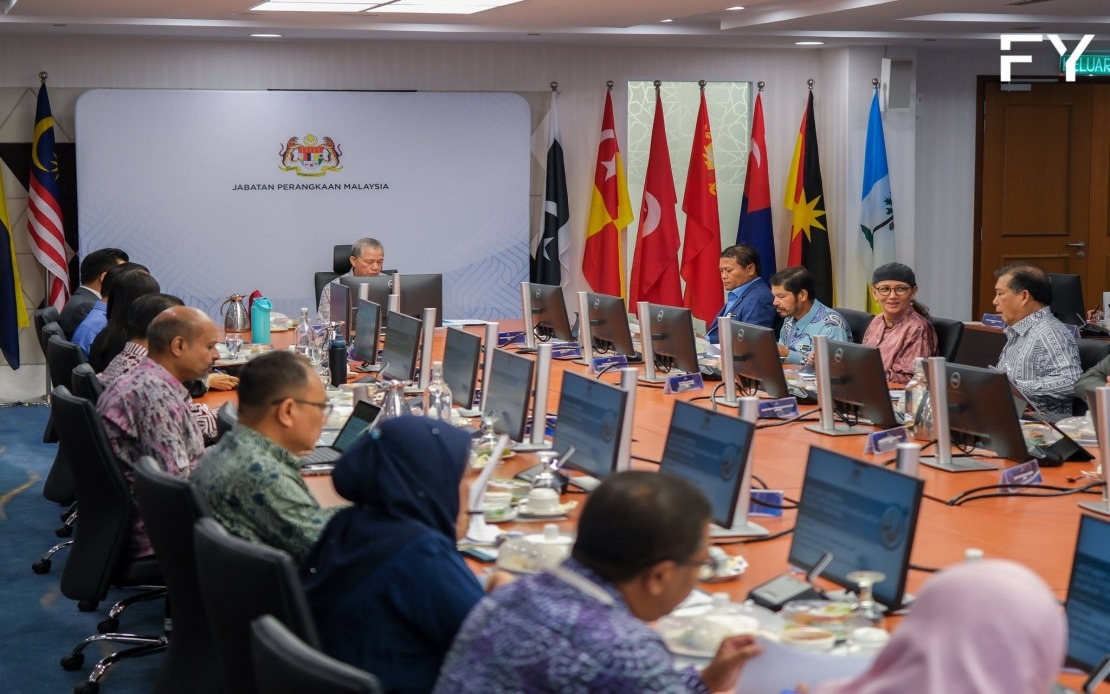
Malaysia's federal government plans to deepen its reliance on data-driven decision-making and artificial intelligence capabilities as it executes the 13th Malaysia Plan spanning 2026 to 2030, according to Deputy Prime Minister Datuk Seri Fadillah Yusof. Speaking after chairing a high-level National Statistics and Data Council meeting in Kuala Lumpur on June 18, Fadillah outlined why robust statistical infrastructure has become indispensable to the nation's policy framework, particularly as leaders grapple with interconnected challenges ranging from economic volatility to climate disruption.
The deputy prime minister framed data and official statistics not as mere informational conveniences but as strategic national resources capable of transforming how government operates. In an era marked by technological acceleration, geopolitical volatility and environmental pressure, the capacity to extract actionable insights from comprehensive datasets has become a competitive advantage. Fadillah's remarks underscore a broader recognition within the Malaysian administration that traditional approaches to planning and implementation must evolve to match the complexity of modern governance challenges, from managing energy transitions to optimising public service delivery across diverse sectors.
Concrete economic indicators appear to validate this approach. Malaysia's economy expanded at an annualised rate of 5.4 per cent during the opening quarter of 2026, a figure Fadillah cited as evidence that evidence-based policy architecture yields tangible results. The growth trajectory suggests that development initiatives informed by rigorous data analysis and statistical rigour are delivering measurable improvements in economic activity, providing political momentum for continued investment in statistical capabilities and analytical infrastructure.
The Strengthening of the National Statistical System, a multi-year initiative involving coordinated effort across government, must now accelerate, Fadillah indicated. This requires moving beyond departmental silos to establish seamless collaboration involving federal ministries, state administrations, private enterprises, universities and research institutions. The architecture envisioned suggests a transformation in how Malaysia collects, manages and leverages information—shifting from fragmented systems toward an integrated ecosystem where data flows securely across institutional boundaries to enable comprehensive analysis and rapid policy adjustment.
Digitalisation and secure data integration represent the technical frontier of this transformation. Fadillah stressed that government's capacity to combine information from disparate sources while maintaining security and ethical standards has become crucial to comprehending emerging challenges and accelerating governmental response times. This points toward investments in modern data infrastructure, cybersecurity protocols and governance frameworks that balance analytical utility with privacy protection—a particularly sensitive consideration in Southeast Asia where public trust in data handling remains uneven across different communities and sectors.
Fadillah, who additionally holds the Energy Transition and Water Transformation portfolio, identified several strategic domains requiring enhanced data architecture and analytical support. Energy transition pathways, climate change adaptation, water resource management and sustainable development initiatives all depend on comprehensive, real-time datasets to guide investment allocation and performance monitoring. Without such infrastructure, even well-intentioned policies risk generating suboptimal outcomes or unintended consequences, potentially squandering public resources and undermining developmental objectives.
The council reviewed multiple concurrent initiatives aimed at building institutional capacity. These include standardising official statistical methodologies across government, fortifying data governance frameworks, consolidating administrative data sources, constructing talent databases in science and technology sectors, applying data analytics to youth development programmes, and systematising management of national road infrastructure information. Collectively, these programmes represent an attempt to create redundancy and interconnection across disparate data ecosystems, enabling government agencies to access relevant information more readily and collaborate more effectively on cross-cutting challenges.
Big data analytics and artificial intelligence applications emerged as priority technologies deserving expanded deployment. These tools can uncover patterns in large datasets that human analysts might overlook, forecast emerging problems before they become acute, and simulate outcomes of alternative policy approaches with greater precision than conventional methods permit. For a middle-income economy like Malaysia seeking to enhance productivity and innovation competitiveness, such capabilities represent potential multipliers on existing human expertise and institutional knowledge.
The National Statistics and Data Council membership reflects the breadth of government commitment required. In addition to Fadillah, the session included Datuk Seri Alexander Nanta Linggi from Works, Datuk Hanifah Hajar Taib from Health, Teo Nie Ching from Communications, Datuk Wilson Ugak Kumbong from Digital, Datuk Mohd Shahar Abdullah from Economy, and chief statistician Datuk Seri Dr Mohd Uzir Mahidin. This constellation of cabinet-level participation signals that data governance and statistical enhancement rank among senior government priorities rather than remaining technical matters confined to statistical agencies.
For Malaysian policymakers and observers, Fadillah's emphasis on data-driven governance reflects a maturing understanding that complexity in public administration requires proportional sophistication in analytical methods. The 13th Malaysia Plan's success will partly hinge on whether institutions can genuinely operationalise data integration principles and translate analytical insights into responsive policy adjustments. The coming years will reveal whether Malaysia can construct the cultural, technical and institutional conditions necessary for evidence-based governance to flourish across a sprawling federal system encompassing diverse stakeholder interests and regional circumstances.

