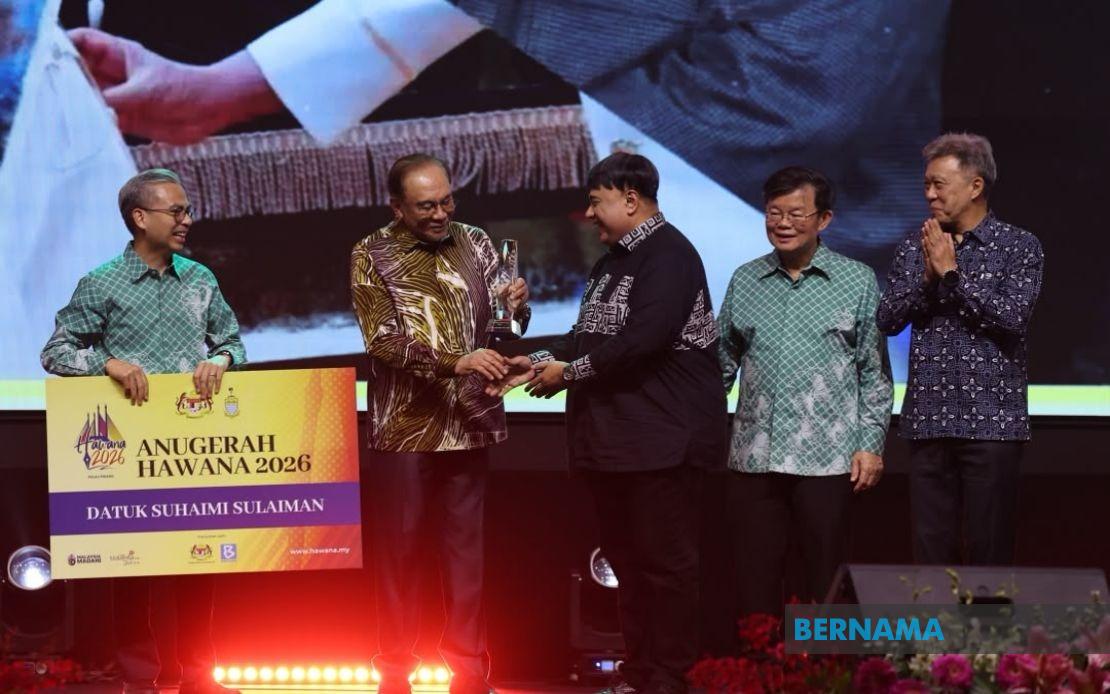
Datuk Suhaimi Sulaiman has been recognised for his transformative career spanning more than thirty years in Malaysia's broadcasting and journalism sectors, receiving the National Journalists' Day (HAWANA) 2026 Award at a ceremony in Butterworth yesterday. The honour, presented by Prime Minister Datuk Seri Anwar Ibrahim, acknowledges the lasting impact Suhaimi has made on the nation's media landscape during his tenure as Broadcasting Malaysia's director-general and beyond. The accolade underscores the continued importance Malaysia places on celebrating figures who have shaped public discourse and journalistic standards in the country.
The award presentation took place at the HAWANA 2026 Grand Finale held at PICCA @ Arena Butterworth Convention Centre, drawing attendance from senior government figures and media leaders. Present alongside Prime Minister Anwar Ibrahim were Penang Chief Minister Chow Kon Yeow, Communications Minister Datuk Fahmi Fadzil, and Bernama chairman Datuk Seri Wong Chun Wai, reflecting the significance of the occasion and the recognition being bestowed. The gathering brought together representatives from Malaysia's public broadcasting apparatus, the national news agency, and state leadership, highlighting how media excellence remains a matter of national importance.
Accepting the award, Suhaimi expressed genuine humility about the recognition, framing it as both a validation of past work and a motivation for future contributions to the field. He acknowledged that receiving such honours carries responsibility, particularly as the media industry faces unprecedented transformation. His remarks revealed a reflective approach to a career that has witnessed the evolution from traditional broadcasting to digital-age journalism, demonstrating awareness of the challenges contemporary practitioners face.
The timing of this award is particularly significant given the rapid technological disruption reshaping global media. Suhaimi emphasised that artificial intelligence now stands as a defining force in how news organisations operate, content is produced, and information reaches audiences. Rather than viewing AI as an external threat to journalism, he positioned it as a catalyst requiring media professionals to expand their skill sets continuously. This perspective aligns with industry conversations in Southeast Asia, where smaller markets like Malaysia grapple with balancing technological adoption against concerns about maintaining editorial integrity and local voice.
Suhaimi's career trajectory represents the institutional approach to Malaysian journalism that developed in the post-independence era, where government-linked media played a central role in nation-building and public information. His rise through Broadcasting Malaysia reflects a generation of communicators who worked within established structures to advance professionalism in the sector. However, his openness to acknowledging the transformative power of AI suggests recognition that future media leaders must operate differently, adopting technologies while safeguarding the values that define responsible journalism.
The HAWANA 2026 Award itself carries deep significance in Malaysian media circles. Established to celebrate the contributions of journalists and broadcasters, the award represents the profession's attempt to document and honour those who advance standards in reporting, ethics, and public service. For someone like Suhaimi, whose career predates the digital revolution, receiving this recognition in 2026 symbolises a bridge between traditional journalism values and the demands of contemporary media practice. The award thus functions as acknowledgment that experience and institutional knowledge remain valuable even as the technological foundations of the industry transform fundamentally.
Suhaimi's comments about continuous learning resonate across Southeast Asia's media landscape, where practitioners increasingly recognise that standing still is no longer viable. In Malaysia specifically, where traditional media remains influential but faces sustained competition from digital platforms and social media, the message that journalists must adapt becomes urgent. His emphasis on acquiring new knowledge reflects practical awareness that media organisations investing in AI literacy, data analysis, and digital storytelling are better positioned to navigate an increasingly crowded information environment.
The recognition comes at a moment when Malaysia's media sector is experiencing significant structural change. The rise of digital-native news outlets, the dominance of social media algorithms, and changing audience consumption patterns have created pressure on traditional broadcasters. Suhaimi's long career provided stability within these institutions during earlier periods of change, and his continued voice—even in retirement—carries weight in discussions about the industry's future direction. His willingness to embrace technological adaptation while maintaining journalistic principles provides a model for others navigating similar transitions.
Beyond individual achievement, the HAWANA 2026 award ceremony itself reflects Malaysia's ongoing commitment to recognising media contributions at the national level. The presence of the Prime Minister and Communications Minister at the Butterworth event underscores how government views journalism's role in society. In the Malaysian context, where state and media institutions maintain closer relationships than in some other democracies, such ceremonies provide opportunity to reaffirm expectations around professional standards and public service responsibilities that should guide journalists and broadcasters.
Looking forward, Suhaimi's receipt of this honour may encourage others in Malaysia's broadcast and journalism sectors to pursue excellence despite industry disruptions. His long career demonstrates that sustained commitment to improving media practices yields recognition and influence over time. At a juncture where younger journalists are entering a profession transformed by technology and economics, the validation of someone from an earlier generation who recognises the need to evolve sends an important signal about the profession's capacity to honour both traditional values and contemporary innovation.

