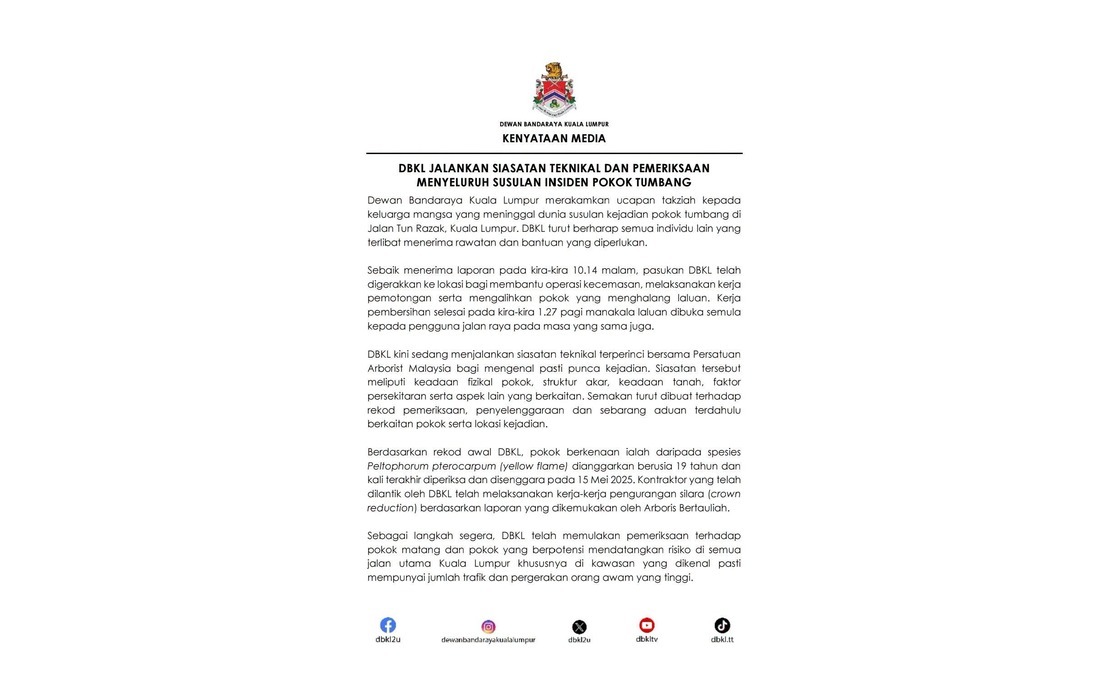
A collaborative investigation has been launched by Kuala Lumpur City Hall (DBKL) and the Malaysian Society of Arborist following a fatal incident on Jalan Tun Razak in which a fallen tree claimed the life of a man on the night of July 18. The detailed technical inquiry aims to establish what led to the collapse, examining multiple aspects of the tree and its surrounding environment to prevent similar tragedies.
The investigative scope is notably comprehensive, extending beyond a simple structural assessment. DBKL's teams are conducting a thorough evaluation of the tree's physical state, its root system architecture, the composition and stability of surrounding soil, and prevailing environmental conditions. Additionally, the inquiry includes a review of historical inspection records, maintenance schedules, and any previous complaints filed regarding the specific tree and the broader area, creating a multi-layered understanding of contributing factors.
The Yellow Flame tree (Peltophorum pterocarpum) involved in the incident was approximately 19 years old at the time of collapse. Municipal records indicate the tree had undergone inspection and maintenance as recently as May 15, and the contracted maintenance service had previously implemented crown reduction work following recommendations from a certified arborist. These details suggest that despite recent attention, unforeseen structural vulnerabilities may have developed or environmental stress factors may have accumulated beyond what routine maintenance typically addresses.
The emergency response to the incident was swift and coordinated. Upon receiving notification at 10.14 pm, DBKL dispatched an emergency team to the location to conduct tree-cutting operations and clear obstructed areas. The critical roadway was successfully reopened by 1.27 am, minimizing extended disruption to traffic flow in this major arterial route through the capital. DBKL has expressed its condolences to the victim's family and indicated commitment to providing necessary support to affected parties.
The incident has prompted DBKL to adopt a preventive stance toward mature trees and those displaying risk indicators throughout Kuala Lumpur's road network. Systematic inspections have commenced on major thoroughfares, particularly those experiencing substantial vehicular and pedestrian traffic. The initial phase encompasses Jalan Ampang, Jalan Sultan Ismail, Jalan Raja Laut, Jalan Datuk Keramat, and sections of Jalan Tun Razak itself. Eight inspection teams, including five certified arborists, are expected to complete this urgent assessment within a ten-week timeframe, representing a significant mobilization of specialized expertise.
Beyond immediate reactive measures, DBKL is pursuing a longer-term technological solution to enhance tree safety management across the city. The authority is awaiting approval from SIRIM, Malaysia's national standards body, to deploy approximately 400 advanced tree sensors at strategically identified high-risk locations. These sensors represent a shift toward predictive rather than merely reactive maintenance protocols, gathering real-time data on tree health indicators that might signal deteriorating stability.
The proposed sensor network would monitor multiple parameters critical to tree safety, including soil moisture content, structural movement within the trunk and branches, and broader soil stability. Importantly, the system would track the impact of extreme weather phenomena such as prolonged heavy rainfall and flooding, conditions increasingly relevant in Malaysia's tropical climate where monsoon seasons bring intensive precipitation. Early warning signals from these sensors would theoretically allow municipal authorities to intervene before dangerous conditions develop into catastrophic failure.
The initial rollout of this sensor technology focuses on four critical locations identified as particularly vulnerable: Jalan Bangsar, Dataran Merdeka, Jalan Ampang, and Jalan Raja Chulan. These locations likely represent high-traffic areas with mature tree populations where public safety concerns are magnified due to the density of people and vehicles below canopies. The phased installation approach suggests DBKL's intention to evaluate system effectiveness before full-scale metropolitan deployment.
For Malaysian cities grappling with rapid urbanization and aging tree infrastructure, the incident highlights an often-overlooked public safety dimension. Urban forestry management requires balancing ecological benefits against infrastructure maintenance demands. The Jalan Tun Razak collapse underscores how routine maintenance, while necessary, may prove insufficient for detecting all structural vulnerabilities, particularly in aging specimens subjected to years of environmental stress. The combination of immediate systematic inspection and longer-term sensor deployment represents a more sophisticated urban tree management approach than many Southeast Asian municipalities currently employ.
The investigation's outcomes will likely inform broader municipal policy across Malaysia's urban centers. As other city administrations assess their own tree management protocols, findings regarding the Peltophorum pterocarpum failure may prompt similar preventive audits and investments in monitoring technology. The tragedy, while unfortunate, offers an opportunity to establish higher standards for managing the significant tree canopy that characterizes Kuala Lumpur's street network and contributes substantially to the city's livability and environmental function.

