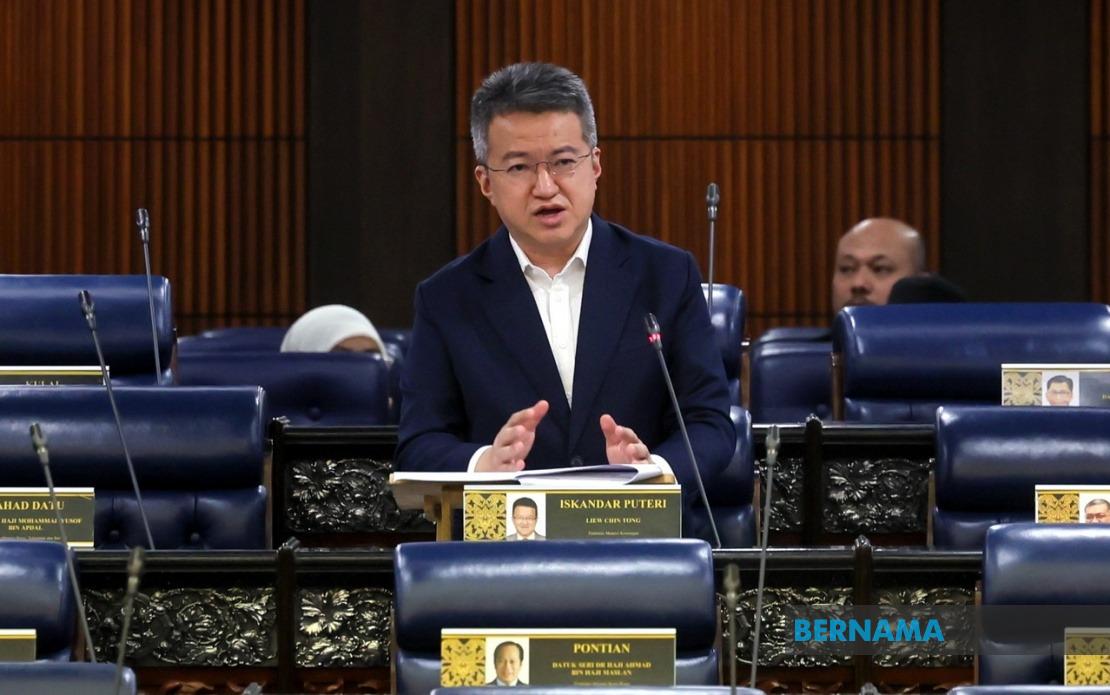
Deputy Finance Minister Liew Chin Tong has flatly rejected allegations that fugitive tycoon Low Taek Jho, known widely as Jho Low, slipped into Malaysia alongside a Chinese delegation last year for confidential talks aimed at resolving the sprawling 1Malaysia Development Berhad scandal. The denial came during parliamentary Question Time on July 9, when Liew responded tersely to a supplementary inquiry from Syed Saddiq Syed Abdul Rahman, the MUDA representative for Muar, who had cited media accounts suggesting such a clandestine meeting had taken place in late 2024.
The question itself drew from earlier parliamentary exchanges about 1MDB's outstanding debts and the government's push to retrieve misappropriated funds. Chong Chieng Jen, a PH lawmaker from Stampin, had posed the original question, prompting Liew to outline the current stance on asset recovery operations spanning both criminal and civil channels. Syed Saddiq subsequently amplified the inquiry by introducing the specific allegation about Jho Low's supposed entry into Malaysian territory for settlement negotiations involving the Ministry of Finance, a claim that Liew immediately and unambiguously dismissed.
The reported secret meeting represents a potentially significant development in the 1MDB narrative, one that had garnered media attention precisely because it suggested behind-the-scenes diplomatic maneuvering between Malaysian authorities and representatives of the fugitive businessman linked to Asia's largest corporate scandal. Jho Low has long evaded capture and remains a central figure in investigations spanning multiple jurisdictions, making any suggestion of his return to Malaysia exceptionally sensitive both domestically and internationally. The allegation that he might orchestrate negotiations through intermediaries underscores the complexity of pursuing figures who have managed to evade formal prosecution while remaining implicated in vast financial wrongdoing.
In detailing the government's ongoing recovery efforts, Liew emphasized the breadth of legal mechanisms deployed against those implicated in 1MDB misappropriation. He highlighted that the High Court, on December 26, 2025, had sentenced former Prime Minister Datuk Seri Najib Tun Razak to a 15-year custodial sentence and imposed a financial penalty of RM11.38 billion after convicting him on 25 separate counts encompassing money laundering and the abuse of authority to solicit bribes connected to 1MDB. This landmark judgment represented a watershed moment in Malaysia's efforts to hold senior political figures accountable for the scandal.
Parallel civil proceedings have likewise targeted other key players in the affair. The government's lawsuit against Datin Seri Rosmah Mansor seeks to recover approximately US$380 million—equivalent to roughly RM1.56 billion—in damages stemming from allegations that 1MDB funds were diverted to finance acquisitions of luxury articles including designer handbags and jewellery. This dimension of the recovery strategy reflects the vast scale of personal enrichment that occurred through the misappropriation of development fund assets.
The most substantial outstanding claim involves Jho Low himself, characterized by official sources as the alleged prime orchestrator of 1MDB's misappropriation. Criminal and civil actions against him encompass a civil claim valued at US$3.78 billion, approximately RM15.4 billion, representing perhaps the largest single asset recovery target in the entire scandal. The existence of such an enormous claim underscores both the magnitude of his alleged involvement and the government's determination to pursue recovery regardless of his fugitive status or geographic location.
Liew's parliamentary testimony situated these individual proceedings within a broader analytical framework encompassing the scandal's overall impact on Malaysia. He identified four primary categories of loss inflicted upon the nation: direct financial damages encompassing the misappropriated funds themselves; opportunity costs reflecting what the diverted resources might have generated had they been deployed as originally intended for development purposes; irrecoverable losses consisting of assets either consumed, concealed, or transferred beyond realistic recovery reach; and intangible but consequential damage to Malaysia's international standing and reputation within global financial and investment circles.
The denial of Jho Low's purported secret visit reflects the Malaysian government's apparent position that no backroom negotiations are underway with the fugitive businessman or his representatives, at least not at the level of ministerial awareness or explicit acknowledgment. Whether such meetings might have occurred at lower bureaucratic levels or through informal channels remains unclear, but Liew's unequivocal rejection serves to reinforce the official narrative that the government maintains an uncompromising stance toward recovering assets and pursuing accountability. The parliamentary exchange itself highlights the continued public and political scrutiny surrounding 1MDB, with opposition lawmakers evidently alert to any suggestion that settlement terms might be negotiated outside the formal judicial system.
For Malaysian readers and regional observers, these ongoing developments demonstrate that the 1MDB saga continues to shape national governance discussions years after its initial exposure. The scale of recovery efforts, combined with the persistent elusiveness of figures like Jho Low, illustrates both the ambition and the inherent limitations of Malaysia's accountability mechanisms when confronting international financial crime. The government's multi-pronged approach—combining criminal prosecutions of domestic figures with civil claims against international actors—represents one model for addressing systemic financial malfeasance, though the ultimate success of such strategies often depends on cooperation from jurisdictions where assets may be held or where fugitives may have taken refuge.

