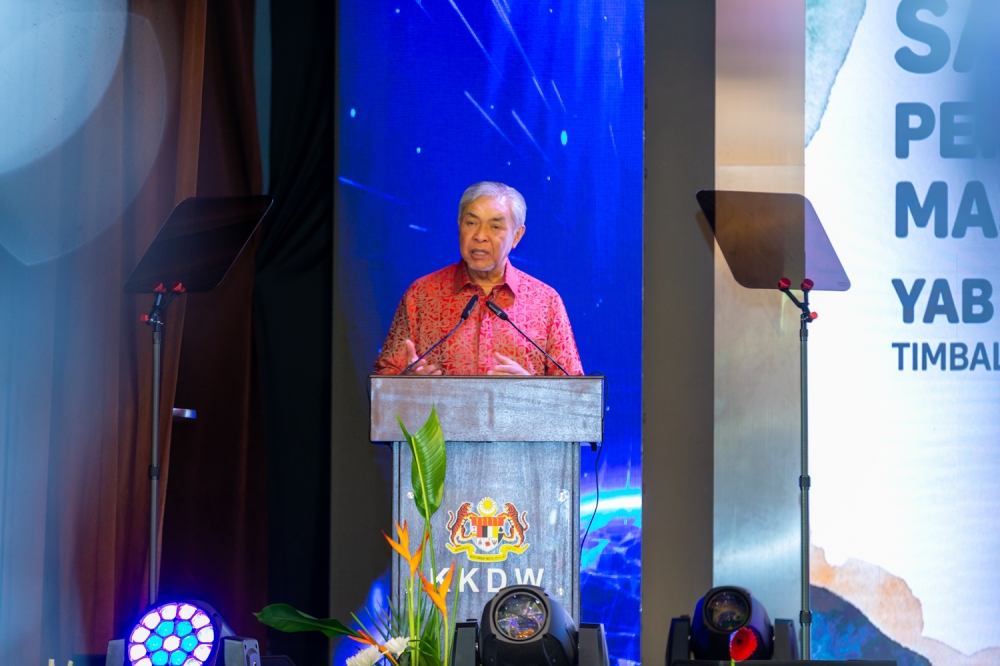
Deputy Prime Minister Datuk Seri Ahmad Zahid Hamidi moved swiftly to quash rumours circulating online that senior politicians from Barisan Nasional, Perikatan Nasional, GPS and GRS had convened for behind-the-scenes negotiations, emphasizing instead his unwavering commitment to the current unity administration framework that has governed Malaysia since 2022.
The denial represents a significant attempt to stabilize sentiment within political circles at a moment when coalition stability has become increasingly scrutinized. Zahid's clarification arrived after claims about the purported meeting gained traction across social media platforms and messaging applications, suggesting renewed jostling among Malaysia's fractious political blocs despite public assurances of solidarity.
The emergence of such reports, whether substantive or merely speculative, underscores persistent fragilities within the unity government coalition that has functioned as a governing arrangement between historically rival political camps. The constellation of Barisan Nasional, Perikatan Nasional, GPS and GRS represents an unusual alliance forged partly from necessity following Malaysia's recent electoral volatility and partly as a pragmatic response to prevent more radical political alternation.
Zahid's reaffirmation of support for the unity government carries particular weight given his position as Deputy Prime Minister and his leadership of the United Malays National Organisation, the dominant component within Barisan Nasional. His voice carries substantial influence over the coalition's direction and internal cohesion, making his public statements regarding political alignment consequential for perceptions of governmental stability.
The denial also reflects ongoing sensitivities regarding potential realignment among Malaysia's political forces. The prospect of negotiations between multiple blocs—particularly one involving Perikatan Nasional, which has positioned itself as an alternative to the unity arrangement—generates immediate concern about governmental durability. Past Malaysian political experience demonstrates that coalition arrangements can unravel rapidly when constituent parties sense opportunity for repositioning or when internal contradictions become untenable.
GPS and GRS represent crucial swing forces within Malaysian politics. GPS, the Gabungan Parti Sarawak, commands substantial representation from Malaysia's largest state, while GRS, the Gabungan Rakyat Sabah, holds similarly significant parliamentary numbers from Sabah. Together with Barisan Nasional and Perikatan Nasional components, these blocs collectively determine parliamentary mathematics that enable or disable any government's legislative capacity.
The unity government framework itself emerged from specific historical circumstances. Following the 2022 general election, no coalition secured outright dominance, necessitating cross-bloc cooperation to achieve parliamentary majorities. This arrangement, while unconventional, has provided relative stability compared to the instability characterizing the preceding years when Malaysia experienced multiple prime ministerial transitions within compressed timeframes.
Zahid's categorical dismissal functions partly as reassurance directed at coalition partners, investors, and the broader Malaysian public that governmental foundations remain intact. Political uncertainty generates economic ripples through currency volatility, foreign investment hesitancy, and business confidence metrics. By publicly reaffirming commitment to unity government principles, Zahid attempts to project continuity and predictability.
Nevertheless, the circulation of such meeting claims illustrates persistent undercurrents of repositioning within Malaysian politics. Coalition members maintain independent interests and agendas that do not always perfectly align. Perikatan Nasional, operating outside the unity framework, possesses incentive to explore alternative combinations that might expand its political leverage or create openings for different governmental configurations. Similarly, regional parties like GPS and GRS continuously calculate their optimal positioning within national political architecture.
The timing of these denials also warrants consideration within broader political calendars. Malaysia faces ongoing policy challenges including economic management, religious affairs, healthcare delivery and infrastructure development. Governmental effectiveness depends substantially upon coalition stability and the ability of constituent parties to function cohesively around shared policy agendas rather than pursuing individual factional advantages.
Zahid's positioning reflects a delicate balancing act inherent in managing complex multi-party coalitions. He must simultaneously reassure coalition partners that their participation remains valuable, signal openness to addressing legitimate grievances that might generate defection pressures, and maintain sufficient flexibility to respond to changing political circumstances. Public denials of meeting reports serve this multifaceted purpose by projecting confidence while attempting to preempt destabilizing speculation.
The unity government's continuation ultimately depends on collective recognition among participating parties that alternatives to current arrangements prove less attractive than maintaining present coalition structures. Should this calculation shift—whether through internal contradictions becoming unbridgeable, external opportunities emerging that advantage particular partners, or public dissatisfaction creating incentives for political realignment—even categorical denials cannot indefinitely forestall reconfiguration.
For Malaysian observers and regional analysts, Zahid's statements provide important signals regarding governmental durability in the near term, even as underlying political currents continue flowing beneath surface declarations of unity.

