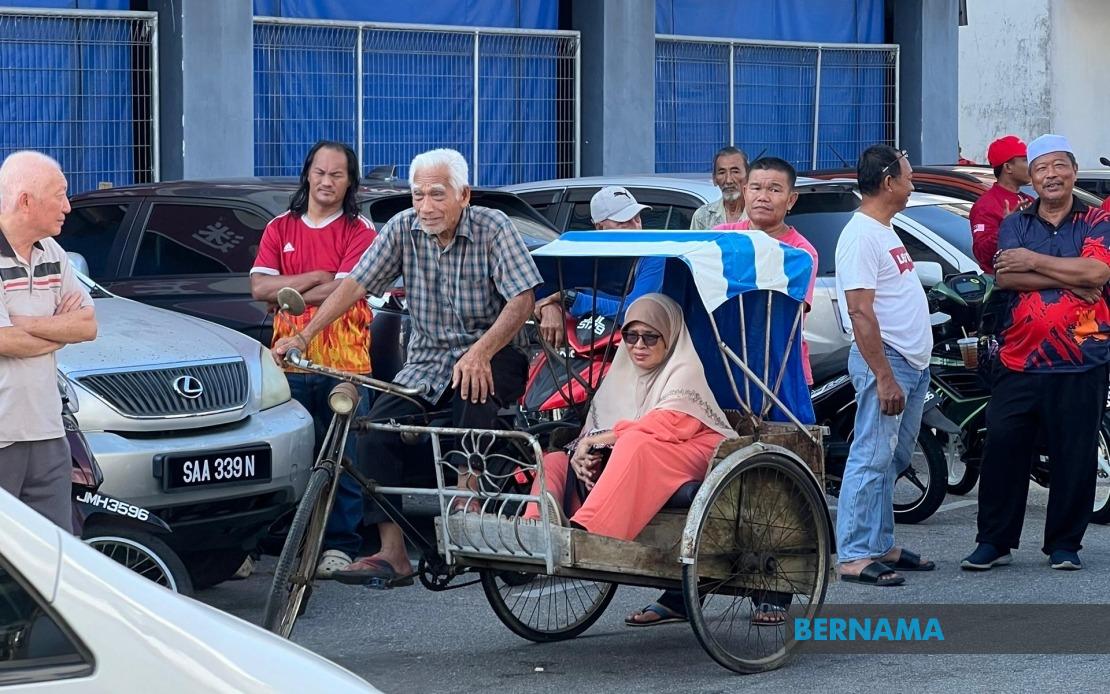
Abdul Razak Pelangga, an 86-year-old imam from Kampung Parit Bugis in Johor, set out on his trishaw in intense midday heat to realise a simple yet meaningful goal: allowing his wife to catch a glimpse of Prime Minister Datuk Seri Anwar Ibrahim. The journey from their home to Kedai Kopi Hailam Sri Medan in Senggarang covered nearly a kilometre, a testament to the elderly couple's determination and the emotional resonance that a prime ministerial visit can hold for ordinary Malaysians.
Abdul Razak's decision to forgo the convenience of a car or motorcycle in favour of his trishaw reflected both practical wisdom and a deeper sentiment. Rather than grapple with the congestion and parking challenges that accompany such events, he chose a mode of transport that, while slower and more physically demanding, allowed him to travel comfortably with his wife, Jamilah Samsudin, aged 64. For a man approaching his 87th birthday, the physical exertion of pedalling through tropical heat underscores the personal significance he attached to the occasion.
The imam's recollection of his earlier encounter with Anwar reveals the long arc of the Prime Minister's public life. Years before ascending to his current position, Anwar had visited Masjid Raudhatul Jannah Parit Bugis to perform prayers, where Abdul Razak led the congregational worship. That interaction left a lasting impression, memorable enough to be preserved in family memory and shared with his spouse. The handshake and cordial exchange that followed the prayers planted a seed of connection that would blossom decades later.
When word reached Abdul Razak that the Prime Minister would be stopping in Senggarang for a campaign visit, the opportunity became irresistible. This was not merely a chance to witness a public figure; it was an invitation to bridge the distance between a cherished personal memory and present reality. The elderly couple's journey represented more than physical movement across a small town—it symbolised the pull that political leadership, particularly when it has touched one's life personally, can exert on citizens.
The Prime Minister's schedule that morning included approximately 50 minutes at the coffee shop, during which he engaged with local residents as part of the PMX Meet-and-Greet Programme. This initiative, linked to the broader campaign efforts for the Senggarang state constituency, exemplifies the personalised engagement strategy that political campaigns employ during election seasons. Such programmes create opportunities for constituents to interact directly with leadership, though the reality often involves viewing from a distance due to crowd sizes and security considerations.
Abdul Razak and his wife, though unable to approach Anwar face to face amid the throng of other visitors and onlookers, achieved their primary objective. Witnessing the Prime Minister in person, even from a distance, represented a qualitatively different experience from the mediated exposure television affords. For elderly Malaysians accustomed to following politics through broadcast media, such direct proximity to a national figure carries particular significance, collapsing the abstract relationship between citizen and leader into a tangible moment.
The timing of this visit aligned with another milestone in Abdul Razak's life. The scheduled state election polling date of July 11 coincided with his 87th birthday—a convergence that infused his forthcoming civic participation with added personal meaning. Although he had exercised his voting rights on numerous previous occasions, the coincidence of fulfilling his democratic duty on his birthday elevated the act from routine obligation to something more memorable and reflective.
Abdul Razak's commitment to voting, despite his advanced age and the physical demands it may entail, reflects attitudes toward electoral participation that remain prominent among Malaysia's older generations. Having witnessed the nation's political evolution across decades, individuals of his age often regard the franchise as a hard-won right deserving consistent exercise. The opportunity to cast his ballot on a day marking his birth—a personal renewal—resonated deeply with his sense of responsibility as a citizen.
The broader context for this moment comprises the 16th Johor state election, representing a significant political event within the state's governance cycle. Campaign movements such as Anwar's breakfast visit serve multiple functions: they generate media coverage, provide platforms for direct voter engagement, and create symbolic moments that illustrate the accessibility and commitment of political leaders. For rural and small-town constituencies like Senggarang, such visits may constitute rare opportunities for residents to witness national-level politics in their immediate surroundings.
Abdul Razak's story, though centred on one individual's morning journey, encapsulates broader themes about Malaysian political culture. It demonstrates how personal memories of political figures can persist across decades, how election cycles mobilise communities, and how individual citizens navigate the distance between their lives and national governance. The trishaw ride itself—a vehicle associated with slower, more intimate modes of urban and rural transport—provided a fitting conveyance for a journey rooted in personal connection rather than mere political obligation.
The presence of Pakatan Harapan Communications Director Datuk Fahmi Fadzil at the event illustrated the coordinated campaign machinery accompanying the Prime Minister. Yet the morning's most human moment belonged to Abdul Razak and his wife, whose determination to travel through heat to witness a moment of connection between past and present reflected something deeper than campaign logistics could capture. For them, the journey completed a chapter opened by a mosque prayer many years prior, affirming the enduring bonds between citizens and leaders within Malaysia's democratic fabric.

