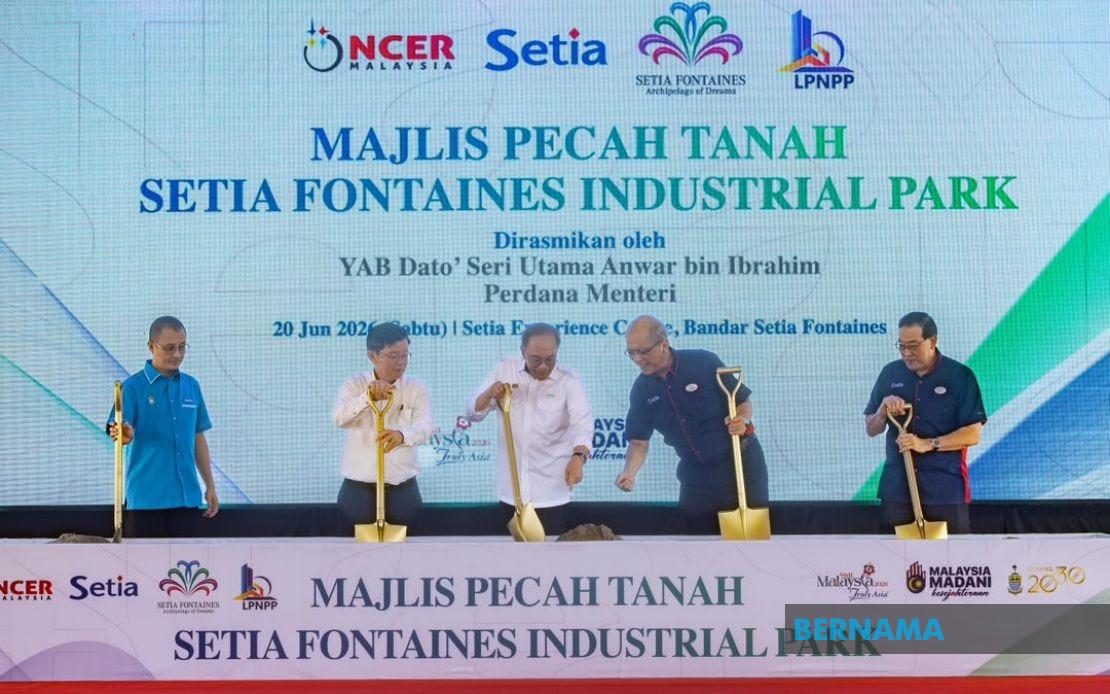
Prime Minister Datuk Seri Anwar Ibrahim has issued a pointed reminder to both government-linked companies and the private sector that their development initiatives must actively generate opportunities for Malaysia's middle- and lower-income populations. Speaking at the groundbreaking ceremony for the Setia Fontaines Industrial Park in Bandar Setia Fontaines, Kepala Batas, Anwar underscored that rapid economic expansion and increased investment flows must be managed in ways that prevent deepening inequality across Malaysian society. The remarks reflect growing concern within government circles that the fruits of development are not being distributed evenly, with some communities left behind as the economy modernises.
The Prime Minister's call carries particular significance given Malaysia's track record of widening income disparities over the past two decades. Anwar pointed out that each time the government approves major projects—whether backed by Khazanah Nasional Berhad, Permodalan Nasional Berhad, the Employees Provident Fund, or private investors—there must be deliberate mechanisms to ensure that ordinary workers and entrepreneurs from lower-income brackets can participate and benefit. Without such safeguards, he warned, the country risks experiencing a bifurcated economy where wealth concentrates among a privileged few while opportunities for disadvantaged groups become progressively scarcer. This concern aligns with Malaysia's broader national agenda of inclusive growth, a theme emphasised repeatedly in recent economic policy statements.
Anwar distinguished between growth measured purely through headline statistics and growth that delivers tangible improvements in people's living standards across all socioeconomic tiers. Many development announcements, he suggested, celebrate impressive investment figures and job creation numbers without scrutinising whether those jobs are accessible to local workers or whether wages enable genuine upward mobility. The distinction matters enormously for Southeast Asia's largest economy, where youth unemployment remains a structural challenge and skills mismatches often prevent workers from accessing well-paying positions. By insisting that development outcomes be measured by real improvements for ordinary citizens, Anwar is reframing how Malaysia assesses economic success—moving beyond GDP growth rates toward human-centred indicators.
The government has established a pattern of directing ministries and relevant agencies to approach development planning with greater attention to equity considerations. Anwar's comments at the Setia Fontaines event represent a reinforcement of these directives, signalling that project approvals will increasingly be scrutinised for their inclusive credentials. This approach reflects recognition that Malaysia's social cohesion depends partly on ensuring that rapid change does not leave large population segments feeling excluded from economic gains. The political calculus is equally important: maintaining broad-based electoral support requires demonstrating that government development strategies serve diverse constituencies, not merely high-income professionals and corporate interests.
The Setia Fontaines Industrial Park itself exemplifies Anwar's broader development philosophy. Located in Seberang Perai, the project addresses a geographic dimension of inequality within Penang state. The island and the southern region have traditionally absorbed the bulk of industrial investment and development attention, while Seberang Perai has lagged. By directing a major industrial park development toward this mainland area, the government aims to distribute economic opportunities more evenly across the state. Anwar characterised this investment as essential for ensuring that Seberang Perai's economic trajectory aligns with the more dynamic growth occurring elsewhere in Penang, tackling regional inequality through deliberate infrastructure allocation.
A critical component of the industrial park's potential lies in its capacity to generate high-quality employment as Malaysia transitions away from low-end manufacturing toward advanced technology sectors. This sectoral shift carries both promise and peril. On one hand, higher-value manufacturing and tech-intensive industries typically offer superior wages and career progression. On the other hand, such sectors demand skilled workforces, and Malaysia faces documented shortages of workers with relevant technical qualifications. Without intentional skills development, many citizens risk being excluded from these emerging opportunities, widening rather than narrowing income inequality.
Anwar explicitly addressed this skills challenge, arguing that collaboration between industry players, technical and vocational education institutions, and universities—specifically mentioning Universiti Sains Malaysia—must be substantially strengthened. The rationale is straightforward: offering professional employment opportunities means little if local workers lack the qualifications to fill them. Malaysian firms have historically imported foreign talent to staff high-skilled positions, a practice that simultaneously reflects capacity constraints and limits domestic workers' upward mobility. By binding education institutions more tightly to industry needs, Anwar proposed creating feedback loops where employers' skill requirements directly shape curricula, potentially accelerating workers' transition into emerging sectors.
The technology sector presents particular complications for skills alignment. Anwar noted that technology evolves within one or two-year cycles, meaning that educational institutions must maintain extraordinary flexibility to keep curricula current. This represents a substantial logistical challenge for Malaysia's education system, traditionally structured around multi-year programmes designed with extended planning horizons. Universities and technical colleges must adopt more dynamic, industry-responsive models—requiring investment, institutional reform, and closer partnerships with employers willing to co-design and co-deliver training. Without such transformation, Malaysia risks finding that even as new industries emerge, domestic workers remain unprepared, forcing companies toward costly foreign recruitment.
The Prime Minister's remarks also implicitly acknowledge that inclusive development requires intervention beyond market mechanisms. Left entirely to profit-maximising logic, companies predictably select the most immediately qualified candidates and locations offering lowest costs, often reinforcing existing inequalities. Deliberate government direction—whether through procurement policies, investment incentives, or regulatory expectations—becomes necessary to steer development toward underserved communities and populations. This represents a more interventionist stance than pure free-market ideology would suggest, reflecting pragmatic recognition that Malaysia's social stability depends on demonstrating that development benefits are widely distributed.
For Southeast Asian policymakers observing Malaysia's approach, Anwar's framework offers a template for reconciling rapid investment growth with equity concerns. The region's middle-income countries face similar pressures: investor demands for optimal returns often conflict with governments' commitments to inclusive development. Malaysia's articulated approach—requiring that major projects incorporate lower-income opportunities, strengthening skills development systems, and directing investment toward lagging regions—addresses these tensions directly. Whether implementation matches rhetoric remains uncertain; development projects frequently fail to deliver promised community benefits. However, the fact that Malaysia's highest political authority is now explicitly demanding inclusive outcomes raises the political and reputational costs of falling short.
The Setia Fontaines event signals that Malaysia's development approach is shifting toward stricter expectations of inclusive outcomes. Government agencies and private companies receiving approvals will face heightened scrutiny regarding their employment practices, skills provision, and community engagement. This recalibration acknowledges that economic growth unmoored from equity concerns generates social pressures that eventually undermine political stability and economic dynamism. By insisting that development serve diverse populations, Anwar is attempting to embed inclusive principles into Malaysia's investment architecture, ensuring that the next phase of economic modernisation delivers tangible benefits across society's breadth rather than concentrating gains among privileged minorities.

