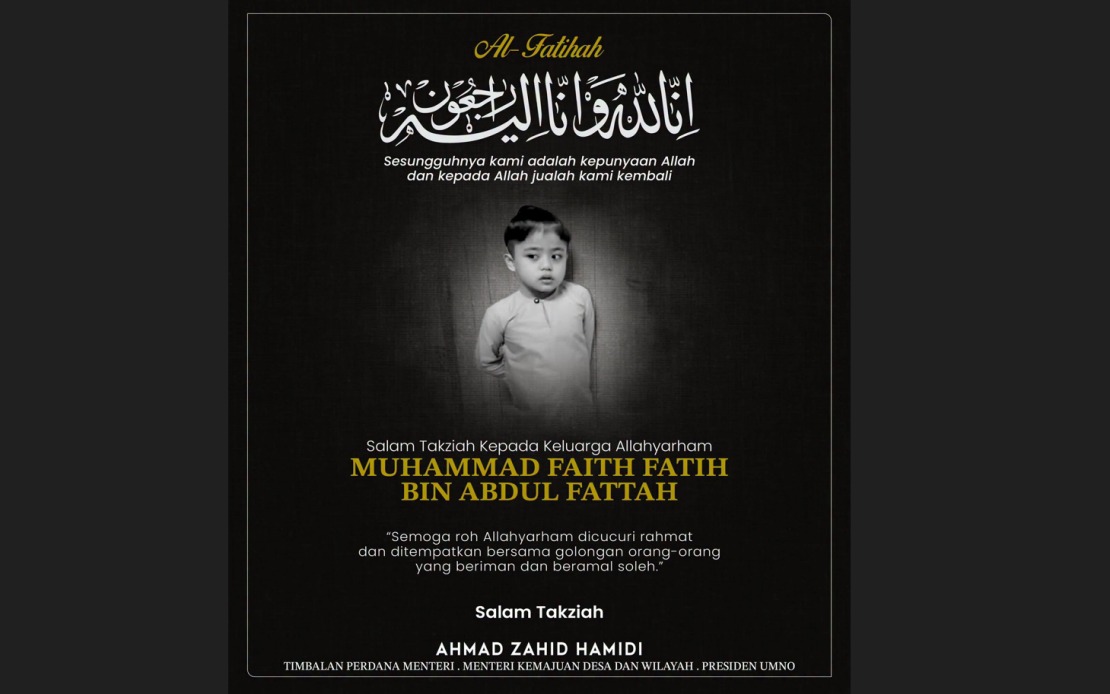
Deputy Prime Minister Datuk Seri Dr Ahmad Zahid Hamidi has offered his deepest condolences to the family of six-year-old Muhammad Faith Fatih Abdullah Fattah, an autistic child whose body was discovered in an oil palm plantation near Kampung Baru in the Hutan Melintang area, close to Sungai Sumun in Perak, on the evening of June 30.
The tragic discovery came after an extensive search operation that lasted several hours. Police records indicate that officers received an initial missing persons report at approximately 4.54 pm on June 30, with information that the young boy had last been seen inside his family home. The search intensified as daylight faded, and the child was eventually located in a drainage channel within the plantation area at 10.08 pm.
In a statement released on his social media platform, Ahmad Zahid, who represents the Bagan Datuk constituency in Parliament, described the news as profoundly saddening, particularly given the vulnerable circumstances of the victim. His remarks highlighted the additional emotional weight carried by families raising children with special needs, underlining the particular tragedy when such a child is lost.
The Deputy Prime Minister's public acknowledgement reflects the broader Malaysian concern for child welfare and the heightened vulnerability of children with autism spectrum disorder. Such incidents underscore ongoing conversations within Malaysian society about safeguarding mechanisms for young people with special needs, whose caregivers often face unique challenges in ensuring their safety and well-being. The case has renewed focus on the support systems available to families navigating autism care in Malaysia.
Ahmad Zahid's statement conveyed empathy directed specifically toward the child's parents, recognising the incomparable grief of losing a young child. His words emphasised the notion that parenthood carries no greater trial than bereavement, a sentiment that resonates across cultural and religious boundaries in Malaysia's diverse society.
The Deputy Prime Minister also incorporated Islamic prayer traditions into his condolences, calling for Al-Fatihah to be recited on behalf of the deceased and invoking divine mercy upon the child's soul. This spiritual dimension of his response reflects the predominant Islamic values within Malaysian governance and society, whilst acknowledging the broader human experience of loss.
According to Bagan Datuk police chief Superintendent Mohammad Ali Mohd Jali, the investigation proceeded following standard protocol for such incidents. The circumstances surrounding the child's disappearance and subsequent death were subject to police examination to establish the factual sequence of events and determine whether any criminal elements were involved in the tragedy.
The incident has particular resonance for Malaysian parents and caregivers of children with autism, a condition affecting thousands of families across the nation. Many families in Malaysia depend on community networks, religious institutions, and government support systems to manage care for children with developmental and behavioural needs. Cases such as this typically prompt discussions about whether existing safeguards are adequate and whether awareness campaigns about autism and child supervision require strengthening.
Autism spectrum disorder in Malaysia remains an area where public understanding continues to evolve. Educational institutions, healthcare providers, and community organisations have increasingly focused on raising awareness about autism and supporting affected families. However, challenges persist in ensuring that special needs children receive appropriate supervision and protection, particularly in rural and semi-rural areas where family support structures may be more isolated.
The loss of Muhammad Faith Fatih Abdullah Fattah occurs against a backdrop of periodic incidents involving missing children in Malaysia, each serving as a reminder of the fragility of childhood and the responsibilities borne by parents, guardians, and community members. Such tragedies often catalyse renewed calls for improved safety protocols, better coordination between authorities, and enhanced public awareness campaigns.
The response from high-level government officials like Deputy Prime Minister Ahmad Zahid demonstrates the seriousness with which the Malaysian leadership regards child welfare issues. His public condolences, whilst a gesture of sympathy, also serve to keep focus on the broader imperative to protect vulnerable populations, particularly children with special needs who may lack the capacity to communicate distress or seek help independently.
Moving forward, the incident may prompt relevant government agencies and civil society organisations to examine whether current protocols for child safety, search and rescue operations, and support for families with autistic children require enhancement. The tragedy underscores the collective responsibility society bears in safeguarding its most vulnerable members.

