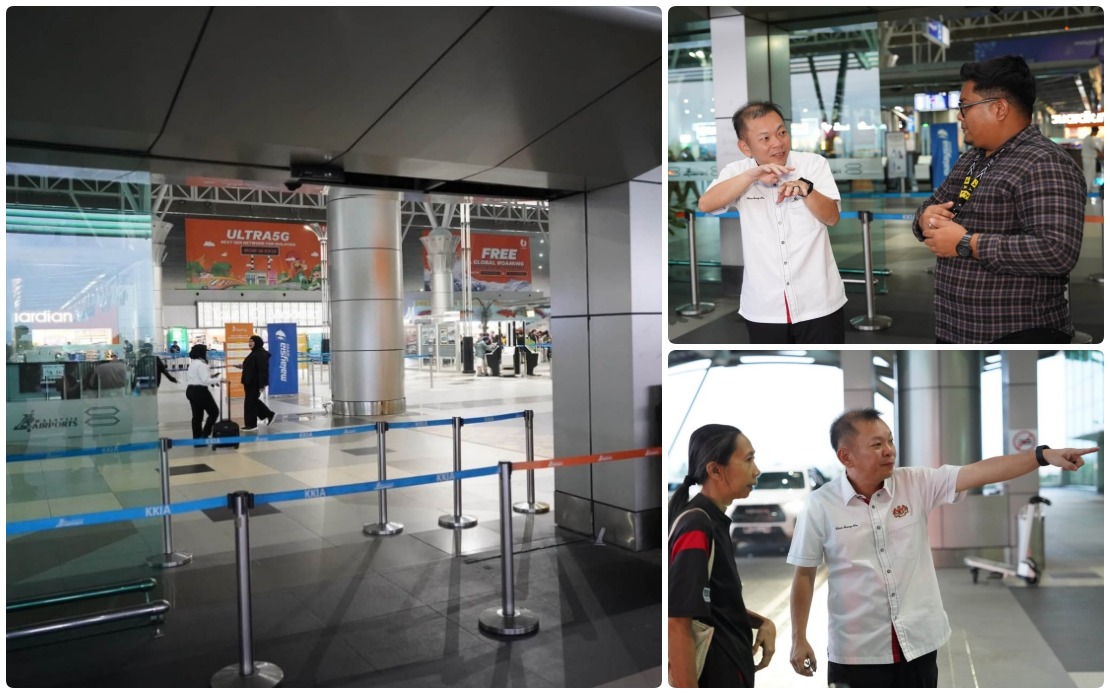
A female driver sustained minor injuries on Wednesday afternoon after her sports utility vehicle lost control and crashed into the entrance of the departure hall at Kota Kinabalu International Airport, striking the reinforced glass doors serving the terminal's kerbside check-in area on Level 3. The collision occurred at approximately 4:20 pm, causing significant structural damage to the door assembly whilst leaving the vehicle's front section severely impaired. The injured motorist was transported by ambulance to a nearby medical facility for treatment of her minor injuries.
Authorities moved quickly to secure the scene and assist the victim. Aviation Security and Customer Service personnel at KKIA responded immediately upon notification, with airport medical staff arranging emergency transportation. The Kota Kinabalu District Police Chief, ACP Shahrudin Mat Husain, confirmed receipt of the incident report and indicated that investigators were gathering evidence to determine the precise circumstances that caused the vehicle to lose control. Police have not yet released any preliminary findings regarding mechanical failure, driver error, or other contributing factors.
The incident triggered swift remedial action from airport management. By 6:00 pm, the affected area had been fully cleared, with the damaged vehicle and associated debris removed from the departure level. Maintenance crews were mobilised to initiate repairs to the compromised entrance doors, which form a critical component of the terminal's passenger flow infrastructure. The glass door structure sustained substantial damage from the impact, though the installation of safety glazing prevented fragmentation from posing additional hazards to nearby travellers and staff.
Despite the dramatic nature of the collision, airport operations continued without interruption. Malaysia Airports, the facility operator, issued an immediate statement confirming that passenger movements and airport functions remained unaffected throughout the incident and its aftermath. The operator emphasised the redundancy built into the terminal design, noting that alternative automatic doors at the same entrance remained fully operational, ensuring that the steady flow of departing passengers experienced no delays or disruptions. This operational resilience reflected both facility design and the coordinated response of multiple airport departments.
Deputy Minister of Agriculture and Food Security Datuk Chan Foong Hin happened to be arriving at the airport at the moment of the incident. He subsequently issued public remarks commending the professionalism of KKIA's management and personnel, characterising their response as efficient and prompt. In a social media post, he acknowledged the swift cleanup efforts and the restoration of normal operations, which he noted was particularly important given the high volume of passenger traffic passing through the terminal during afternoon peak hours.
The airport operator's formal statement outlined the sequence of events and recovery measures with precision. Malaysia Airports confirmed that emergency response protocols had been activated within minutes of the 4:19 pm collision, with trained personnel securing the area and attending to the injured driver's medical needs. The statement indicated that all regulatory requirements had been satisfied, including immediate notification to the Royal Malaysia Police and the provision of full operational cooperation to law enforcement investigators.
From a broader perspective, this incident underscores the operational challenges faced by major Southeast Asian aviation hubs in managing unexpected disruptions whilst maintaining passenger service standards. Kota Kinabalu International Airport, as Sabah's principal gateway for international and domestic aviation, processes thousands of travellers daily across its departure and arrival facilities. The quick resolution of this crisis prevented the type of cascading delays that can propagate through airport operations when key infrastructure is compromised, particularly at departure hall entrances where passenger congestion is typically heaviest during afternoon and evening hours.
The investigation into the underlying cause remains preliminary. Police have indicated that additional evidence gathering and witness interviews would proceed as part of standard accident investigation protocol. Possible explanations could range from mechanical issues affecting vehicle braking or acceleration systems to medical events incapacitating the driver, though authorities have not yet provided directional guidance on which factors are being prioritised in the inquiry.
This occurrence represents a rare but not unprecedented event in major airport terminal operations across the region. Previous similar incidents at Asian aviation facilities have occasionally prompted facility operators and aviation safety authorities to review kerbside design standards, passenger area perimeter protections, and vehicle access restrictions. Whether KKIA management will implement additional preventive measures following this incident remains to be determined, though the current level of safety glass and structural integrity evidently proved adequate in this instance to prevent secondary injuries.
The rapid restoration of full operations at KKIA demonstrates the value of well-trained emergency response teams and clearly established incident protocols in contemporary airport environments. As aviation traffic through Southeast Asian hubs continues to expand, the ability of facilities to absorb unexpected disruptions whilst maintaining service reliability has become an increasingly important competitive and operational consideration. For passengers transiting through Kota Kinabalu, the incident is unlikely to create lasting concerns about terminal safety, given the swift and transparent manner in which airport authorities addressed both the immediate emergency and subsequent recovery.

