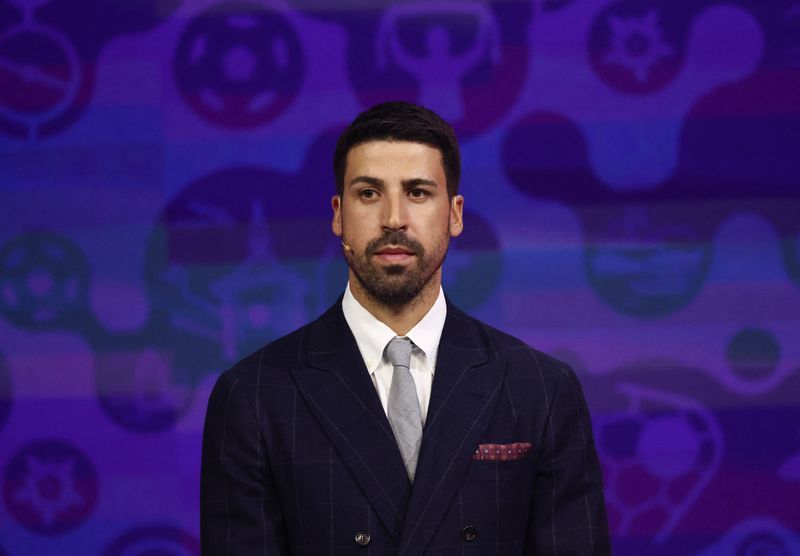
Sami Khedira, the German midfielder who lifted the World Cup trophy in 2014, believes brothers wearing opposing international shirts at the global tournament represents something far more significant than a sporting anomaly. Rather than viewing such arrangements as problematic, the veteran footballer considers them a genuine reflection of how identity operates in our interconnected world, where family heritage often spans multiple nations and allegiances. His perspective carries particular weight given his own experience: while he represented Germany throughout his career, his brother Rani currently competes for Tunisia—their father's homeland—at the World Cup, embodying the very reality Khedira champions.
Speaking to Italian sports media at the Home of Football museum in New York, Khedira articulated a worldview that extends beyond traditional nationalistic frameworks. He framed the phenomenon not as a crisis requiring resolution but as an entirely natural consequence of modern global society. "I don't see it as an issue," he explained, emphasizing instead that such arrangements demonstrate how contemporary football reflects broader demographic and cultural realities. For Khedira, the presence of brothers competing under different flags serves as a powerful statement about belonging, migration, and the genuine multiculturalism that now defines many European and global communities.
The foundation for Khedira's perspective lies in his own lived experience navigating dual heritage. Born and raised in Germany to a German mother and Tunisian father, he grew accustomed from childhood to embodying two distinct cultural identities simultaneously. Rather than viewing these as competing or incompatible, he describes carrying both with natural ease. He acknowledged that society sometimes questioned his authenticity—in Germany, some scrutinized his Germanness based on his surname and appearance, while in Tunisia he could be perceived as foreign. His resolution to this tension was straightforward: both identities are equally valid and coexist within him without contradiction or hierarchy.
The 2026 World Cup will feature an unusually high concentration of brother partnerships, with eight sets competing across the tournament. Four pairs will represent the same nation—including Theo and Lucas Hernández for France, Jurrien and Quinten Timber for the Netherlands, and Laros and Deroy Duarte for Cape Verde. Conversely, four partnerships will be divided between different countries, creating the exact scenario Khedira defends. The Williams brothers, Iñaki and Nico, exemplify this division: despite their shared roots as Athletic Bilbao teammates, they have chosen Ghana and Spain respectively as their international homes. Similarly, Guela and Desire Doucé are split between Ivory Coast and France, while Derrick Luckassen and Brian Brobbey, brothers through their mother but carrying their respective fathers' surnames, represent Ghana and the Netherlands.
Khedira's conviction regarding the beauty of such arrangements crystallized during a specific moment that remained lodged in his memory. When the Doucé brothers faced each other in a France versus Ivory Coast friendly match earlier this month, both sang their respective national anthems before kickoff. That image—two brothers, each patriotic for different flags, standing side by side—captured for Khedira something profoundly important about football's capacity to transcend the match itself. He described the moment as breathtakingly beautiful, recognizing in it the power of sport to communicate messages about multiculturalism and belonging that resonate globally far beyond the sport itself.
Khedira also connected this phenomenon to the broader transformation of international football resulting from the expanded 48-team World Cup format. The enlarged tournament has created opportunities for historically marginalized nations—Cape Verde, Curaçao, and Haiti among them—to demonstrate their competitive capabilities on sport's grandest stage. He observed that African and Asian teams have been steadily narrowing the traditional performance gap separating them from European and South American powerhouses. This levelling of the playing field, he suggested, reflects genuine improvements in sporting infrastructure, coaching quality, and player development across regions that previously lacked resources for comprehensive football systems. However, Khedira cautioned that European nations bear ongoing responsibility to contribute meaningfully to developing football at its source rather than merely benefiting opportunistically from dual-nationality players.
Yet Khedira recognized a genuinely difficult dimension to this otherwise celebratory reality: the immense pressure placed on young footballers courted simultaneously by multiple national federations. When adolescents face approaches from various countries seeking their allegiance before they possess sufficient maturity to comprehend the magnitude of such decisions, the situation becomes ethically complex. Khedira spoke from personal experience, recalling himself at eighteen years old—barely past childhood—confronting the necessity of making a binding commitment to a national community. He emphasized that no outside force—not political pressure, not heritage, not federation persuasion—should dictate such an intimate, consequential choice.
Instead, Khedira advocated for a decision-making process grounded in something more intrinsic: a genuine "gut feeling" that transcends birthplace or external claims. He stressed that the correct answer cannot be manufactured or imposed; it must emerge from within the individual's authentic sense of belonging and connection. Despite his own engagement with Tunisia's football federation out of respect for his heritage, he ultimately acknowledged that such decisions belong entirely to the young players themselves. While recognizing the profound difficulty inherent in asking teenagers to choose their global community, Khedira expressed gratitude that contemporary governance at least permits young dual-heritage athletes autonomy in determining their international futures.
Khedira's perspective gains significance as Southeast Asian and regional football develops increasingly cosmopolitan player pools. Nations like Malaysia, Singapore, and Thailand increasingly feature athletes with mixed heritage and international family connections. His framework—celebrating rather than pathologizing dual identity—offers constructive guidance for how regional football associations might approach similar situations. Rather than viewing dual-heritage players as complications requiring resolution, his worldview suggests embracing them as natural expressions of globalized society. Such an approach could enhance regional football's authenticity and appeal while affirming the legitimacy of players navigating multiple cultural allegiances, ultimately strengthening rather than fragmenting the sport's fabric.

