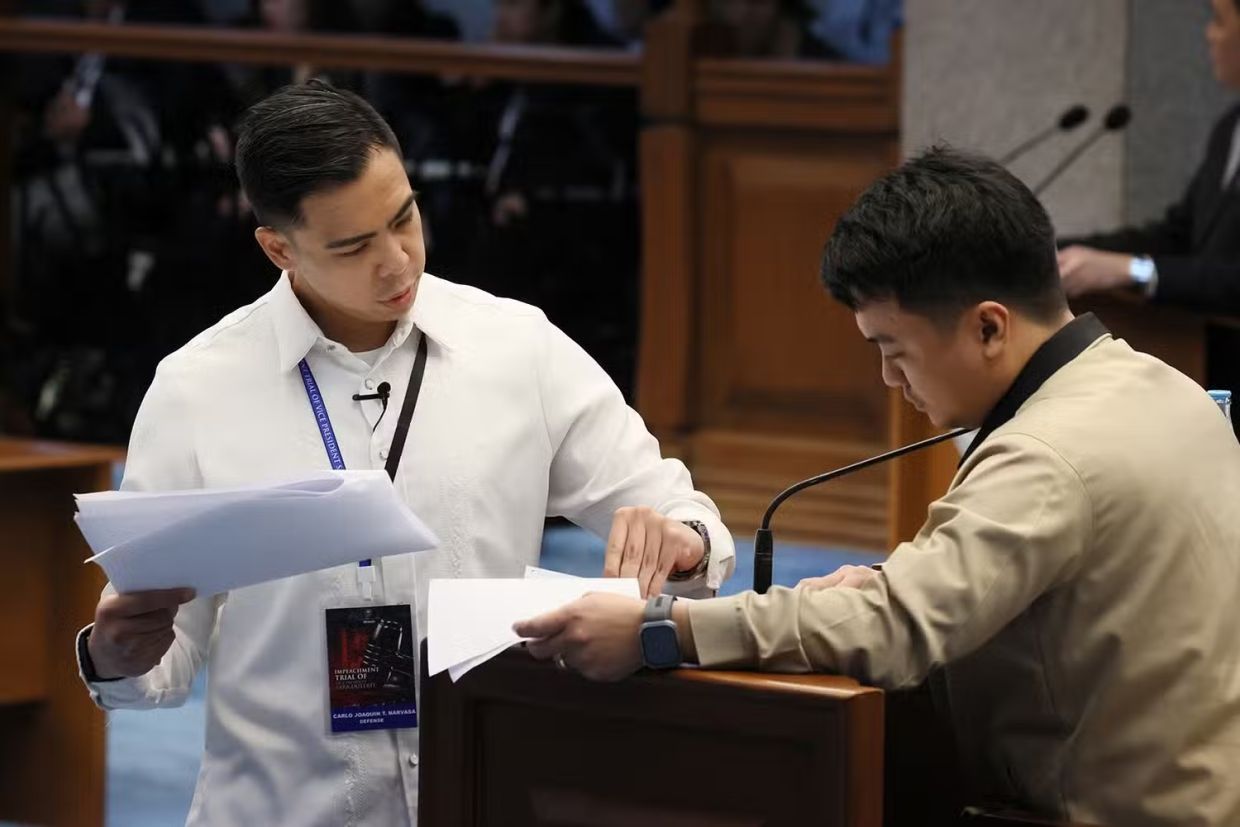
The impeachment trial of Philippine Vice President Sara Duterte entered a critical phase on Wednesday as her legal team mounted a substantive challenge to the prosecution's case, contending that the statements at the centre of the charges fall outside what the 1987 Constitution recognises as impeachable offences. Speaking before the Senate impeachment court on the third day of proceedings, defence counsel argued that even if Duterte had made the disputed remarks—issued during an online press briefing on November 23, 2024, directed at President Ferdinand Marcos, First Lady Liza Araneta-Marcos, and former Speaker Martin Romualdez—such utterances alone cannot constitute grounds for removal from office.
The constitutional foundation of this argument proved pivotal to the defence strategy. The Constitution specifies a narrow list of impeachable offences under Article XI, Section 2: culpable violation of the Constitution, treason, bribery, graft and corruption, betrayal of public trust, and "other high crimes." Defence counsel Mark Vinluan emphasised that the prosecution had not demonstrated the existence of this last category in relation to Duterte's conduct. By dwelling on the vagueness of what qualifies as "high crime," the defence shifted debate away from the substance of Duterte's statements toward the legal framework governing impeachable conduct, a tactic that highlights fundamental ambiguities in Philippine impeachment jurisprudence.
Central to the defence's demolition of the prosecution case was their relentless attack on evidentiary gaps. The National Bureau of Investigation's senior agent John Mark Calilung, appearing as the prosecution's lead witness, faced incisive cross-examination regarding the absence of formal complaints from any of the three alleged victims. Calilung conceded that neither Marcos, Araneta-Marcos, nor Romualdez had filed criminal charges or appeared before the NBI to provide sworn statements. The bureau had proceeded motu proprio—on its own motion—without a formal complainant initiating the investigation, a procedural irregularity that defence lawyers weaponised to suggest the entire probe lacked proper foundation. This departure from standard investigative protocol underscores questions about whether the case originated from legitimate security concerns or represented politically motivated prosecution.
The prosecution's own acknowledgement that the video recording of Duterte's remarks did not conclusively prove she had contracted an assassin provided defence counsel with a powerful rhetorical weapon. Prosecutor Amando Ligutan, when pressed by Senator Risa Hontiveros, admitted that the statements alone could not establish with certainty that an assassination plot existed or had been commissioned. Defence counsel seized on this concession, arguing that the charge itself rested on speculation and inference rather than demonstrable fact. Vinluan repeatedly emphasised that the term "assassin" had been injected into the narrative by outside parties interpreting Duterte's words out of context, suggesting that the prosecution had constructed a meaning from ambiguous remarks rather than proving criminal intent.
A crucial dimension of the defence strategy involved reframing Duterte's statements within a narrative of family protection under extraordinary circumstances. Vinluan argued that when Duterte issued the controversial remarks, she was not speaking in her official capacity as Vice President but as a private citizen—wife, mother, daughter, and sister—responding to alleged government surveillance and security threats against her household. This argument attempted to remove the statements from the realm of official conduct subject to impeachment, placing them instead in the personal sphere where different standards of reasonableness might apply. The defence claimed that Duterte's homes in Davao and Manila had been profiled by government agents, that classified surveillance reports documented this activity, and that her security personnel had been removed by government action, collectively subjecting her family to intense fear and trauma.
The detention of Duterte's chief of staff Zuleika Lopez on the day of the press briefing emerged as a contextual anchor for the defence argument. Videos presented to the court showed Lopez objecting to her planned transfer to a women's correctional facility in Mandaluyong City, expressing fears for her safety and denying she was a criminal. Defence counsel Carlo Narvasa framed this incident not as a routine administrative matter but as part of a broader pattern of "systematic oppression" orchestrated by the House committee investigating confidential funds of the Office of the Vice President and Department of Education. Narvasa identified House prosecutor Joel Chua, who chairs the investigating committee, as a key figure in this alleged persecution. By establishing this timeline and sequence of events, the defence sought to demonstrate that Duterte's statements emerged from a genuine crisis within her immediate circle rather than representing calculated threats.
The procedural integrity of the NBI investigation came under withering scrutiny as defence lawyers exposed multiple deficiencies in the bureau's approach. Calilung acknowledged that the NBI's revised affidavit dated February 10, 2025, contained no statements from the three identified victims or from journalists who attended Duterte's press briefing. The witness admitted executing only an affidavit attesting to minutes of investigators' interviews rather than presenting original evidence. When Narvasa posed the pointed question "Did you really investigate this case?" the prosecution objected before Calilung could respond, a moment that crystallised the defence's core argument about the investigation's superficiality. These gaps suggest either investigative incompetence or, as defence counsel implied, a predetermined conclusion in search of supporting evidence.
The broader context for this impeachment trial extends beyond the immediate charges to encompass fundamental questions about the exercise of impeachment power in the Philippines. The trial represents the fourth impeachment case against a Philippine Vice President and reflects broader political tensions between Duterte's political apparatus and the Marcos administration. For Malaysian observers, the case illustrates how Westminster-derived impeachment mechanisms can become vehicles for political conflict when constitutional safeguards remain ambiguous. The debate over what constitutes "high crime" demonstrates how the absence of precise definition in a constitution permits expansive interpretation during moments of political friction.
The defence's challenge to the evidentiary foundation of the case carries particular significance for Southeast Asian constitutional law more broadly. Several nations in the region employ impeachment provisions with similarly vague language, and the Duterte proceedings may establish precedent regarding how aggressively courts should scrutinise the factual basis for impeachment charges. The Philippine Senate's willingness to permit the prosecution to advance a case relying on inference, contextual interpretation, and circumstantial connection rather than direct evidence will influence how other regional legislatures approach such proceedings. This trial essentially examines whether impeachment requires the same rigorous proof standards as criminal prosecution or whether a lower threshold suffices for removing elected officials.
Senator Francis Escudero, the court's presiding officer, intervened during proceedings to clarify that questions posed by senator-judges should not require counsels to draw legal conclusions, confining such analysis to closing arguments. His intervention acknowledged the distinction between fact-finding and legal interpretation that impeachment courts must navigate. However, Senator Hontiveros' observation that previous impeachment trials permitted broader questioning by senator-judges suggests inconsistency in procedural standards across Philippine impeachment history. This inconsistency itself becomes a vulnerability for any impeachment verdict, as future legal challenges could argue that conviction rested on procedurally defective proceedings.
The trial's trajectory remains uncertain as proceedings advance beyond the prosecution's evidence presentation. The defence has established multiple lines of attack: the absence of formal complaints from victims, the insufficiency of evidence to prove criminal conspiracy, the questionable constitutional classification of the alleged conduct, and the contextual factors allegedly justifying Duterte's statements. Whether the Senate impeachment court will find these arguments persuasive depends partly on its interpretation of constitutional language and partly on political calculations within the Senate itself. The distribution of support among senator-judges may ultimately determine the verdict more decisively than the legal arguments presented.
For regional observers watching Philippine constitutional governance, the Duterte impeachment trial demonstrates how Westminster-derived systems can struggle when political institutions weaponise constitutional mechanisms against rivals. The absence of clearly defined standards for impeachable conduct, combined with the political salience of removing a Vice President from office, creates conditions where legal arguments become secondary to political alignment. The case also highlights how security concerns, personal family protection, and government surveillance allegations can complicate straightforward judgments about official misconduct. As the trial progresses toward closing arguments and eventual Senate voting, the fundamental question remains whether impeachment serves as a check on genuine constitutional violations or as an instrument of political warfare dressed in constitutional language.

