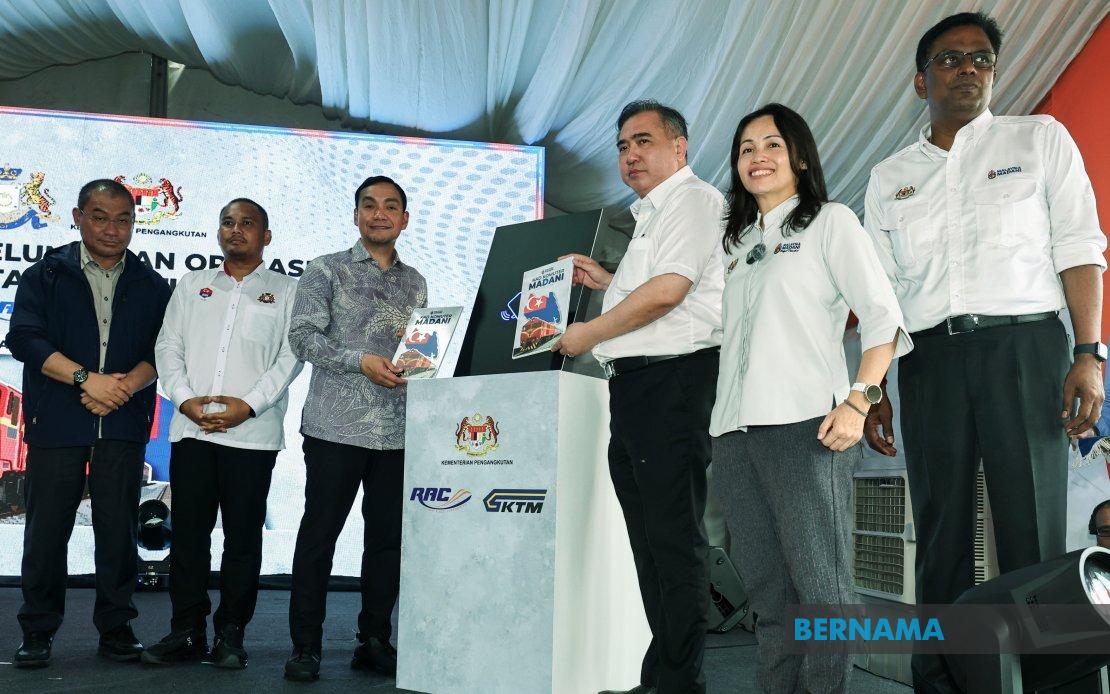
Johor Menteri Besar Datuk Seri Onn Hafiz Ghazi has underscored the urgency of accelerating the Elevated Autonomous Rapid Transit (E-ART) project, positioning it as a cornerstone solution to mitigate severe traffic disruptions anticipated when the Johor Bahru-Singapore Rapid Transit System (RTS) Link commences operations in 2025. Speaking at the Southern Shuttle train service launch at KTM Kulai Station, Onn Hafiz articulated how the incoming cross-border transit facility will fundamentally alter mobility patterns in the region, necessitating supplementary infrastructure to distribute passenger loads across multiple transport corridors.
The RTS Link represents a transformative moment for the Johor Bahru metropolitan area, expected to facilitate seamless rail connectivity between Malaysia's southern hub and Singapore's transport network. However, this integration carries substantial implications for ground-level congestion. Onn Hafiz characterised the situation with clarity: existing interim measures cannot serve as permanent remedies. The temporary interventions now underway—including expanded Park & Ride facilities and intelligent traffic management systems at JB Sentral—will provide relief for perhaps two to three years, but they address symptoms rather than systemic capacity constraints.
The E-ART project emerges as the definitive long-term response to this anticipated mobility crisis. By introducing autonomous elevated rapid transit, planners aim to create a dedicated, grade-separated network that bypasses surface congestion entirely. This architectural advantage proves particularly valuable for a metropolitan area where ground-level infrastructure faces competing demands from commuters, commercial vehicles, and tourists. The elevated pathway creates a parallel transport ecosystem, channelling high-volume passenger flows independently of traditional road networks while maintaining accessibility for vehicle traffic essential to commerce and essential services.
Johor Bahru's demographic reality underscores why such intervention cannot be delayed. With approximately 1.8 million residents, the state capital rivals Penang in population, yet its transport infrastructure was designed for a fraction of this density. This undersized capacity becomes acutely problematic once the RTS Link activates, introducing additional passenger volumes from cross-border commuters, business travellers, and leisure visitors. The metropolitan area functions simultaneously as Malaysia's foremost international gateway, channelling trade and movement across the Causeway and the Second Link at scales that dwarf most Southeast Asian border crossings.
Onn Hafiz's remarks reflect broader frustration within Johor's administration regarding project timelines. Federal agencies control E-ART implementation, creating a principal-agent dynamic where state-level urgency may not translate into accelerated federal action. By invoking the Transport Minister Anthony Loke and Deputy Communications Minister Teo Nie Ching's presence at the launch, Onn Hafiz sought to elevate E-ART's political salience and secure tacit federal commitment to expedited development. This strategy acknowledges that transport infrastructure planning requires alignment across multiple governmental levels, with federal funding and oversight authority ultimately determining delivery timelines.
The interconnection between RTS Link operations and E-ART deployment illustrates a fundamental planning challenge: sequential infrastructure projects create dangerous windows where new capacity generates demand that existing systems cannot accommodate. Transport planners face a binary choice—either delay the RTS Link until supporting infrastructure reaches completion, or accept temporary congestion as the price of faster regional integration. Johor's leadership has implicitly chosen the latter path, betting that interim measures plus accelerated E-ART development will manage the transition period without unacceptable disruption to economic activity or commuter experience.
Context matters significantly for Malaysian and regional readers. Johor Bahru functions as Southeast Asia's most important Malaysia-Singapore interface, handling daily cross-border flows in the hundreds of thousands. Unlike comparable border regions elsewhere in the bloc, Johor-Singapore integration directly implicates major economic centres—Singapore's financial district lies within 90 minutes of JB's core—creating powerful incentives for frictionless connectivity. The RTS Link promises exactly this, but only if supporting surface infrastructure can absorb induced demand and distribute congestion across multiple modes rather than concentrating pressure on existing roads.
For Malaysian commuters and businesses, E-ART represents more than engineering—it signals whether federal authorities genuinely commit to managing the consequences of major infrastructure expansion. Onn Hafiz's invocation of "Federal intervention that can truly be felt, appreciated and remembered by the people" reframes transport infrastructure as political legitimacy. This rhetorical move recognises that infrastructure satisfaction directly shapes electoral behaviour and public trust in government competence. Citizens who experience smooth commutes attribute success to governing authorities; those enduring gridlock assign blame regardless of root causes or planning constraints.
The E-ART project's technological dimension also merits consideration. Elevated autonomous rapid transit represents cutting-edge transit technology, positioning Johor Bahru and by extension Malaysia within the vanguard of Southeast Asian urban mobility innovation. Comparable systems in Singapore, Bangkok, and Jakarta demonstrate commercial viability and passenger acceptance. By adopting this technology, Johor Bahru signals ambitions to compete with regional peers for talent, investment, and commercial activity. High-quality transport infrastructure functions as both practical necessity and symbolic marker of modernity and urban sophistication.
Implementation challenges, however, remain substantial. E-ART requires substantial capital investment, secure long-term operational funding, land acquisition across urban areas, and coordination between state and federal authorities. Construction timelines for elevated systems typically span five to seven years from finalised design through commissioning. If the RTS Link launches in 2025 and E-ART construction begins immediately upon approval, the auxiliary system might not achieve full operations until 2030-2032, leaving a five-to-seven-year window when Johor Bahru's transport system operates below optimal capacity. Managing this interval without permitting congestion to spiral remains the central tactical challenge for transport authorities.
The launch of the Southern Shuttle service itself represents incremental progress toward distributed mobility, adding capacity on existing rail corridors and demonstrating commitment to multi-modal integration. Yet this initiative alone cannot substitute for systemic capacity enhancement that E-ART promises. Southern Shuttle may absorb 5-10 percent of regional trips; E-ART could eventually handle 15-20 percent of major corridors, fundamentally altering how residents and visitors navigate Johor Bahru's metropolitan expanse.
Looking ahead, Onn Hafiz's emphasis on E-ART acceleration suggests Johor Bahru enters a critical infrastructure planning phase. The state government must simultaneously manage the RTS Link's integration, oversee interim congestion management, and propel E-ART toward realisation. Success requires sustained political will, consistent federal funding, effective project management, and public communication that maintains confidence through the transition period. For Malaysia and the broader Southeast Asian region, how Johor Bahru navigates this infrastructure moment may establish precedent for managing future transport transitions in increasingly dense metropolitan areas throughout the region.