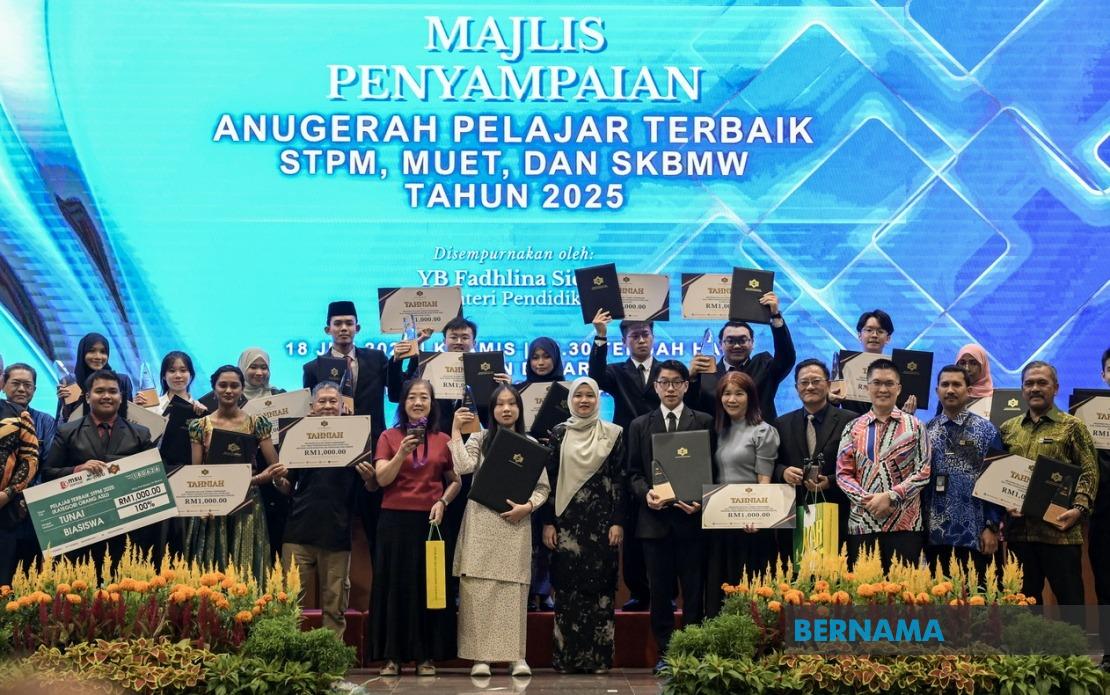
Eighteen outstanding performers in the 2025 Sijil Tinggi Persekolahan Malaysia (STPM) examination will receive tuition fee scholarships from the country's public universities, Education Minister Fadhlina Sidek announced today. The initiative represents a fresh government strategy to bolster the Form Six sector and encourage greater student uptake of the traditional pre-university route, which has faced declining enrolment in recent years.
Fadhlina, speaking at a press conference following the awards ceremony for top STPM 2025, MUET, and Certificate of Proficiency in Malay for Foreigners achievers at the Malaysian Examinations Council headquarters here, described the scholarship programme as a collaborative effort with the country's tertiary institutions. She underscored the importance of recognising academic excellence and converting that recognition into tangible support that removes financial barriers to university education.
The sponsorship initiative, beginning with the 2025 cohort, sees each public university committing to offer undergraduate degree scholarships for their respective top-performing STPM students. Fadhlina extended formal recognition to all participating public universities for embracing the scheme, framing it as evidence of institutional commitment to nurturing talent and maintaining the competitiveness of Malaysia's higher education system.
The announcement forms part of a broader government strategy to revitalise the Form Six ecosystem, which has experienced structural challenges over the past decade. Beyond the scholarship programme, the government has rolled out an array of supporting measures designed to make the pre-university pathway more attractive and accessible. These include expansion of Form Six College capacity nationwide, provision of smartboards and modern teaching technology in classrooms, early intervention assistance for struggling students, and distribution of MADANI Book Vouchers to support educational materials.
For Malaysian students, the scholarship announcement carries practical significance. Unlike tertiary fees that can stretch beyond RM10,000 annually at public universities, tuition sponsorships substantially reduce out-of-pocket educational costs for high-performing families and potentially open pathways previously closed by financial constraints. The scheme particularly matters for rural and lower-income students whose academic talent might otherwise remain underdeveloped due to affordability barriers.
The STPM 2025 examination results themselves reflected encouraging trends in Malaysia's secondary education outcomes. The national cumulative Grade Point Average (CGPA) climbed to 2.88, up marginally from 2.85 recorded in the previous year. While the improvement appears modest in percentage terms, sustained upward movement in aggregate performance metrics suggests that recent educational reforms are gradually yielding results across schools nationwide.
Fadhlina emphasised that this incremental progress validates the government's comprehensive approach to education strengthening. She framed the rising CGPA alongside infrastructure investments, support mechanisms, and now direct financial incentives as evidence that Malaysian education quality is on an improving trajectory. The minister expressed confidence that the combination of ecosystem enhancements and targeted scholarships would generate measurable improvements in both quantity and calibre of STPM completions.
The scholarship scheme also addresses a strategic concern that has occupied Malaysian policymakers for several years: the relative appeal of the STPM pathway compared to alternative pre-university routes including private colleges, international qualifications, and overseas secondary schooling. By making the public STPM route financially more attractive for high-achievers, the government signals commitment to keeping the domestic pathway competitive within an increasingly globalised education market.
Deputy Education Minister Wong Kah Woh, Malaysian Examinations Council chairman Prof Datuk Dr Md Amin Md Taff, and Education Ministry director-general Datuk Dr Mohd Azam Ahmad were present at the ceremony, underlining the administrative significance assigned to the announcement across Malaysia's education establishment. The attendance of senior officials from multiple government agencies suggests coordinated policy implementation moving forward.
For regional observers, the Malaysian scholarship initiative warrants attention as part of broader Southeast Asian trends toward strengthening domestic pre-tertiary pathways. Neighbouring countries including Thailand and Vietnam have similarly invested in making their traditional secondary-to-tertiary bridges more competitive against international alternatives. Malaysia's approach combining infrastructure improvement, financial incentives, and targeted excellence recognition reflects a mature understanding that pathways require multi-dimensional reinforcement to succeed.
The scheme's success will likely depend on several implementation factors not yet detailed in public announcements. University scholarship administration, selection criteria consistency across institutions, and mechanisms for ensuring awards reach intended beneficiaries represent practical dimensions requiring careful management. How public universities balance competing financial pressures while honouring scholarship commitments will also merit monitoring in coming semesters.
Moreover, the seventeen places remaining after top achievers secure scholarships prompt questions about whether the government envisions expansion. Currently, the initiative touches fewer than twenty students from a cohort numbering several thousand. Strategic expansion of the scheme could amplify its systemic impact, though budgetary constraints and institutional capacity obviously limit immediate possibilities. Fadhlina's emphasis on this being a "new initiative" suggests openness to evolution as the programme demonstrates results and gains operational experience.