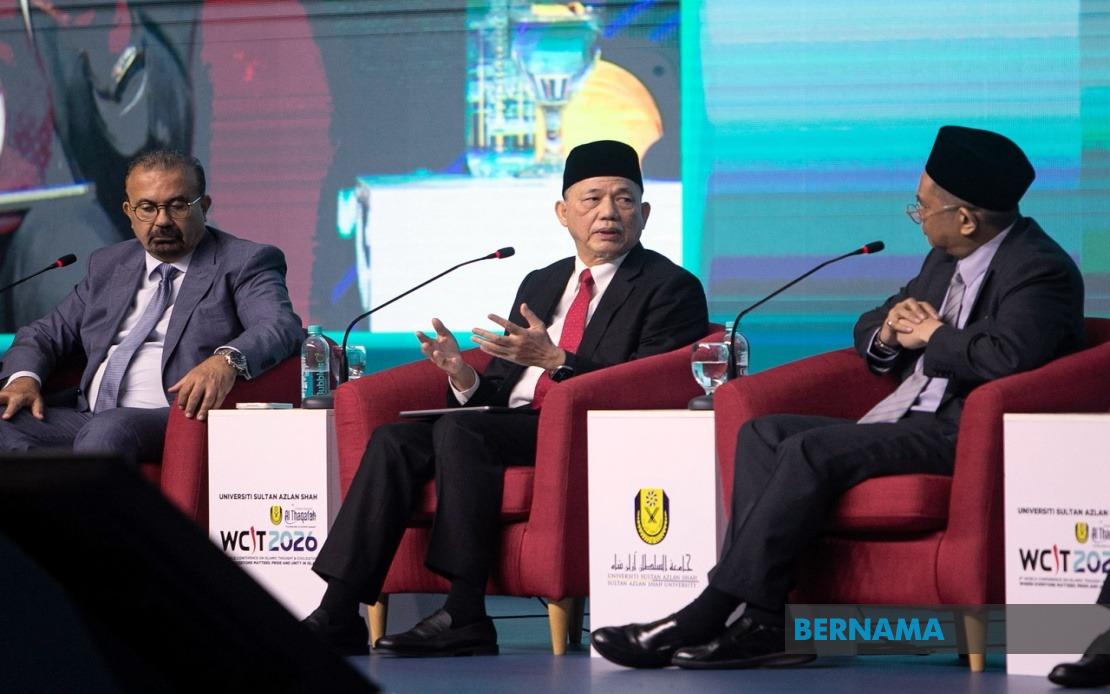
The growing nexus between energy markets and maritime stability represents one of the most pressing challenges facing Southeast Asia, according to Deputy Prime Minister Datuk Seri Fadillah Yusof. Speaking at a distinguished panel discussion during the 8th World Conference on Islamic Thought and Civilisation in Ipoh, Fadillah, who holds the Energy Transition and Water Transformation portfolio, stressed that recent geopolitical tensions—particularly escalating friction between the United States and Iran—have exposed the vulnerability of global supply chains to distant political upheaval. What happens thousands of kilometres away no longer remains a distant concern; instead, it cascades directly into Malaysian homes through higher electricity bills, constrained fuel availability, and disrupted commerce.
The interconnectedness that Fadillah outlined reflects a structural reality often overlooked in traditional policy discussions. For decades, energy security was treated as a commodity question—how to ensure adequate oil, gas, and electricity supplies—while maritime security focused on piracy, territorial disputes, and freedom of navigation. Today, these domains have merged into a single ecosystem where disruption in one inevitably destabilises the other. The recent developments in the Strait of Hormuz, a chokepoint through which roughly one-third of global maritime petroleum trade passes, have crystallised this linkage. When tensions rise in that waterway, the ripple effects extend far beyond energy markets, touching insurance premiums, shipping costs, supply chain resilience, and ultimately consumer prices across virtually every economic sector.
Malaysia's position renders it particularly sensitive to such volatility. The country sits along the Strait of Melaka, one of the world's most critical maritime passages, through which trillions of dollars in annual trade flows. This geographic proximity to major shipping lanes means that any disruption to regional or global maritime stability immediately threatens Malaysian economic interests. Beyond the direct impact on energy supplies, which Malaysia both consumes and trades, the nation's role as a logistics hub and manufacturing centre depends on the predictable movement of goods and materials. Insurance cost increases triggered by heightened maritime risks, fuel surcharges imposed by shipping companies responding to geopolitical uncertainty, and delays in receiving critical components for domestic industries all impose tangible economic costs that eventually reach Malaysian consumers and businesses.
Fadillah's emphasis on Malaysia's diplomatic approach to these challenges underscores a pragmatic acknowledgment that military or confrontational responses would only deepen regional instability. Instead, the Deputy Prime Minister highlighted Malaysia's longstanding commitment to operating within a rules-based international system, a posture that has served the nation well for over a century. This orientation reflects not idealism but hard-nosed calculation: as a mid-sized economy dependent on open trade and stable shipping routes, Malaysia has no interest in a world organised around strategic competition and closure. The country's diplomatic neutrality and emphasis on multilateralism represent not weakness but a rational choice to protect Malaysian interests.
The convergence of energy and maritime security also carries implications for Malaysia's own energy transition agenda, another key responsibility of Fadillah's ministry. As the country moves toward renewable energy sources and away from hydrocarbon dependence, the volatility of global oil and gas markets becomes simultaneously more pressing and more manageable. Increased renewable capacity would reduce Malaysia's exposure to international energy price shocks triggered by geopolitical events. Yet the transition itself depends on stable global supply chains for importing solar panels, wind turbines, battery technology, and other components. The interconnected nature of modern industrial systems means that energy security and maritime stability cannot be pursued in isolation; they must be addressed through integrated strategies that recognise their mutual reinforcement.
The insurance sector's response to heightened maritime risks illustrates how abstract geopolitical tensions translate into concrete economic consequences. When shipping insurance premiums spike due to perceived danger in key passages, those costs are embedded into product prices across entire supply chains. Small Malaysian exporters in furniture, electronics, or petrochemicals face higher shipping costs that erode profit margins or force price increases that damage competitiveness. Similarly, Malaysian importers of raw materials or components experience cost pressures that cascade through domestic manufacturing and retail sectors. These microeconomic impacts, multiplied across thousands of firms and millions of transactions, can measurably affect inflation, employment, and growth.
Fadillah's intervention at the World Conference on Islamic Thought and Civilisation also carried a subtle diplomatic message. By situating Malaysia's pragmatic response to energy and maritime security challenges within a broader framework of Islamic values and civilisational dialogue, he implicitly advocated for conflict resolution and mutual understanding. The conference's theme of "Everyone Matters: Pride and Unity in Islam" provided an appropriate venue for arguing that escalating tensions between major powers serve no one's interests and that Islamic-majority nations like Malaysia have a particular responsibility to promote de-escalation and diplomatic solutions.
Looking ahead, the challenge for Malaysian policymakers lies in building resilience across multiple dimensions simultaneously. This requires not only diversifying energy sources and trade partners but also strengthening early warning systems for maritime and geopolitical risks, investing in supply chain redundancy, and deepening regional cooperation mechanisms that can respond collectively to disruptions. The alternative—remaining passive and hoping that distant conflicts remain distant—is no longer viable in an integrated global economy where energy prices, shipping costs, and political stability form an inseparable trinity.

