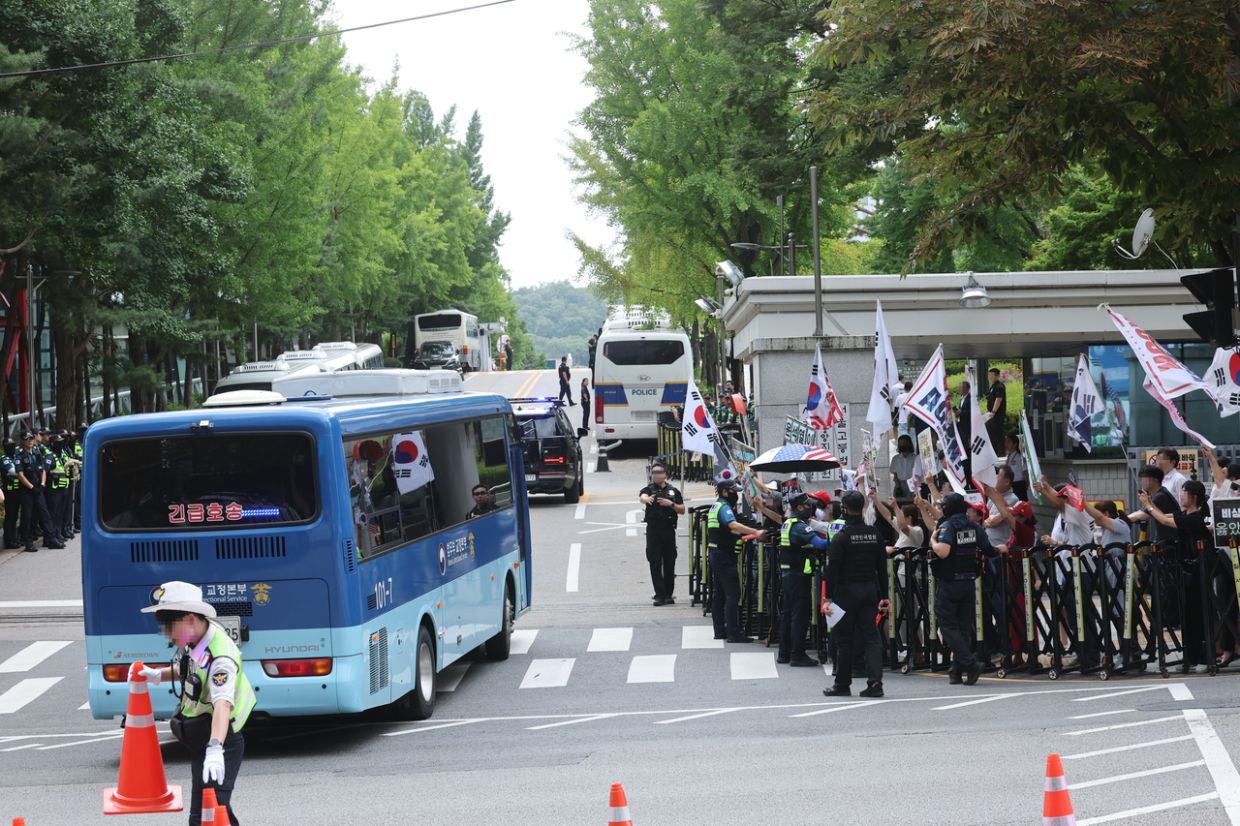
Former South Korean President Yoon Suk Yeol received a two-year prison sentence on Monday after the Seoul Central District Court found him guilty of breaching the Political Funds Act by accepting complimentary polling services valued at 27.92 million won (approximately US$18,600) from political broker Myung Tae-kyun during his presidential campaign. The conviction represents a significant legal setback for the ousted leader, who has faced mounting legal challenges since leaving office.
The court's guilty verdict centred on 14 opinion surveys provided by Myung between June 2021 and March 2022, determining that the polling services constituted an undeclared financial contribution to Yoon's campaign. Presiding Judge Lee Jin-gwan emphasized the fundamental role polling plays in democratic elections, noting that opinion surveys directly influence voter behaviour and shape public discourse. The judge articulated that when politicians accept contributions through mechanisms circumventing the Political Funds Act, the integrity of electoral processes faces serious jeopardy, as polls themselves become instrumentalized to manipulate democratic outcomes.
Prosecutors had initially presented a more expansive case, alleging that Yoon and his wife, former First Lady Kim Keon Hee, had conspired to receive 58 free surveys valued at over 270 million won from Myung during the same period. However, the court found sufficient evidence to convict only on 14 of the disputed surveys, ultimately valuing the proven benefit at 27.92 million won. This narrower conviction suggests the judiciary applied stringent evidentiary standards, requiring demonstrable proof of each individual transaction rather than accepting broader patterns of alleged misconduct.
The court determined that former First Lady Kim had granted Myung authority over critical polling decisions, including when surveys would be conducted, their subject matter, methodology, and whether results would be publicly disclosed. Yoon's awareness of this arrangement and his implicit acceptance of it constituted tacit consent, effectively binding all three parties to what the court characterized as a successive and continuing agreement. This finding proved crucial, as it allowed the court to treat the polling provision as an orchestrated scheme rather than isolated instances of assistance.
A significant component of the prosecution's original case involved allegations that Yoon promised to secure the People Power Party's presidential nomination for former lawmaker Kim Young-sun in exchange for the polling services. The court confirmed that Yoon did indeed make such commitments to Myung and subsequently exerted influence through Chang Je-won, who served as chief of staff to the president-elect, to facilitate Kim Young-sun's nomination process. This quid pro quo arrangement—polling services in return for political preferment—demonstrated how campaign finance violations intersected with electoral manipulation.
Notably, the court emphasized that proving an explicit quid pro quo arrangement was not legally necessary to establish a Political Funds Act violation. This distinction carries substantial implications, as it means Korean campaign finance law treats undeclared contributions as inherently problematic regardless of whether direct reciprocal arrangements can be demonstrated. Such an approach reflects legislative intent to maintain transparent, regulated campaign financing without creating opportunities for shadow support networks.
Myung Tae-kyun, the political broker who provided the surveys, received an 18-month prison sentence and was taken into custody immediately following the ruling. His conviction alongside Yoon's demonstrates that facilitators of campaign finance violations face comparable criminal exposure to the benefiting politicians, potentially deterring future brokers from engaging in similar arrangements.
The divergent treatment of Yoon and his wife in the courts created notable complications. While Yoon's conviction proceeded, his wife Kim Keon Hee was acquitted at both trial and appellate levels in her separate case involving the identical polling services. The appellate court found that prosecutors failed to establish that Kim received a quantifiable financial benefit or that the polling provision was conditional upon securing Kim Young-sun's nomination. Judge Lee acknowledged these fundamental differences, stating that allegations concerning the polling in Kim's case could not be regarded as identical to those in Yoon's case.
This divergence highlights interpretive subtleties within campaign finance prosecution. The courts apparently distinguished between receiving polling services (Kim's alleged offense) and orchestrating the broader scheme through which polling services were provided (Yoon's proven violation). The distinction suggests that those who passively benefit from campaign support may face lower evidentiary burdens than those who actively structure arrangements, though this remains subject to further review.
The Supreme Court is scheduled to deliver its final ruling on Kim Keon Hee's case on Thursday, potentially clarifying whether the appellate court's more lenient interpretation will survive highest-level judicial scrutiny. Given Yoon's conviction on the same factual foundation, the Supreme Court faces pressure to explain why the former First Lady's legal position differs materially from the former President's.
For Malaysian and Southeast Asian observers, the Yoon case illustrates how established democracies investigate and prosecute alleged campaign finance violations through independent judicial mechanisms. South Korea's relatively robust system of political accountability—featuring vigorous prosecution and appellate review—contrasts with enforcement patterns in some regional jurisdictions. The case underscores broader challenges in campaign finance regulation: determining what constitutes improper contribution, establishing causation between support and political favours, and distinguishing between legitimate political networking and corrupt arrangements.
Yoon's conviction also reflects South Korea's ongoing reckoning with presidential-era corruption, a cyclical pattern affecting multiple former heads of state. The sentence adds to mounting legal jeopardy facing the conservative leader, who faces additional pending trials on charges ranging from misuse of state funds to abuse of power, with each conviction narrowing potential appeals and amplifying prospects for sustained incarceration. Whether Yoon's legal defeats will reshape South Korean conservative politics or merely represent a temporary setback remains an open question as the country navigates persistent tensions between accountability and political continuity.

