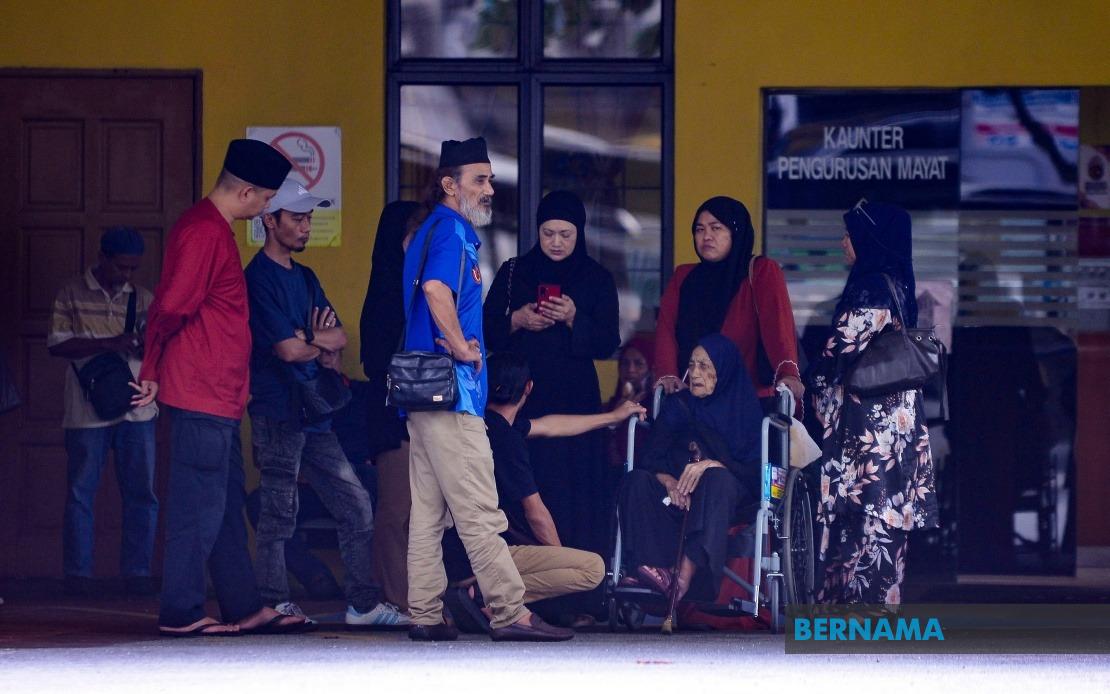
A relative of the victims in last week's fatal crash at Maju Junction involving a Malaysian Immigration Department lorry has publicly demanded a comprehensive and transparent investigation, raising questions about the circumstances that claimed three family members' lives in the early morning incident.
Mohd Nadzri Razali, 69, whose brother-in-law Shaik Mohd Firdaus Shaikh Yahya was among those killed, spoke from his home in the Klang Valley about the urgency of establishing the facts surrounding the collision. According to initial accounts, the empty Isuzu Black Maria lorry was traveling from the Kuala Lumpur Immigration Office toward Chow Kit for enforcement operations targeting undocumented workers when it entered the Maju Junction intersection. Witnesses and early reports suggest the vehicle may have proceeded through a red traffic light at the moment of impact, an assertion that has become central to the family's desire for a thorough examination of events.
The tragedy unfolded around 1 am when the lorry's trajectory collided with a Proton Saga sedan that was lawfully proceeding through the intersection on a green light. The force of the impact sent the Immigration vehicle spinning out of control, where it struck a group of pedestrians and a parked Inokom Matrix multi-purpose vehicle. Three members of a single family perished at the scene: Shaik Mohd Firdaus Shaikh Yahya, 53; his daughter Siti Nor Sazlin, 25; and his younger daughter Siti Darwisyah Auni, 12. The children's mother, Norhayati Razali, 55, sustained severe injuries and remains under intensive care at Kuala Lumpur Hospital, though she has regained consciousness.
For the extended family, the anguish of this incident is compounded by recent loss. Just months earlier, in May, another family member had passed away, making this fresh tragedy particularly devastating. Mohd Nadzri described the shock of losing three relatives simultaneously as deeply heartbreaking, noting that he had seen them alive only two weeks prior when they had traveled together to clean family graves in Teluk Bakong, in the Perak district of Ayer Tawar.
The condition of Norhayati Razali remains uncertain as medical teams assess whether she can be discharged from Kuala Lumpur Hospital or requires transfer for continued treatment. The family has expressed a preference for relocating her to Hospital Ipoh or Teluk Intan Hospital, both of which are closer to their base in Perak's Kampar district. Plans are already underway to lay all three deceased family members to rest in a single grave at the Muslim Cemetery in Kampung Air Hitam Labu, Kampar, a somber gesture reflecting the family's unity even in death.
The investigation into the collision has been formally initiated under Section 41(1) of the Road Transport Act 1987, the statutory framework governing serious motor vehicle incidents in Malaysia. This charge typically applies to dangerous or reckless driving causing death or injury. The involvement of a government vehicle in the accident raises additional scrutiny, as public bodies are expected to maintain the highest standards of operational safety and adherence to traffic laws. The question of whether the Immigration Department lorry's beacon lights and siren—which were reportedly active during the incident—created a false sense of right-of-way or distracted other road users, remains relevant to understanding how this tragedy occurred.
This incident highlights broader concerns about emergency and official vehicle operations on Malaysian roads. While beacon lights and sirens are intended to alert other drivers to the presence of authorized vehicles attending to urgent duties, their use does not grant immunity from traffic regulations. The suggestion that the lorry may have proceeded against a red light, while engaging in enforcement operations, underscores a potential disconnect between the urgency of official operations and compliance with road safety protocols that protect civilian lives. For families such as the Razalis, whose breadwinner and children were taken in an instant, such operational ambiguities translate into irreversible human cost.
The family's call for transparency reflects a broader public expectation that investigations into serious incidents involving government vehicles should be conducted with the same rigor applied to civilian cases, without any suggestion of protective bias. Malaysian authorities have in recent years made efforts to improve traffic safety and enforcement, yet incidents involving official vehicles continue to test public confidence in the consistency of that commitment. The loss of two young children in this particular collision makes the demand for answers particularly resonant for road safety advocates and families throughout the nation.
As Mohd Nadzri waits for details of the investigation to unfold, his family faces the immediate challenge of managing their grief while caring for their injured relative and arranging final rites. The long-term pursuit of justice and clarity may extend well beyond the initial police inquiry, potentially involving civil and administrative proceedings that could shape how government agencies operate their vehicles on public roads. For the Razali family, transparency in this investigation is not merely procedural; it is a matter of honoring the memory of those lost and protecting other families from similar tragedies.

