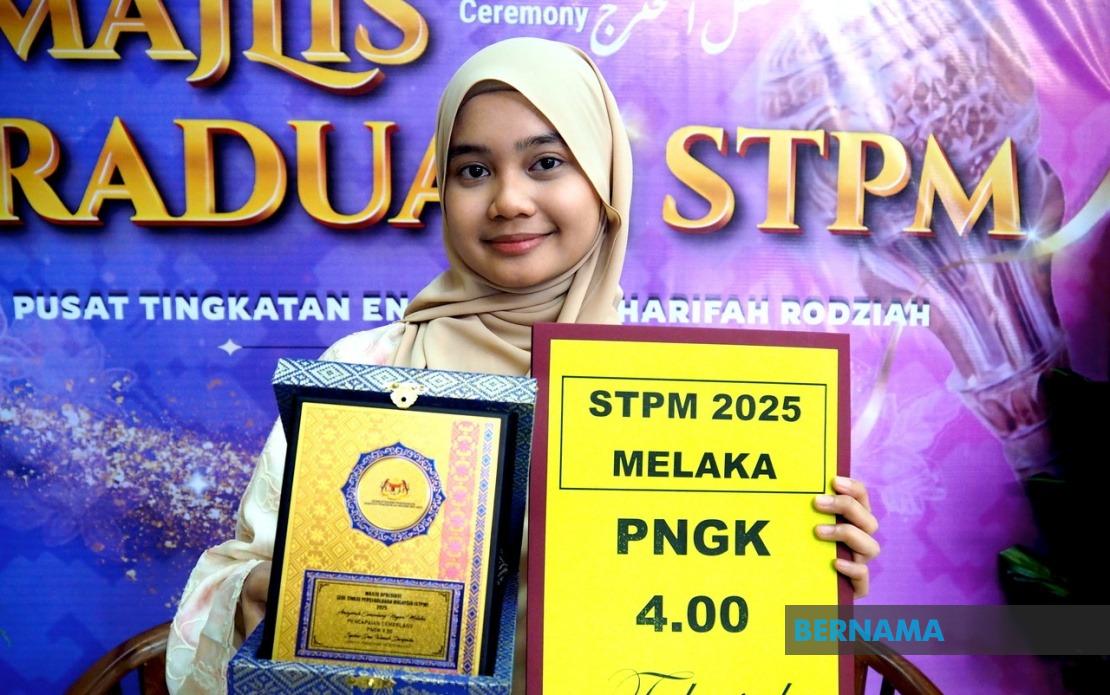
Nurfariesya Nasywa Hamedee's journey to a flawless 4.00 Cumulative Grade Point Average in the 2025 Sijil Tinggi Persekolahan Malaysia examination reflects how personal tragedy can become a source of extraordinary motivation. The 21-year-old from Sekolah Menengah Kebangsaan Agama Sharifah Rodziah in Melaka achieved the top score after her father, Hamedee Asri, passed away from a heart attack just days before her Sijil Pelajaran Malaysia trial examinations several years ago. That harrowing period tested her resolve as a student and as a young person navigating both academic pressures and family grief.
The emotional toll of losing a parent during formative educational years drove Nurfariesya to contemplate abandoning her studies altogether. The financial burden on her family and the psychological weight of her father's absence created a situation where continuing school seemed impractical and emotionally overwhelming. However, her mother, Yusnita Ruslan, became the bridge between Nurfariesya and her father's final wishes, conveying his explicit instruction that she should not squander her abilities. This transmission of encouragement across the divide between life and death became the cornerstone upon which she rebuilt her academic commitment.
What distinguishes Nurfariesya's achievement is not merely the numerical outcome but the deliberate choice she made to honor her father's memory through academic excellence. She transformed grief into discipline, viewing her studies as a tangible way to fulfill his dying hope for her future. This psychological reframing enabled her to approach her STPM subjects—General Studies, Arabic, Usuluddin, History, and Shariah—not as burdensome requirements but as pathways to realizing a shared family vision. Her previous SPM performance, earning seven A grades, had already signaled academic promise, yet the STPM results surpassed even her own expectations.
During the 2025 Melaka State STPM Results announcement presided over by State Deputy Exco Datuk Rosli Abdullah, Nurfariesya's accomplishment was recognized among the state's finest students. She had approached the examination with modest internal projections, based on trial examinations and preliminary calculations suggesting a CGPA around 3.92. The perfect 4.00 outcome exceeded these estimates, suggesting that her preparation and focus had crystallized into performance that transcended her own predictions. This gap between expectation and outcome underscores the sometimes mysterious relationship between academic preparation and examination day performance.
Her vocational aspirations shaped her subject selection and study approach throughout the STPM period. Nurfariesya harbors a specific ambition to become a Shariah lawyer, a career path requiring both rigorous religious and legal knowledge. Her choice of Shariah as one of her examination subjects reflected this long-standing interest, an intellectual curiosity that had animated her secondary education. Rather than viewing STPM as a generic qualification hurdle, she engaged with her coursework as foundational steps toward a defined professional identity, a perspective that likely intensified her commitment to achieving superior grades.
The practical dimension of Nurfariesya's decision-making also warrants attention. She selected STPM over alternative pre-university pathways because she perceived it as offering a more direct route to degree-level study while simultaneously providing flexible entry into various tertiary institutions. This calculated approach demonstrates that her success was not accidental but the product of strategic thinking about educational trajectories. Having recently completed an interview for Universiti Malaya's Bachelor's Degree program, she positions herself well to advance toward her professional objective at one of Malaysia's premier institutions.
When asked about the mechanics of her success, Nurfariesya resisted offering a formula or secret technique. Instead, she emphasized foundational principles: consistent hard work, psychological resilience in the face of setbacks, and maintenance of spiritual faith. This modesty regarding her achievement reflects a maturity uncommon among teenagers, possibly hardened by her early confrontation with mortality and loss. She articulated that grappling with academic difficulties was not grounds for despair but rather an occasion to deepen her motivation and recommit to her objectives. The intellectual discipline required for Shariah and Islamic theology studies likely cultivated this philosophical resilience.
Parallel recognition came to another outstanding Melaka student, Ng Zhen Hong from Kolej Tingkatan Enam Tun Fatimah, who earned the National-Level Best Student Award for the Science Stream in the 2025 STPM examination. The 20-year-old's achievement through Chemical Engineering and Electrical Engineering aspirations demonstrates that excellence in Malaysian pre-university examinations extends across diverse subject streams. Ng, who scored ten A grades in his SPM examination, credited parental support and pedagogical guidance as instrumental factors. His commitment to daily revision—dedicating one to two hours each day to consolidating knowledge—and his reframing of scientific challenges as motivational spurs rather than obstacles mirrored the psychological frameworks that underpinned Nurfariesya's success.
The distinction between these two exemplary students illuminates the heterogeneous pathways to academic achievement. Nurfariesya drew strength from grief and familial obligation, channeling emotional intensity into disciplined study. Ng derived momentum from passion for scientific investigation and the intellectual satisfaction of problem-solving. Both benefited from stable family environments and institutional support, yet their psychological architectures differed meaningfully. Nurfariesya's motivation operated substantially at the emotional and spiritual register, while Ng's functioned more through intellectual engagement and systematic preparation. These variations suggest that high-performing students succeed through diverse psychological mechanisms rather than a uniform formula.
For Malaysian educational stakeholders and parents, these narratives offer sobering insight into the importance of cultivating resilience and purpose beyond grades themselves. Nurfariesya's story particularly resonates because it demonstrates that students experiencing profound personal adversity need not abandon their educational aspirations but can instead transmute hardship into determination. The role of parental encouragement, even communicated posthumously through surviving family members, appears significant in sustaining commitment through difficult periods. Similarly, the recognition of Ng's science achievement at the national level affirms Malaysia's capacity to produce globally competitive minds in technical disciplines.
Both students exemplify the outcomes possible within Malaysia's structured secondary and pre-university educational systems. Their selections of Universiti Malaya as their intended institution suggests that domestic higher learning opportunities remain attractive to top-tier students despite the availability of international alternatives. This preference may reflect confidence in Malaysia's premier university's capacity to deliver quality education aligned with their professional ambitions, whether in Shariah law or engineering disciplines. The STPM qualification itself, having produced perfect scorers and national-level award recipients, demonstrates its continued relevance as a rigorous pathway to tertiary education and professional development in contemporary Malaysia.

