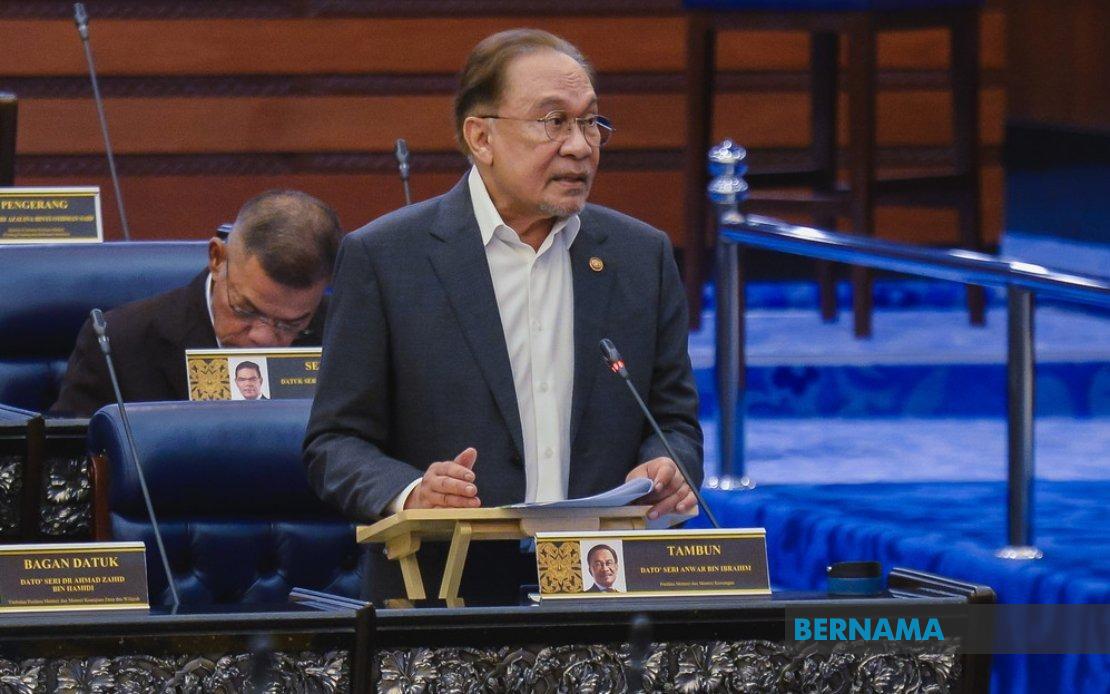
Prime Minister Datuk Seri Anwar Ibrahim has established a clear protocol for managing state-level requests for supplementary project financing, particularly when construction costs exceed original budgets. Speaking in the Dewan Rakyat on June 30, Anwar underscored that any Notice of Change—a formal mechanism signalling project modifications and associated financial implications—cannot simply be approved at the state level without triggering a comprehensive federal review process.
The Prime Minister's position reflects growing concerns about fiscal discipline across Malaysia's federal structure. When a state government issues an NOC, it represents more than a simple administrative adjustment; it signals potential cost overruns that must be scrutinised through multiple lenses before taxpayer funds are committed. Anwar identified two critical assessment criteria that must precede any decision on additional allocations. First, authorities must establish whether the contractor bears responsibility for the escalated expenses, as opposed to unforeseen circumstances or genuine market pressures. This distinction carries legal and contractual ramifications that could influence how disputes are resolved and whether cost recoveries are pursued.
Second, and perhaps more fundamentally, Anwar articulated a constitutional principle that federal resources cannot be deployed automatically whenever state-level expenditures increase. The central government cannot be bound by unilateral decisions taken by state authorities, nor can it be expected to absorb costs as a matter of routine. This statement reinforces the boundaries of cooperative federalism in Malaysia and establishes that financial interdependence does not equate to abdication of federal fiscal oversight.
The specific catalyst for this pronouncement was a supplementary parliamentary question from Datuk Awang Hashim, the PN member for Pendang, concerning Kedah's application for extra funding on the Pulau Bunting Water Treatment Plant project. The Pulau Bunting facility represents significant infrastructure investment for the northern state, and the emergence of cost pressures illustrates a recurring challenge across Malaysia's development landscape. Water infrastructure projects frequently encounter complications stemming from geological surveys, environmental assessments, or labour shortages that materialise only during construction phases, explaining why such projects commonly require financial restructuring.
Anwar's intervention carries particular weight given his position navigating a coalition government comprising federal and state administrations of varying political hues. Kedah, governed by Perikatan Nasional, represents a different political constellation than the federal government, potentially adding complexity to negotiations over resource allocation. However, the Prime Minister's framing suggests that political alignment would not influence the rigour of the assessment process—the principles governing cost review would apply uniformly regardless of state administration colour.
The requirement for renegotiation before federal approval essentially establishes a multi-stage approval mechanism. Rather than state NOCs triggering automatic federal disbursements, affected parties—state authorities, contractors, and federal ministries—must reconvene to examine the cost drivers, apportion responsibility, and determine whether federal participation is proportionate and justified. This approach mirrors international best practice in project finance, where cost overruns trigger value-for-money assessments rather than rubber-stamp approvals.
Deputy Prime Minister and Energy Transition and Water Transformation Minister Datuk Seri Fadillah Yusof was assigned responsibility for elaborating on these principles, suggesting that water infrastructure projects will receive particular attention under this new framework. Water treatment and distribution networks have become increasingly critical across Malaysia as urbanisation intensifies and climate variability affects supply reliability. However, the sector has also experienced persistent budget pressures, making fiscal discipline essential.
The policy direction carries implications extending beyond Kedah. Other state governments—whether under federal coalition members or opposition control—will likely interpret this pronouncement as a signal that cost escalations cannot be resolved through expedited federal channels. States will be incentivised to conduct more thorough pre-construction risk assessments, tighten contractor oversight, and structure contingency provisions more conservatively. This may slightly slow project initiation timelines but should ultimately reduce the frequency of costly mid-construction redesigns.
For contractors, Anwar's stance creates additional scrutiny regarding cost estimates and performance. Firms submitting tenders for state-level projects cannot assume that subsequent cost pressures will be absorbed through federal bailouts. This should theoretically encourage more rigorous cost engineering and risk management practices, though it may also deter some contractors from bidding on projects perceived as containing high uncertainty.
The renegotiation requirement also reflects broader fiscal pressures confronting Malaysia's federal government. With debt levels elevated and competing demands on limited resources, the Prime Minister appears intent on preventing state cost overruns from becoming a de facto claim on federal revenues. This disciplinary approach acknowledges that federal support, while essential for major infrastructure, cannot be unlimited or unconditional.
Anwar's framework suggests a maturing approach to project governance within Malaysia's federal structure. Rather than treating NOCs as technical adjustments requiring minimal scrutiny, they are now positioned as significant financial events warranting systematic review. This change in emphasis—from administrative processing to substantive assessment—should strengthen overall project outcomes and fiscal accountability across Malaysian public investment.
Going forward, state administrations pursuing large infrastructure projects would be wise to allocate greater resources to initial planning, site investigation, and risk identification before construction commences. The federal government's willingness to support genuine contingencies remains evident, but automatic approval for cost escalations appears to have ended. This recalibration of state-federal financial relations, though constraining in the short term, creates incentives for more disciplined public investment practices throughout Malaysia.

