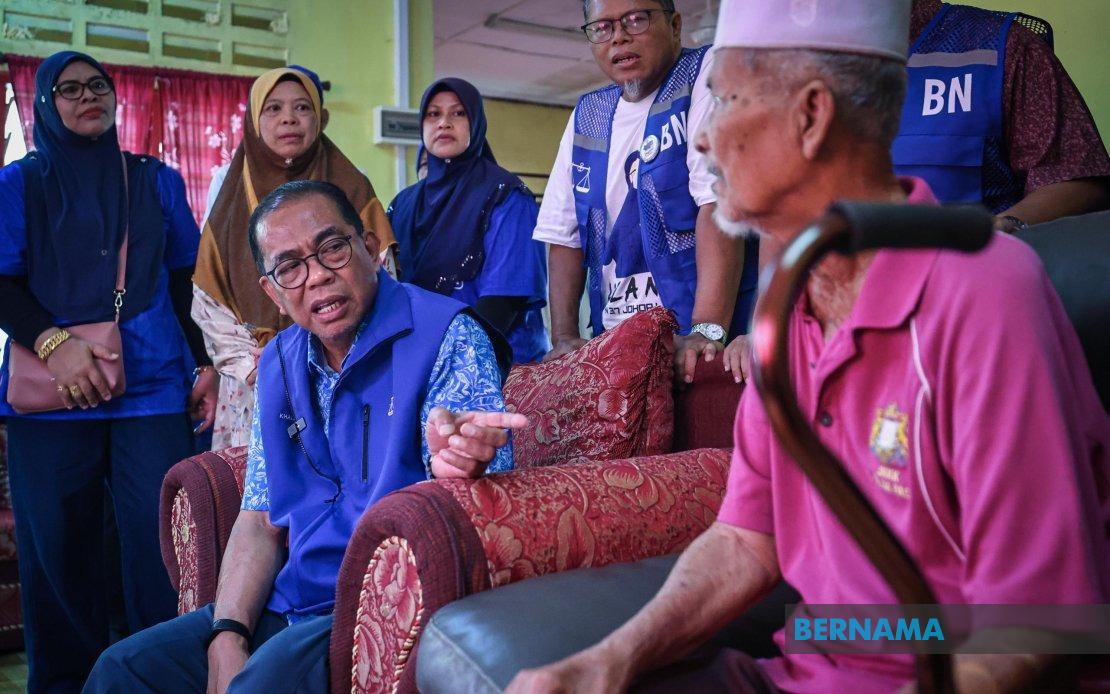
Ahead of Johor's state election this Saturday, Defence Minister and UMNO vice-president Datuk Seri Mohamed Khaled Nordin has sought to calm voter concerns about potential friction between state and federal governments should different political coalitions win power. Speaking during a campaign visit to Kota Tinggi, he emphasized that constitutional mechanisms ensure both levels of government will work together regardless of their political composition, underpinning his remarks with references to the Federal Constitution's framework for power-sharing.
Mohamed Khaled's comments address a significant concern among some Johor voters about the implications of a divided government—where the state administration may answer to one coalition while federal authority rests with another. This scenario has become increasingly plausible in Malaysia's fragmented political landscape, where no single bloc commands overwhelming dominance nationwide. The Defence Minister stressed that both the UMNO party leadership and constitutional architects have crafted safeguards to prevent political differences at different governmental levels from deteriorating into conflict that might harm public services or development initiatives.
The constitutional framework he referenced designates specific powers and responsibilities to federal and state authorities, creating distinct spheres of governance that reduce the potential for inter-governmental disputes. Under this division, state governments retain control over matters such as land, Islamic affairs, and local administration, while the federal government manages defence, foreign policy, and certain economic matters. This compartmentalization theoretically allows governments of different political stripes to function effectively without necessarily compromising one another's agendas, though historical experience shows cooperation remains vital in many practical areas affecting citizens' daily lives.
Mohamed Khaled articulated a principle of mutual respect that he positioned as binding on both federal and state administrations. He indicated that whoever forms government at either level must receive cooperation from the other tier, suggesting this obligation flows both directions and is not conditional on shared political ideology. This framing attempts to present constitutional governance as transcending partisan divisions, appealing to voters who might otherwise fear that electing an opposition state government could result in punitive action or withholding of development funding from the federal government.
The Defence Minister's reassurance comes as Johor embarks on the 16th state election on July 11, in which 172 candidates are competing for 56 state assembly seats. A total of 2,727,926 registered voters will determine the outcome, making this a significant test of political sentiment in the country's southernmost peninsula state. The electorate's composition and voting patterns often signal broader trends affecting national politics, giving this election relevance beyond state boundaries.
Barisan Nasional, the long-governing coalition anchored by UMNO, is defending its position with candidates contesting all 56 seats. The coalition's track record here remains strong by historical standards—in the 2022 state election just three years prior, BN secured 40 of the 56 seats available, though this represented a decline from its previous dominance in the state. That result reflected Malaysia's broader political turbulence during that period and demonstrated that even BN's traditional strongholds were not immune to voter dissatisfaction or opposition inroads.
Mohamed Khaled's confidence in BN's prospects reflects the coalition's reliance on its established track record and what he characterized as voter confidence in its performance. He appealed explicitly to the Johor electorate to grant BN a fresh mandate, framing the choice as fundamentally about which coalition has demonstrated competence in governance and development delivery. This messaging underscores BN's typical campaign strategy of emphasizing stability, experience, and continuity rather than radical policy departures.
For Malaysian observers and Southeast Asian analysts watching state-level politics in the region's larger democracies, the Johor election offers insights into how federalism functions in practice across different political scenarios. Malaysia's constitutional framework theoretically permits the kind of divided government that has become routine in countries like India or Australia, yet the political culture and historical precedent differ substantially. The question of whether federal-state cooperation can genuinely transcend party lines remains partly untested in recent Malaysian experience, making Mohamed Khaled's assurances both noteworthy and testable.
The timing of the Defence Minister's comments reflects BN's apparent strategy of addressing voter hesitations head-on rather than assuming their concerns will automatically resolve in the coalition's favor. By proactively discussing constitutional protections and mutual cooperation principles, the campaign seeks to neutralize arguments from opposition parties that might emphasize risks of divided government or suggest that federal resources might be weaponized against opposition-led states. This defensive positioning, even while expressing optimism, suggests BN strategists recognize that voter enthusiasm may not be entirely assured.
The broader implication of Mohamed Khaled's remarks extends to how Malaysia's political system has evolved in an era of genuine multipolarity. No longer can any coalition assume automatic cooperation from other governmental tiers simply by virtue of electoral victory. Instead, successful governance increasingly requires explicit commitments to constitutional norms and cross-partisan cooperation. The Defence Minister's emphasis on constitutional foundations rather than party loyalty reflects this maturation, even as BN simultaneously campaigns for expanded power.
For Johor specifically, the election result will indicate whether voters are persuaded by BN's record and reassurances, or whether they believe alternative coalitions offer better prospects. The state's economic importance—particularly its role as a manufacturing hub and strategic southern gateway—means that governance quality and federal-state cooperation have tangible impacts on investment, employment, and infrastructure development. Both factors likely weigh in voters' calculations, sometimes reinforcing and sometimes complicating partisan considerations.
As the July 11 election approaches, the contest will reveal whether Mohamed Khaled's constitutional reassurances address voter anxieties effectively or whether deeper concerns about political fragmentation and governance uncertainty influence voting patterns. The result will contribute to the evolving narrative about whether Malaysia's democratic system and federal framework can accommodate genuine political competition across multiple governmental levels without sacrificing developmental or institutional cohesion.

