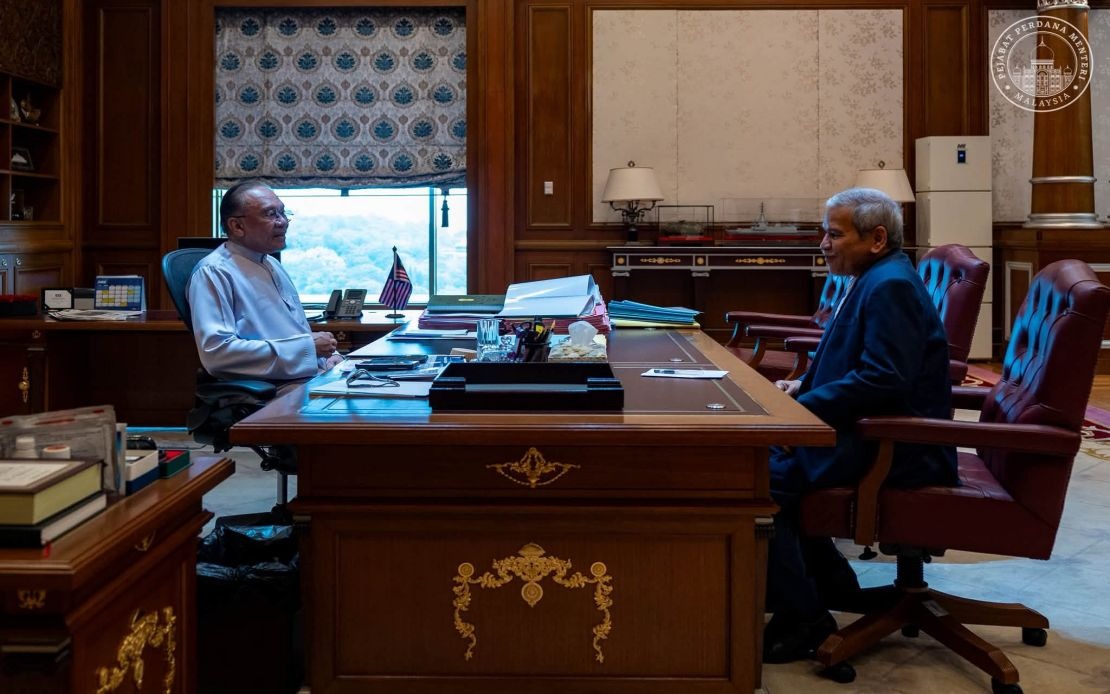
Prime Minister Datuk Seri Anwar Ibrahim has reaffirmed the government's commitment to systematically strengthening the Federal Land Development Authority, emphasizing that the institution remains fundamental to improving the lives of settlers and their dependents. The assurance came during a meeting in Putrajaya with newly appointed FELDA chairman Tan Sri Ahmad Badri Mohd Zahir, reflecting the administration's determination to place settler welfare at the forefront of policy priorities.
Anwar, who concurrently holds the Finance Ministry portfolio, stressed that institutional reinforcement must proceed in tandem with safeguarding settler prosperity across all age groups. This dual-track approach acknowledges that simply preserving FELDA's historical mission is insufficient without addressing the evolving challenges faced by younger settlers who inherit smallholdings and confront modern market dynamics. The Prime Minister's emphasis on generational concerns signals recognition that successive cohorts of settlers confront fundamentally different economic landscapes from their predecessors, requiring tailored solutions.
The appointment of Ahmad Badri marks a transition in FELDA's leadership structure. He assumes the chairman role from July 15, succeeding Datuk Seri Ahmad Shabery Cheek, whose tenure concluded on June 30. This transition occurs within a broader policy environment where the government increasingly scrutinizes state-linked entities for their alignment with development objectives. Ahmad Badri's appointment thus carries significance beyond routine administrative succession, representing an opportunity to recalibrate FELDA's strategic direction.
Anwar's comments underscore a critical dimension often overlooked in discussions about FELDA's future: the tension between maintaining social welfare functions and achieving economic sustainability. As commodity prices fluctuate and global supply chains shift, FELDA-managed agricultural operations face mounting pressure to remain competitive. The incoming chairman therefore inherits responsibility not merely for protecting settler incomes but for positioning the authority as an economically viable enterprise capable of delivering dividends.
The reference to strengthening FELDA's economic competitiveness carries particular relevance for Malaysian smallholder agriculture. Approximately 112,000 settlers work within FELDA's framework, many cultivating oil palm, rubber, and cocoa on allocated plots. These individuals represent a substantial portion of Malaysia's agricultural workforce, yet they often operate at scale disadvantages relative to larger commercial operations. Any institutional reforms must therefore balance efficiency improvements with the imperative to ensure settlers themselves benefit from productivity gains rather than bearing adjustment costs.
Anwar's articulation of the MADANI Government's support signals that FELDA modernization features prominently within the administration's broader development agenda. The MADANI framework—centred on principles of unity, prosperity, and sustainability—positions FELDA upgrading as integral to achieving inclusive economic growth. This framing suggests that forthcoming policy initiatives may expand beyond traditional settler support mechanisms to encompass digital agricultural adoption, cooperative strengthening, and market access improvements.
Younger settler cohorts present particular policy challenges. Many inherit smallholdings as family assets but lack agricultural backgrounds or face geographic remoteness from processing facilities. Land values have appreciated, creating tensions between agricultural use and development pressures. These emerging tensions demand innovative solutions, potentially including agricultural value-chain integration, agritourism opportunities, or deliberate cultivation of higher-margin specialty crops. Ahmad Badri's appointment therefore arrives at a juncture where strategic decisions will significantly shape FELDA's medium-term trajectory.
The institutional strengthening agenda also connects to broader regional considerations. Southeast Asian smallholder agriculture increasingly confronts competition from Vietnamese, Indonesian, and Thai producers operating at varied scales and cost structures. Malaysian FELDA settlers cannot compete purely on volume; instead, they must differentiate through quality, sustainability certification, or brand positioning. Institutional support mechanisms that facilitate such upgrading become economically rather than merely socially justified.
Anwar's explicit commitment to continued government support carries financial implications that merit examination. FELDA has historically relied on government subsidies, loan facilities, and preferential pricing arrangements. Sustaining these mechanisms while achieving financial autonomy presents a paradox that successive administrations have struggled to resolve. The Prime Minister's pledge suggests willingness to maintain fiscal support, yet achieving genuine sustainability may ultimately require settlers themselves to transition toward more market-responsive production and management practices.
The timing of leadership transition coincides with evolving global agricultural policy frameworks. Sustainability standards, carbon footprinting requirements, and traceability mechanisms increasingly shape international commodity markets. FELDA's institutional capacity to guide settlers through these regulatory transitions—whether through certification programmes, coordinated marketing, or processing facility upgrades—will determine whether settlers benefit from or become marginalised by global market evolution.
Ahmad Badri assumes chairmanship during a period of significant internal and external pressures on FELDA's traditional model. Commodity price volatility, climate impacts on production, and land scarcity in certain regions compound structural challenges. The incoming chairman's ability to navigate these constraints while maintaining settler morale and institutional credibility will substantially determine whether FELDA evolves as a modernised institution capable of serving contemporary settler needs or gradually diminishes in relevance.
Moving forward, FELDA's reinforcement under Ahmad Badri's stewardship will likely emphasize both heritage preservation and pragmatic modernization. Settlers entered the authority with expectations of dignified livelihood and community belonging; these social dimensions remain essential. Simultaneously, without meaningful economic advancement and competitive sustainability, FELDA risks becoming a museums-piece institution serving an ageing population. The Prime Minister's emphasis on dual-track development—strengthening both welfare and competitiveness—suggests the government understands this fundamental challenge and intends Ahmad Badri to navigate it constructively.

