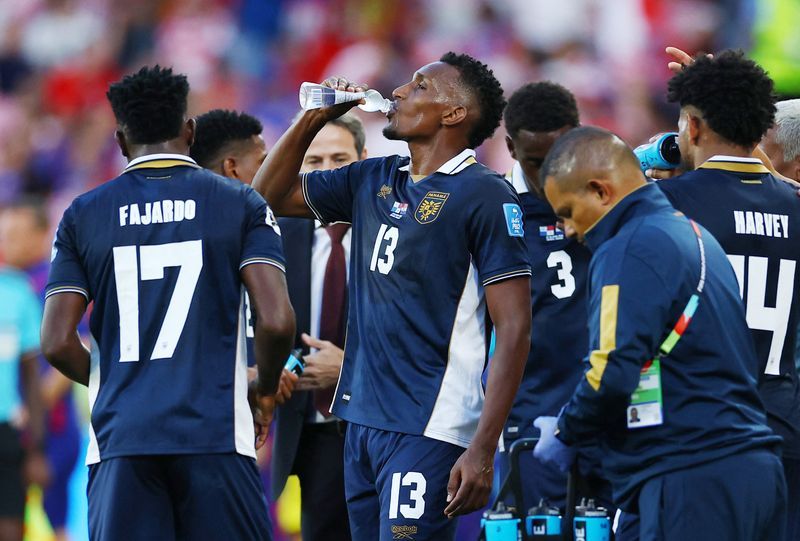
FIFA president Gianni Infantino has moved to quash growing criticism of the mandatory hydration breaks now featuring in every World Cup match, emphatically stating that the initiative stems from sporting necessity rather than financial opportunism. The three-minute stoppages, occurring at the 22nd and 67th minutes of play, have become a focal point of debate among players, managers, and supporters since matches began, with Infantino on Wednesday providing his most detailed defence of the controversial measure.
The introduction of these breaks at the tournament, held across North America, was initially justified as a response to the searing heat conditions facing competitors throughout the competition. However, the stoppages have coincided with new advertising slots for broadcasters, sparking accusations that FIFA has cynically exploited player welfare as a smokescreen for revenue generation. This commercial dimension has resonated with viewers frustrated by frequent interruptions to gameplay, making the issue a flashpoint in broader discussions about the integrity of the sport.
Infantino directly addressed these suspicions in his statement, clarifying that FIFA receives no additional financial benefit from the breaks because all broadcast rights and commercial agreements had been finalised before the hydration breaks were introduced. This distinction carries weight in separating the sporting rationale from any revenue motive, though it does not entirely silence concerns about whether the measure was necessary or proportionate. The president's assertion that the financial element was disconnected from the decision's implementation marks an attempt to reset the conversation around motivation and intent.
Beyond thermoregulation, the breaks have introduced a tactical dimension that has alarmed several high-profile managers. The stoppages provide opportunities for coaching staff to deliver in-match instructions and adjustments, fundamentally altering the rhythm and strategic flow that have traditionally defined football. England manager Thomas Tuchel voiced concerns that the breaks "interrupt and change the identity of the football match," a sentiment echoing broader worries about how they reshape tactical contests. Uruguay's Marcelo Bielsa similarly objected, arguing that subdividing matches into shorter segments undermines a core characteristic of football's nature.
Yet support for the principle of the breaks has emerged from unexpected quarters, with some leading figures acknowledging merit in the underlying philosophy despite reservations about application. Spain coach Luis de la Fuente and Netherlands captain Virgil van Dijk have signalled acceptance of the heat mitigation argument, though both questioned whether the breaks should apply uniformly across all venues and conditions. This nuanced position reflects genuine concern for player safety whilst questioning whether one-size-fits-all implementation serves all circumstances equally.
Infantino's response to these critiques emphasised the cumulative demands placed on players across the tournament's extended schedule. Over the 39-day competition, teams competing in later stages face the prospect of playing eight matches within that window, a compressed calendar that amplifies fatigue and injury risk. In this context, the additional rest moment serves purposes beyond immediate heat management, functioning as a necessary intervention in a tournament structure that tests human physical limits. This scheduling reality underpins Infantino's insistence that the breaks address legitimate welfare concerns.
The FIFA president also framed the measure as essential to maintaining competitive equity across the entire tournament. Without standardised hydration breaks, the temperature conditions experienced during different matches might create uneven advantages, allowing coaches in hotter conditions to justify tactical adjustments whilst their counterparts in cooler environments faced different constraints. By imposing identical breaks regardless of actual heat levels, FIFA sought to ensure that all teams operated under comparable rules, preventing circumstantial factors from determining access to strategic opportunities. This principle of fairness across diverse conditions underpins what Infantino characterised as a necessary uniformity.
Criticism that the breaks have diminished match intensity has also been rebutted by Infantino, who argued that data suggests players maintain competitive vigour throughout games despite the stoppages. This claim directly challenges perceptions that the interruptions disrupt momentum in ways that weaken spectacle or athletic standards. Whether such claims can be substantiated through objective metrics remains an open question, particularly given the subjective nature of assessing match rhythm and intensity.
For Southeast Asian audiences, the hydration breaks carry particular relevance given the region's climate challenges and the tournament's North American setting. Malaysian football observers will recognise the practical difficulties posed by heat and humidity, issues that Southeast Asian players navigate regularly during regional competitions. The World Cup's decision to incorporate formal hydration protocols sets a precedent that could influence how tournaments in tropical regions approach player welfare, potentially encouraging similar measures in future competitions hosted in Asia. This precedent may reshape how international football balances commercial imperatives with genuine concerns for athlete safety in demanding climates.
The debate also illuminates broader tensions within modern football between tradition and adaptation. As competitions evolve and external pressures mount—whether climatic, commercial, or logistical—governing bodies must navigate between preserving the sport's essential character and accommodating new realities. Infantino's defence represents FIFA's positioning within this ongoing negotiation, asserting that sporting integrity and player protection can coexist with structural innovation. Whether the global football community accepts this framing will likely determine whether hydration breaks become a permanent fixture or a temporary experiment.

