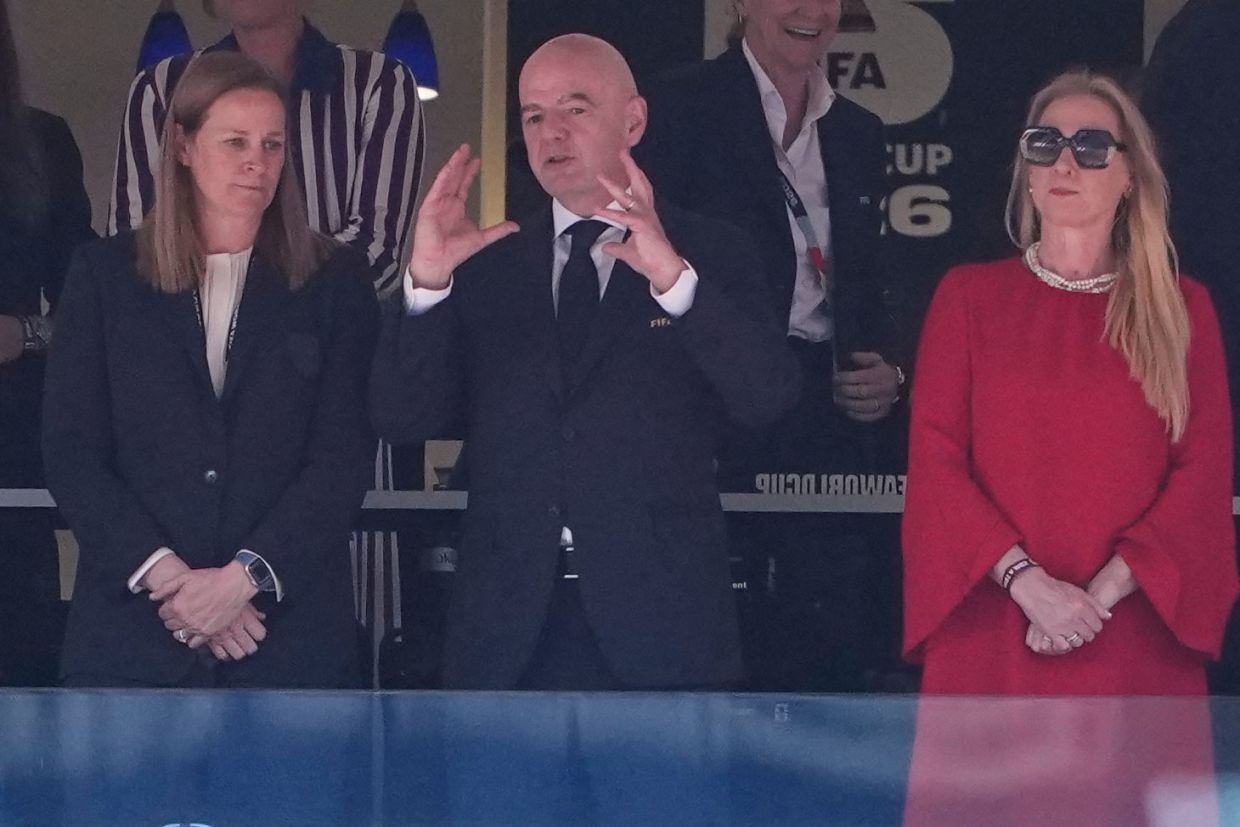
Gianni Infantino's grip on world football has tightened considerably as the dust settles on a World Cup marred by numerous controversies, from astronomical ticket prices to geopolitical entanglements involving Donald Trump. The FIFA president's position appears remarkably secure heading into his re-election bid in early 2027, when he will again run unopposed for a third consecutive term at the federation congress in Rabat, Morocco.
The tournament has faced relentless criticism on multiple fronts. Ticket costs have drawn widespread complaints from supporters unable to afford attendance. Iran's squad was excluded from competing, while a Somali referee was barred from participation. Most recently, FIFA's decision to allow a suspended American player to compete after Trump's intervention triggered accusations that the organization had capitulated to political pressure and compromised the sport's fundamental integrity. The incident prompted stark warnings from senior figures including former Liverpool manager Jurgen Klopp, who declared that permitting such interference was "madness" that "calls everything into question."
Yet these mounting controversies have failed to dent FIFA's financial performance or Infantino's political standing. The 56-year-old Swiss administrator has positioned the organization to extract approximately $9 billion in direct revenue from the 2026 World Cup—nearly $2 billion more than Qatar 2022 generated. This dramatic increase underscores Infantino's primary talent: monetizing global football at unprecedented scale. Since his appointment a decade ago following a major corruption scandal that engulfed his predecessor Sepp Blatter, he has systematized FIFA's revenue generation while maintaining tight control over the world's most popular sport.
The financial windfall extends far beyond FIFA's headquarters. Expanded stadium concessions have proven extraordinarily lucrative, with fans in some venues spending up to $100 per person on food and beverages—nearly double the spending typical at NFL matches. Mandatory hydration breaks, a decision widely viewed as a nod to American television schedules and sponsors, have essentially restructured the traditional format into four quarter-long segments rather than two halves, creating additional advertising and broadcast opportunities. Host cities have experienced measurable economic stimulus, with Bank of America data showing credit and debit card spending in World Cup venues jumped 6.3 percent year-on-year during the tournament, while non-local visitor spending surged 16.7 percent.
The prize distribution mechanism has become central to Infantino's strategy for securing federation loyalty ahead of his reelection. The total prize pot has doubled to a record $871 million, with every participating nation guaranteed a minimum $12.5 million simply for entering the tournament. This represents a transformational shift for smaller football associations. Cape Verde's historic tournament run generated over $21 million in FIFA payouts—equivalent to approximately 0.75 percent of the nation's entire annual GDP. For dozens of developing football federations across Africa, Asia, and South America, FIFA's financial generosity has become indispensable to their operational budgets and strategic planning.
This structural dependence explains why Infantino's reelection appears assured despite the controversies. The Asian Football Confederation, South American federations, and the vast majority of African nations have already pledged support. Sheikh Salman, president of the AFC, has declared that "FIFA is in its best position ever," effectively endorsing Infantino's continuity. The Royal Moroccan Football Federation, representing the next World Cup host nation, has publicly praised "the great work carried out by Mr. Gianni Infantino and his team to develop African and world football." With 211 member associations each holding a single vote, the arithmetic is overwhelmingly in Infantino's favor.
The expansion to 48 teams represents Infantino's most consequential structural reform, one that has simultaneously broadened football's global reach while entrenching his power base. Nine African nations reached the knockout stages, a historic achievement that resonated across the continent and reinforced African federation support. The larger tournament format has created more pathways for emerging football nations to participate and profit, effectively locking in voting support from the Global South—the overwhelming majority of FIFA's membership.
Sports lawyer Nick De Marco has articulated the fundamental tension underlying recent events: the question is no longer whether individual decisions were justified, but whether FIFA has fundamentally compromised its authority as football's global regulator. The Trump episode crystallized this concern. When FIFA permitted a suspended American player to compete following the American president's intervention, critics argued the organization had abandoned any pretense of neutral governance. Politicians from the United Kingdom and Belgium called for Infantino's resignation, suggesting that allowing national political leaders to influence on-field decisions represented an existential threat to the sport's credibility.
Yet within days of the controversy, the intensity of public outrage dissipated. Belgium's 4-1 defeat of the United States pushed the story from headlines, demonstrating the public's appetite for sporting drama over administrative governance questions. This pattern—controversy, international condemnation, rapid forgetting—has characterized Infantino's tenure since 2016. Complaints surface, generate headlines and social media outrage, then fade as the next match commands attention.
Infantino inherited a FIFA gravely damaged by the 2015 corruption scandal that toppled Blatter. He implemented modest transparency improvements and elevated the organization's public image, but fundamentally pursued expansion of FIFA's commercial operations and tournament footprint. The World Cup's restructuring reflects this philosophy: larger competitions generate more matches, more broadcasting opportunities, and more sponsorship inventory. The addition of 16 teams and expansion to three host nations in 2026 represents the logical culmination of this expansionist strategy.
The challenge for Infantino's critics—whether football purists concerned about competitive balance, smaller nations worried about dilution, or governance advocates demanding accountability—is that their complaints lack institutional power. Member federations, particularly in Africa and Asia where FIFA's financial support proves most consequential, have overwhelmingly decided that Infantino's tenure has benefited their organizations. Even controversies involving political interference have failed to mobilize sufficient dissent among voting federations.
Looking toward 2027, Infantino's reelection appears a formality rather than a genuine competitive contest. The federation congress in Rabat will likely provide theatrical ceremony around what amounts to a coronation. His third consecutive term will extend his stewardship of global football through 2031, consolidating perhaps the most consequential period of institutional change in FIFA's modern history. The World Cup's commercial success and expanded footprint, combined with strategic financial distributions that benefit the federation majority, have rendered Infantino effectively unassailable among the voting membership that determines FIFA's leadership.

