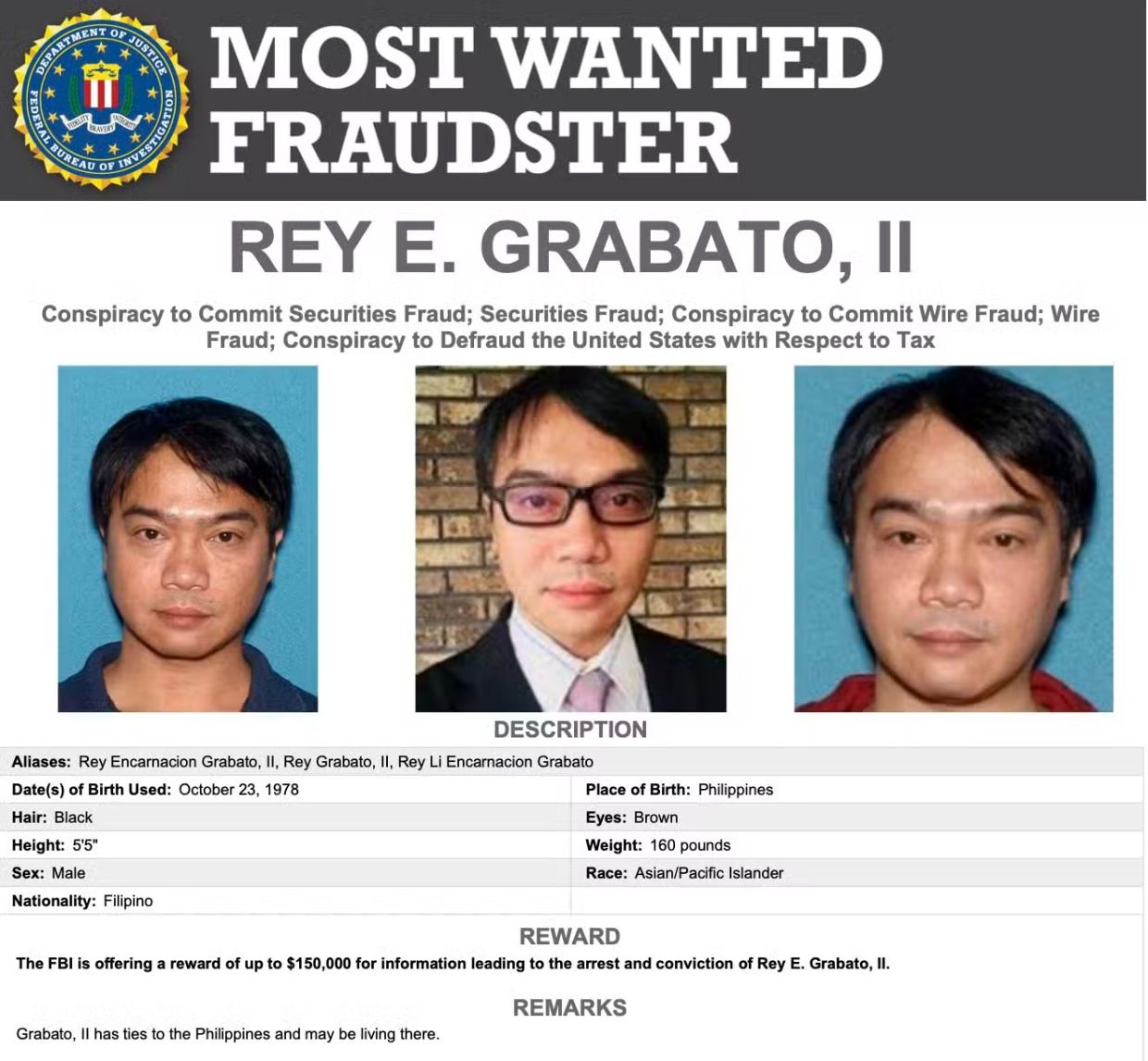
A Filipino businessman with high-profile family connections in Iloilo province has become the latest addition to the Federal Bureau of Investigation's Most Wanted Fraudsters list, accused of orchestrating one of the largest investment fraud schemes in recent years. Rey E. Grabato II, whose father serves as mayor of Mina and whose mother previously held the same municipal office, stands charged with defrauding approximately 2,000 investors of more than US$650 million through what authorities describe as an elaborate Ponzi operation. The case underscores how sophisticated financial crimes can span continents, ensnaring victims across the United States, the Philippines, and elsewhere while exploiting the veneer of legitimacy provided by corporate structures and aggressive marketing.
Grabato, who was identified at the time of his indictment as being based in Hoboken, New Jersey, though maintaining ties to the Philippines, is the former president and majority owner of National Realty Investment Advisors LLC, or NRIA. The FBI is offering a reward of up to US$150,000 for information that leads to his arrest and conviction, reflecting the bureau's prioritization of locating major fraud fugitives since the agency established its dedicated Most Wanted Fraudsters list in June 2026. Federal authorities have issued a warrant for Grabato's arrest on charges encompassing securities fraud, wire fraud, and conspiracy to defraud the United States in connection with tax obligations, demonstrating the multifaceted nature of the alleged wrongdoing.
The fraudulent scheme operated between February 2018 and January 2022, during which time Grabato and an alleged co-conspirator, Thomas Nicholas Salzano, are accused of using deceptive representations to convince investors to place capital into the NRIA Partners Portfolio Fund I LLC. The pair purportedly portrayed the real estate fund as a financially sound operation generating substantial returns, when prosecutors allege the company produced minimal to negligible profits. Instead of generating legitimate revenue, the operation allegedly followed the hallmark pattern of Ponzi schemes by funneling money from newly recruited investors to make payments to earlier participants, creating a facade of profitability that ultimately proved unsustainable.
The marketing campaign designed to attract investors demonstrated considerable sophistication and reach. Federal prosecutors documented that NRIA conducted an aggressive nationwide publicity drive encompassing thousands of email solicitations alongside television, radio, and billboard advertisements, complemented by in-person investor presentations. This multichanneled approach proved particularly effective in reaching hundreds of victims in New Jersey alone, alongside thousands of others across the country. The breadth and professional nature of the marketing effort suggest that the operation was designed to appear as a legitimate, well-established investment firm rather than an opportunistic scheme, lending credibility to the false narratives presented to prospective investors regarding fund performance and asset security.
Beyond the core investment fraud, prosecutors allege that Grabato and his associates misappropriated millions of dollars in investor funds for personal use, converting capital that should have remained invested or preserved for client returns into private enrichment. This layer of alleged misconduct transforms the scheme from a mere accounting manipulation into direct theft from vulnerable investors whose retirement savings and life's work may have been decimated by the fraud. For Malaysian investors who may have encountered similar operations or promotional materials, the case serves as a cautionary reminder of the risks posed by offshore investment schemes offering unusually generous returns without transparent underlying assets.
The alleged wrongdoing extended beyond the investment fraud into deliberate tax evasion. Grabato faces additional accusations of participating in a separate scheme designed to obstruct the Internal Revenue Service's collection efforts regarding approximately US$26 million in outstanding tax liabilities owed to the United States government. This separate fraud operation reportedly continued from November 2007 through August 2022, suggesting a pattern of systematic tax avoidance spanning multiple years and potentially involving sophisticated strategies to conceal income and obscure asset ownership. The overlap between these schemes indicates prosecutors' view of Grabato as having engaged in coordinated, premeditated criminal conduct rather than isolated lapses in judgment.
While Grabato remains at large following his indictment in the US District Court for the District of New Jersey in October 2022, his alleged co-conspirator Salzano was apprehended that same month. Grabato has reportedly used multiple variations of his name, including Rey Encarnacion Grabato II, Rey Grabato II, and Rey Li Encarnacion Grabato, a practice commonly employed by fugitives seeking to evade detection across different jurisdictions. His fugitive status and the continued inability of authorities to locate him highlight the challenges law enforcement faces in pursuing white-collar offenders with resources and international mobility.
The inclusion of Grabato on the FBI's Most Wanted Fraudsters list places him alongside other individuals with Filipino and Southeast Asian connections who have committed major financial crimes. Also on the roster is Michael Lizaso Marasigan, a Filipino-American with ties to Guam and the Philippines, convicted in May 2025 on charges involving illegal gambling, money laundering, and wire fraud. Additionally, the list includes John Michael Dimitrion and Julieanne Baldueza Dimitrion, a husband-and-wife team who pleaded guilty to orchestrating a mortgage fraud scheme in Hawaii before disappearing to avoid sentencing in 2010. These cases collectively demonstrate that major fraud operations frequently involve individuals with multiple national allegiances and geographic bases, complicating investigation and prosecution.
For Southeast Asian readers, particularly Malaysians, the implications of such cases extend beyond the immediate victims. The sophistication of transnational fraud schemes raises questions about the adequacy of cross-border regulatory coordination and investor protection mechanisms. Malaysia's Securities Commission and other regulatory bodies have increasingly emphasized the importance of investor vigilance when evaluating offshore investment opportunities, particularly those marketed aggressively through digital channels or offering above-market returns. The Grabato case exemplifies how legitimate-appearing corporate structures, professional marketing, and compelling promises of returns can obscure fraudulent fundamentals, making due diligence essential for any investor considering capital deployment across borders.
The financial consequences for victims have been substantial and often devastating. Defrauded investors, particularly those nearing or in retirement, have lost irreplaceable capital that cannot easily be recovered through legal proceedings, especially when perpetrators remain fugitive. Recovery efforts, even when successful in locating assets, typically return only a fraction of original investments to creditors after legal expenses and court-ordered restitution priorities. The case underscores the importance of regulatory frameworks that emphasize prevention over remediation, ensuring that investment firms undergo rigorous scrutiny before permission to solicit funds from the public is granted.
Authorities have appealed for public assistance in locating Grabato, requesting that anyone with information contact their local FBI office or the nearest US embassy or consulate. The US$150,000 reward for information leading to his arrest represents a significant financial incentive, though the fugitive's apparent success in remaining undetected since October 2022 suggests either sophisticated evasion techniques, ongoing support from sympathetic associates, or possible relocation to a jurisdiction with limited extradition cooperation with the United States. For Malaysian authorities and regional law enforcement, the case serves as a reminder of the importance of maintaining vigilance regarding financial fugitives who may attempt to exploit Southeast Asia's geographic proximity to the Philippines and regional banking networks.

